
Corrugated box strength: ECT, BCT & choosing board
A corrugated box has one job that everything else depends on: hold its shape under the weight stacked on top of it. This guide explains how that strength is specified, how it's predicted before a box even exists, and why the real-world number is always lower than the lab one.
THE SHORT ANSWER
Corrugated box strength is mostly about top-to-bottom compression — how much weight a box carries before it buckles. It's specified two ways, predicted with one formula, and always derated for the real world:
- ECT (edge crush) measures stacking strength; Mullen / burst measures puncture resistance
- BCT (box compression) is the load the whole box holds — estimated from ECT and box size by the McKee formula
- Flute profile sets the trade-off: taller flutes cushion and stack, finer flutes print and fold
- Real strength is derated hard for humidity, time under load, pallet overhang, and stacking pattern
What corrugated board actually is
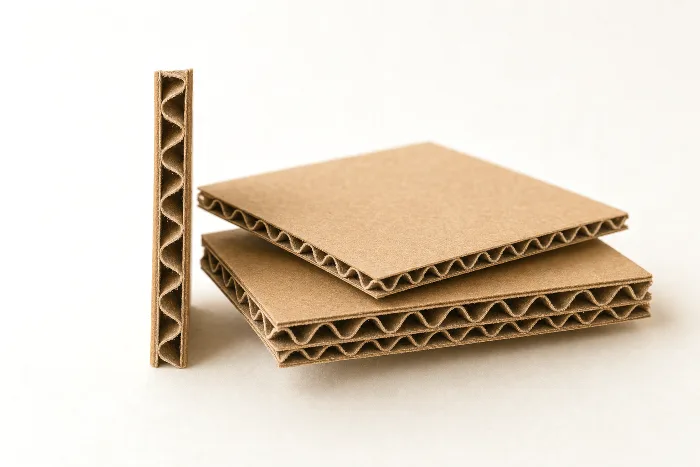
"Corrugated" is not the same as "cardboard." Corrugated board is a sandwich: two flat outer sheets — the liners — bonded to a wavy inner sheet called the medium or fluting. Glue holds the tips of the waves to the liners, and those arches are what make an otherwise floppy panel stiff. Stand a strip on edge and the flutes behave like a row of tiny columns; that column action is the entire basis of a box's stacking strength.
The most common construction is single-wall: liner, fluted medium, liner. Add a second medium and a third liner and you get double-wall; a third medium gives triple-wall, which approaches crate strength for heavy industrial loads. A single liner with exposed fluting and no second liner is single-face, used as wrap and void fill rather than as a box wall.
How that fiber behaves under load is the story of this whole article, and it's part of our complete guide to packaging logistics. Two things set a board's performance: the grade of the liners and medium — their weight and stiffness — and the flute profile, the size and pitch of the waves.
Flute profiles: from cushioning to crisp print
Flutes are named by letter, roughly in the order they were invented rather than by size. Taller flutes put more material between the liners, which cushions shock and resists top load; finer flutes give a flatter, smoother surface that prints and folds like a carton. The heights below are approximate — they vary by mill and by how much the board is crushed during converting.
| Flute | Approx height | Trades |
|---|---|---|
| A | ~4.7 mm (3/16 in) | Tallest flute; best cushioning and stacking strength; coarsest surface and the bulkiest to ship flat. |
| B | ~2.5 mm (3/32 in) | Shallow flute; strong flat-crush resistance and a smooth face for print and die-cutting; less stacking strength. |
| C | ~3.6 mm (5/32 in) | The shipping-box workhorse; balances stacking strength and print; the default flute for RSC cases. |
| E | ~1.6 mm (1/16 in) | Fine flute; smooth, high-quality print and tight folds; retail and e-commerce cartons; little cushioning. |
| F | ~0.8 mm (1/32 in) | Finest common flute; premium small retail packs with minimal material; least cushioning and stacking. |
The pattern is consistent: thicker flutes cushion and stack, finer flutes print and fold. When a design needs both — a retail-ready shipper, say — makers combine profiles in a double-wall board (a coarse flute paired with a fine one) to get stacking strength and a printable face at once.
Two ways to spec strength: ECT vs Mullen
Corrugated is certified for strength in one of two ways, and the difference matters because they measure different things.
- Mullen, or burst, test. A rubber diaphragm pushes through a clamped sample until the board ruptures; the rating is the pressure it took, in pounds per square inch (you'll see specs like "200# test"). Burst strength tracks puncture and rough-handling resistance, and it historically scaled with the basis weight — the sheer amount of fiber — in the board.
- ECT, the edge crush test. A short sample is stood on edge and crushed; the rating is the force per inch of width it withstands, in pounds per inch (for example, "32 ECT"). ECT measures the board's column strength on edge, which is exactly what resists top-to-bottom stacking load.
The industry has shifted toward ECT for two reasons. First, ECT correlates directly with box compression — the number that decides how high you can stack a pallet — while burst does not. Second, ECT rewards better fiber, not just more of it: a mill can hit an ECT target with lighter, high-performance liners, cutting weight and cost, whereas the burst spec effectively demanded heavier board. That's why lightweighting a case almost always means moving from a burst spec to an ECT one.
So why do box makers still print both on the box maker's certificate? Because carrier rules and many legacy customer specs still accept either, and the two aren't interchangeable in what they protect: a light ECT board can stack well yet puncture more easily than a heavy burst board. The carrier rules publish equivalence tables — a given ECT construction is accepted in place of a stated burst rating — but treat those as compliance equivalences, not a physical conversion. If a product is fragile or handled roughly, burst still tells you something ECT doesn't.
BCT and the McKee estimate
ECT rates the board; BCT — the box compression test — rates the finished box. On a compression tester, two platens squeeze a sealed box from top to bottom until it buckles, and the peak force is the BCT. It's the single most useful strength number, because a stack of boxes is, structurally, a column in which each box carries everything above it.
You don't always have to build and crush a box to estimate BCT. The McKee formula is the industry's long-standing shortcut, and its simplified form relates box compression to three inputs:
- the board's ECT (edge crush strength),
- the board's caliper (its thickness), and
- the box's perimeter (twice the length plus the width).
Written out, it says compression is proportional to ECT multiplied by the square root of caliper times perimeter, with an empirical constant that testing puts in the neighborhood of five to six for a standard regular slotted container. Treat that figure as calibration, not gospel — it was fit to test data, and different sources quote slightly different constants.
What the formula teaches is more durable than any single number:
- Compression scales roughly linearly with ECT — double the edge crush and you roughly double the box's top-load capacity.
- It scales with the square root of caliper and perimeter — so a bigger box or a thicker board helps, but with diminishing returns.
- It assumes a clean, sealed RSC in lab conditions. A real box with vents, hand holes, heavy print, or a poor manufacturer's joint will test lower.
In other words, McKee gives you a fresh-off-the-line ceiling. What a box survives in a warehouse is always less — sometimes far less.
The derates that turn lab numbers into real ones
Every BCT number, measured or estimated, assumes a dry box crushed in seconds. Real pallets sit in real warehouses, and a handful of factors chip that number down. Design to the lab value and boxes crush; design to the derated value and they hold.
| Factor | Effect on compression | Practical guidance |
|---|---|---|
| High humidity | Fiber absorbs moisture and strength falls sharply — near saturation a box can hold roughly half its dry BCT, or less. | Engineer cold-chain and export packs with extra margin; consider moisture-resistant liners. |
| Time under load (creep) | A box that holds for weeks fails well below its few-second lab BCT. | Design long storage to a fraction of BCT — a safety factor of several times is common. |
| Pallet overhang | Corners are the load-bearing posts; boxes hanging past the pallet edge lose a large share of strength. | Size boxes to the pallet footprint and keep columns aligned; avoid overhang. |
| Print, vents, hand holes | Every cutout removes load-bearing wall, and heavy coverage can soften the board. | Keep openings small and away from corners; account for them in the spec. |
| Stacking pattern | Interlocked (brick) stacking ties a load together but misaligns the corner posts, cutting compression sharply versus a column stack. | Column-stack for maximum strength; interlock only when stability demands it, and add board to compensate. |
These stack up. A warehouse design often folds them into a single safety factor applied to lab BCT — frequently in the range of roughly four to seven, and higher for humid or long-term storage. The exact figure is a judgment call; the discipline is to apply one at all.
Single wall vs double wall
When a single-wall board can't hit the derated BCT you need, the next move is usually double-wall rather than simply heavier single-wall liners. Two mediums and three liners give a big jump in both compression and puncture resistance, and they hold up better through humidity and long storage. Double-wall is standard for heavy loads, tall stacks, and pallets that sit for weeks. Triple-wall goes further still, substituting for wooden crates on very heavy or industrial shipments. The trade-offs are cost, added board thickness, and a slightly larger shipping cube — all worth it when a collapsed stack is the alternative.
Choosing board for your load and stack height
Board selection is a top-down calculation. Work it in this order:
- Find the worst-case load on the bottom box. That's the combined weight of every box stacked above it at your maximum stack or rack height — not the weight of a single box.
- Apply a safety factor for the derates above: humidity, storage time, overhang, and stacking pattern. This is where a lab number becomes an in-service requirement.
- Back out the required BCT, then use the McKee relationship — with your actual box dimensions — to find the ECT and board grade that deliver it. Because compression scales with the square root of perimeter, box size and board grade trade off against each other.
- Choose flute and wall to hit that grade: single-wall C or B for typical cases, double-wall for heavy or tall stacks, a finer flute when print quality drives the pack.
- Prototype and compression-test real boxes in the condition they'll ship and store. The estimate gets you close; the test confirms it.
Stack height and pallet pattern feed straight into this, which is why board strength, Ti-Hi and freight class, and how many boxes fit on a pallet are really one connected problem: the pallet pattern sets the load on the bottom box, and the bottom box sets the board.
How PackOS estimates BCT for packout
When you plan a packout in PackOS — case pack, Ti-Hi, and pallet layout — it doesn't stop at counting boxes. From the board spec (flute, ECT, and caliper) and the box dimensions, PackOS estimates box compression through the McKee relationship, then derates it for your stack height, storage time, and stacking pattern to flag whether the chosen board actually holds the pallet — before you commit to tooling. If it doesn't, you see it as a warning rather than as a crushed bottom layer on a receiving dock. You can see the packout and logistics engine on the technology page, or run your own box through Quick Quote and get the spec, the pallet math, and the compression estimate together.
Frequently asked questions
What's the difference between ECT and Mullen (burst) strength?
ECT, the edge crush test, measures how much edgewise force a board withstands before crushing, in pounds per inch, and it predicts stacking strength. Mullen, or burst, measures the pressure needed to rupture the board and speaks to puncture and rough-handling resistance. The industry has shifted toward ECT because it correlates with box compression and rewards lighter, high-performance liners.
What is BCT, the box compression test?
BCT is the top-to-bottom load a box can carry before it buckles, measured by squeezing a sealed box between two platens. It is the number that governs how high boxes can be safely stacked. The McKee formula estimates BCT from a board's ECT, its caliper, and the box perimeter, but it is an estimate — real boxes with vents, print, and cutouts test lower.
Which corrugated flute is strongest for stacking?
Among common single-wall flutes, taller profiles such as A-flute and C-flute give the best top-to-bottom compression and cushioning, while finer flutes like E and F trade stacking strength for a smoother print surface and tighter folds. For heavy or tall loads, a double-wall board outperforms any single wall.
How much does humidity reduce corrugated box strength?
A lot. Corrugated fiber absorbs moisture, so as relative humidity rises the board weakens. Near saturation a box can retain only around half of its dry compression strength, sometimes less. This is why cold-chain and export packaging is engineered with extra margin built in.
How do I choose the right board grade for my load?
Work out the worst-case load on the bottom box — the total weight above it at your maximum stack height — then apply a safety factor for storage time, humidity, pallet overhang, and stacking pattern. That in-service requirement maps back through the McKee relationship to a required BCT and board grade. Prototype and compression-test before committing.