
Glass vs plastic packaging: an honest comparison
Glass or plastic is one of the oldest questions in packaging, and the honest answer is that neither wins outright. This guide walks the real trade-offs — feel, protection, weight, breakage, cost, and recyclability — so you can choose on evidence instead of instinct.
THE SHORT ANSWER
Neither glass nor plastic is universally better. The right choice depends on the product, how far it ships, and what you're optimizing for. Glass reads as premium and is chemically inert; plastic is light, tough, and cheaper to move. The decision comes down to a handful of factors:
- Glass — premium feel, near-total barrier, endlessly recyclable, but heavy and breakable
- Plastic — light, shatter-resistant, squeezable, and cheaper to ship, but under harder recyclability scrutiny
- Weight drives freight — glass costs more to ship and usually needs more protective packaging
- Both are recyclable in theory — whether they actually get recycled depends on local systems
The honest comparison, factor by factor
Most "glass vs plastic" arguments collapse into a single value — cost, or sustainability, or premium feel — and pick a winner from there. Real packaging decisions weigh several factors at once, and glass and plastic each win some and lose others. The table below lays out the trade-offs the way a packaging buyer actually meets them.
| Factor | Glass | Plastic |
|---|---|---|
| Premium feel | Heft, clarity, and a cool touch read as high-end; hard to fake | Lighter in hand; can look premium with the right resin and wall thickness, but rarely matches glass's cues |
| Inertness & barrier | Chemically inert; a near-total barrier to oxygen, moisture, and aromas | Varies by resin — PET is clear with a moderate barrier, HDPE is opaque with a good moisture barrier; some products need coatings or multilayer structures |
| Weight | Heavy for its volume | Light — often a fraction of the equivalent glass container |
| Breakage | Shatters when dropped; needs protection in transit | Shatter-resistant; flexes and dents rather than breaking |
| Freight cost | Higher — loads hit weight limits sooner and need more dunnage | Lower — lighter units and denser packing per truck |
| Recyclability | Infinitely recyclable with no quality loss, but color sorting and collection matter | PET and HDPE are widely accepted, but real-world rates are lower and sleeves or multilayer films complicate sorting |
| Recycled content | Recycled cullet is a routine furnace input | rPET and rHDPE are available, though food-contact grades and supply can be constrained |
Read down a single column and a personality emerges: glass is the inert, premium, heavy option; plastic is the light, durable, versatile one. The rest of this guide unpacks the factors that most often decide the call — weight and freight, breakage, and sustainability — and then lays out when each material tends to win.
Weight, freight, and what it costs to ship
The biggest hidden difference between glass and plastic isn't at the shelf — it's on the truck. Glass is far denser than any common packaging plastic, so an identical container can weigh several times more in glass. That weight follows the product through every mile of the supply chain, and it shows up as cost in two ways.
First, full truckloads are usually weight-limited: you hit the trailer's legal weight ceiling long before you run out of cubic space. A pallet of glass therefore carries fewer sellable units under the same weight cap than a pallet of plastic, which raises the freight cost allocated to each unit. Second, parcel and e-commerce carriers bill on dimensional weight — the greater of a package's actual weight and a volume based figure — so a heavy glass item is more likely to be billed on its real, higher weight. Our explainer on how carriers really bill you walks through the math.
None of this means glass is "too expensive" — plenty of categories ship glass profitably every day. It means weight is a real line item, and the further a product travels, the more that line item grows. A local or regional brand feels the freight difference far less than one shipping nationwide, so the same product can land on glass in one distribution model and plastic in another. When you compare a glass option against a plastic one, compare the landed cost with freight included, not just the price of the empty container.
Breakage and secondary packaging
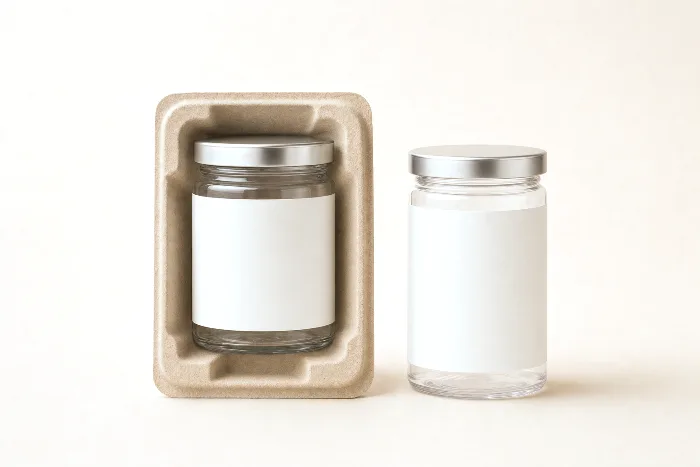
Glass breaks, and breakage is expensive in ways that go beyond the lost container. A cracked bottle can ruin the product inside, trigger a return or replacement, create a cleanup and safety issue, and — for a direct-to-consumer brand — turn an unboxing into a bad review. Because of that risk, glass usually demands more secondary packaging: molded pulp trays, corrugated dividers, extra void fill, or a sturdier shipper than the same product would need in plastic.
That protective packaging adds its own weight, material, and cost, which compounds the freight penalty above. In the parcel network especially — where drops, compression, and rough handling are the norm rather than the exception — the protection budget for glass can be substantial. Plastic's forgiveness here is a genuine advantage: it flexes, absorbs impact, and often ships safely in far less packaging. Breakage also has a hidden cost most spreadsheets miss: a container that arrives intact but rattling or scuffed still erodes the brand experience, so the goal isn't just "survives the drop" but "arrives looking the way it left the line."
- Glass in transit — plan for dividers or molded pulp, a rated shipper, and drop testing before you commit to a format
- Plastic in transit — usually survives the same journey with lighter protection, cutting both material and dimensional weight
- Retail vs e-commerce — a glass jar that's perfect on a store shelf may need a very different secondary pack to survive a parcel carrier
If your product moves primarily through e-commerce, weigh breakage heavily. If it moves by the pallet to retail distribution centers, the protection burden is smaller and glass becomes easier to justify.
Sustainability: both recyclable, neither simple
Sustainability is where the glass-vs-plastic debate gets loudest and least honest. Both materials are recyclable, and both have real caveats — there is no clean winner, and anyone who tells you otherwise is usually selling one of them.
Glass can be recycled endlessly without losing quality, and recycled cullet is a normal furnace input. Its downsides are physical: it's heavy, so shipping it burns more fuel, and melting it takes a lot of energy. Colored glass and contamination can also lower how much collected glass actually gets remade into new containers. Plastic is light, which lowers transport emissions, and PET and HDPE bottles are among the most widely collected plastics. But real-world recycling rates are lower than the theoretical recyclability suggests, some plastic is downcycled rather than made back into packaging, and material that escapes collection persists in the environment.
Recycled content muddies it further. Recycled cullet is routine on the glass side; on the plastic side, rPET and rHDPE exist but food-contact grades and reliable supply can be limiting. The genuinely sustainable move is rarely "switch to material X" — it's reducing total material, designing for the recycling stream that actually exists where the product is sold, and avoiding features (mixed materials, full-body sleeves) that disqualify an otherwise recyclable container. Our sustainable packaging guide digs into those trade-offs without the greenwashing.
When each material wins
Strip away the ideology and the choice usually resolves cleanly once you know the product and the channel. Here's how it tends to break down.
Glass tends to win when:
- Premium feel is central to the brand — spirits, fine fragrance, high-end skincare, specialty foods
- The product needs an inert, near-total barrier or a long ambient shelf life — sauces, oils, certain actives
- The container is meant to be kept, refilled, or reused, where heft signals quality
- Distribution is mostly pallet-to-retail, so the freight and breakage penalties are contained
Plastic tends to win when:
- Weight and shipping cost matter — large formats, bulk sizes, and anything sold through e-commerce
- The product benefits from squeezability or an unbreakable pack — personal care, sport, outdoor, kids' products
- Design calls for shapes, dispensing, or clarity that plastic delivers more cheaply
- Cost sensitivity or high unit volumes reward the lower material and freight footprint
Material choice also interacts with the container format and the closure. If you're weighing resins on the plastic side, our bottle types guide compares HDPE, PET, PP, and glass by clarity and barrier, and the jar packaging guide does the same for wide-mouth formats. This article is part of our complete guide to rigid packaging, which covers how bottles, jars, tubes, and closures fit together.
How PackOS helps you choose and quote
The reason glass-vs-plastic feels hard is that the real cost isn't on the container's price tag — it's spread across material, weight, protective packaging, and freight. PackOS pulls those together. When you describe or upload a container, it works out the material and geometry, then computes the pack-out, pallet, and freight implications, so you can compare a glass option and a plastic one on landed cost rather than gut feel. You can see how the logistics math is modeled on the technology page, or price both paths on a real product with Quick Quote.
Frequently asked questions
Is glass or plastic better for packaging?
Neither is universally better. The right choice depends on premium feel, product compatibility, weight and freight, breakage risk, and sustainability goals. Glass is inert, premium, and endlessly recyclable but heavy and breakable, while plastic is light, shatter-resistant, and cheaper to ship but faces tougher recyclability scrutiny.
Is glass more sustainable than plastic?
It depends. Glass is infinitely recyclable without quality loss and made from abundant materials, but it is heavy, so shipping it burns more fuel and melting it takes energy. Plastic is lighter and cuts transport emissions but has lower real-world recycling rates and persists in the environment. There is no single winner.
Why does glass cost more to ship than plastic?
Glass is much denser and heavier than plastic, so a truck or parcel of glass hits its weight limit sooner and each unit carries more freight cost. Glass also usually needs more protective secondary packaging, which adds dimensional weight and material.
Can both glass and plastic be recycled?
Yes. Glass and common bottle plastics like PET and HDPE are all technically recyclable, but real-world recycling depends on local collection, sorting, and end markets. Contamination, colored glass, mixed materials, and labels or sleeves can all reduce whether a container is actually recycled.
When should I choose glass over plastic?
Choose glass when premium feel, chemical inertness, or a strong barrier against oxygen and aromas matters most, such as for spirits, fragrances, sauces, and high-end cosmetics. Choose plastic when light weight, shatter resistance, squeezability, or lower shipping cost matter more, such as for e-commerce, personal care, and large-format products.