
Rigid packaging: bottles, jars, tubes & closures
Bottles, jars, tubes, cans — the containers that hold their own shape carry a huge share of the products you buy. This guide maps the materials, the neck-and-closure system, and the decoration methods that turn a rigid container into a finished, shelf-ready package.
THE SHORT ANSWER
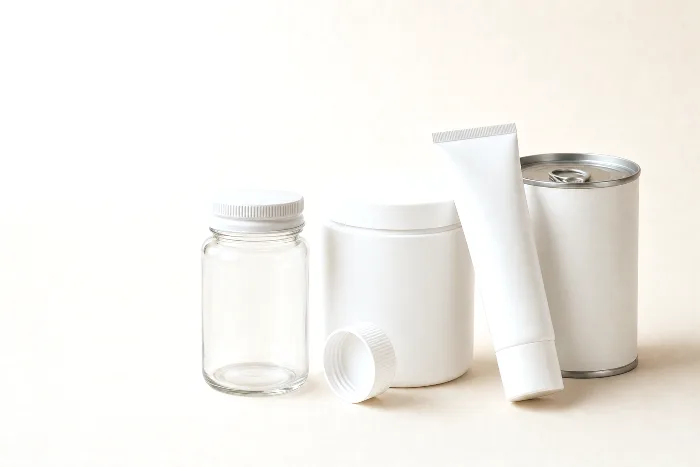
Rigid packaging is any container that holds its own shape — bottles, jars, tubes, cans, and pails — made from glass, plastic, or metal. Unlike a pouch, it keeps its form full or empty, which is what lets it stand on a shelf, take a threaded closure, and protect its contents from crushing. Choosing a rigid pack comes down to four decisions:
- Material — glass, PET, HDPE, PP, or aluminum, each trading clarity, barrier, weight, and recyclability
- Format — bottle, jar, tube, or can, chosen by how the product pours, scoops, or squeezes
- Neck finish — the standardized thread spec (like 24-410) that decides which closure fits
- Decoration — a pressure-sensitive label, a shrink sleeve, or direct print, chosen by shape and coverage
What counts as rigid packaging
Rigid packaging is the family of containers that hold their own shape. A bottle, a jar, a tube, a can, a pail — full or empty, upright or tipped on its side, it keeps its form. That single property is what separates rigid packaging from flexible packaging such as pouches, bags, and films, which take the shape of whatever fills them.
Rigidity buys you three things. It lets the container stand on a shelf and present a face to the shopper. It provides a threaded neck that accepts a reusable, resealable closure — a screw cap, a pump, a dropper. And it protects the contents from crushing while giving the product a controlled way to be poured, scooped, sprayed, or dosed. That is why rigid formats dominate wherever the product is a liquid, a cream, a powder, or anything that has to be measured or dispensed: beverages, personal care, supplements, household chemicals, and a large slice of food.
The trade-off is material and space. A rigid container ships some air, weighs more than a flat pouch, and uses more resin or glass per unit of product. So the real question is rarely "rigid or flexible" in the abstract — it is which format protects and presents the product for the least cost and impact. The rest of this guide walks the decisions that answer it.
The material map: glass, PET, HDPE, PP and aluminum
Almost every rigid container is one of five materials. Each sits at a different point on the same four axes — how clear it is, how well it blocks oxygen and moisture, how much it weighs, and how easily it is recycled. Read the table as a starting map, not a verdict; the right pick depends on the product inside.
| Material | Clarity | Barrier | Recyclability (typical) |
|---|---|---|---|
| Glass | Crystal clear, or colored for light protection | Excellent — inert and impermeable | Widely collected in many programs; can be remelted repeatedly. Heavy to transport. |
| PET (#1) | Clear, glass-like | Good moisture, moderate oxygen | Commonly accepted curbside; one of the stronger recycled-resin markets. |
| HDPE (#2) | Opaque or translucent | Good moisture, chemical-resistant | Commonly accepted; established recycled stream. |
| PP (#5) | Translucent to opaque | Good moisture, tolerates heat | Increasingly accepted; recycled stream is growing but less universal. |
| Aluminum | Opaque (metal) | Excellent — full light and oxygen barrier | Widely collected; commonly carries high recycled content. |
A few honest caveats. "Recyclable" and "recycled" are not the same thing — whether a container is actually recovered depends on local collection, sorting, and end markets, so treat the last column as general and check the programs your customers live in. Clarity can be tuned: PET and glass can be tinted, and HDPE and PP are usually opaque, which matters for light-sensitive contents. And barrier is often not the bottle alone — oxygen-sensitive products may add a liner, a coating, or an induction seal on top of the base resin. For the long-form trade-offs, see glass vs plastic packaging.
The four rigid formats
Once the material is roughly settled, the format follows from how the product behaves — whether it pours, scoops, squeezes, or gets pressurized. Four shapes cover most of the category:
- Bottles — the pour-and-dispense workhorse for liquids and free-flowing powders. Shapes run from the squat packer to the tall Boston round to the flat cosmo oval, and the choice is driven as much by shelf presence and label real estate as by volume. See bottle types: HDPE, PET, glass & neck finishes.
- Jars — the wide-mouth format for anything thick or chunky you reach into: creams, balms, salves, spreads, powders, capsules. The opening is nearly the full diameter, which trades some barrier and shipping efficiency for easy access. See jar packaging: glass & plastic jars.
- Tubes — the squeeze format for viscous product you meter out a little at a time: lotions, cleansers, gels, ointments. A tube collapses as it empties, so it dispenses cleanly and needs little headspace. See tube packaging: squeeze, laminate & extruded.
- Cans — rigid metal or composite bodies for beverages, aerosols, and shelf-stable foods, where a full light-and-oxygen barrier and pressure resistance matter more than seeing the product.
These are not rigid boundaries. A powder supplement can ship in a bottle, a jar, or a canister; a serum can live in a bottle or a tube. The format is a balance of dispensing, protection, shelf face, and cost, and it is often the first thing worth pressure-testing before you commit to tooling.
Neck finishes: why the thread spec decides the closure
The most important number on a rigid container is not its volume — it is its neck finish. The neck finish is the standardized dimension of the opening: its diameter and its thread style. It is what decides which closures will fit, and it is why a cap from one bottle can screw perfectly onto a completely different bottle from a different supplier.
Neck finishes are written as two numbers, for example 24-410. The first number (24) is the outside diameter of the opening in millimeters. The second (410, 415, 400, and so on) is an industry code for the thread profile and the height of the cap skirt. Two containers with the same finish take the same closure; mismatch the finish and the cap either will not thread on or will not seal. Because these designations are standardized across the industry, specifying "24-410" tells a supplier exactly what closure population you can draw from.
The practical takeaway: choose the bottle or jar and its closure as a system, not two separate purchases. The neck finish is the contract between them, and it also constrains dispensing — a given finish supports certain pumps, sprayers, or droppers and not others. Caps & closures goes deeper on matching the two.
Closures: sealing, dispensing, and child-resistance
A closure does more than keep the container shut. It seals against leaks and moisture, it often controls how the product comes out, and in some categories it has to resist a child or prove that the package has not been opened. The common types, roughly by job:
- Screw / continuous-thread caps — the default seal. Simple, reliable, resealable.
- Disc-top and flip-top caps — one-hand dispensing for lotions, sauces, and shampoos.
- Pumps and treatment pumps — metered dose for lotions, foamers, and airless actives.
- Trigger sprayers — cleaners and mists that need coverage and reach.
- Droppers — precise, drop-by-drop dosing for serums and tinctures.
- Child-resistant closures (CRC) — push-and-turn or squeeze-and-turn caps for products that must be hard for a young child to open. Requirements vary by category and market, so verify what applies to your product; our overview of child-resistant packaging requirements is a starting point, not a ruling.
Sealing is a layer of its own. Liners inside the cap, heat-applied induction seals across the neck, and shrink or tamper bands around the closure all add leak protection and, in many cases, visible tamper-evidence — proof the container was opened. Those overlap with tamper-evident packaging and matter most for ingestibles. The point is that the closure system — cap, liner, seal — is engineered together with the neck finish, not bolted on at the end.
Decorating a round container
A rigid container is a curved, sometimes tapered surface, which makes decorating it a different problem from printing a flat carton. Three methods dominate, and the right one depends on the container's shape, how much of it you want to cover, your volume, and your budget.
| Method | Best for | Trade-off |
|---|---|---|
| Pressure-sensitive label | Most bottles and jars; low commitment, quick changes, short runs | Coverage is a panel, not the whole container; edges and seams are visible |
| Shrink sleeve | Full 360° graphics, compound curves, tamper bands, unusual shapes | More tooling and setup; the sleeve can complicate the container's recyclability |
| Direct print | High volumes on a consistent shape; no label edge at all | Higher setup; less flexible to artwork changes; not economical for short runs |
For most brands starting out, a pressure-sensitive label is the practical default: it is fast, forgiving, and cheap to revise, and the label material — paper, film, clear "no-label look" — sets the finish. When the design has to wrap the whole container, hug a taper, or carry a built-in tamper band, a shrink sleeve earns its extra cost. Direct print pays off at scale on a shape that will not change.
Whichever method you choose, decoration on a round container lives or dies on registration and on color fidelity across a curved surface. That is where the artwork prep — bleed around a die-cut label, distortion compensation on a shrink sleeve, brand colors held consistent from one run to the next — does the quiet work of making the pack look intentional rather than approximate.
Choosing across formats
With the pieces on the table, choosing becomes a short sequence of questions. Work them in order:
- What does the product need? Barrier, light protection, heat tolerance, chemical resistance, and dispensing style narrow the material and format faster than anything else.
- How does it come out? Pour, scoop, squeeze, spray, or drop points you at a bottle, jar, tube, or a particular closure — and the neck finish that supports it.
- What does the shelf demand? Premium feel, a clear view of the product, a big label face, or a distinctive silhouette can override the cheapest technical option.
- What will it cost to ship and store? Glass is heavy and freight adds up; a lighter or more nestable pack can win on total landed cost. Weight and cube feed straight into dimensional weight.
- Where does sustainability land? Mono-material, recycled content, and refill or reuse all shift the answer — and the honest trade-offs (weight vs breakage vs recyclability) rarely point the same way. The glass vs plastic comparison lays them out.
There is rarely one right answer — only the best fit for a specific product, brand, and supply chain. The value is in making the trade-offs explicit instead of defaulting to whatever the last product used.
The full Rigid & Containers library
This pillar is the map; each format and system below has its own deep-dive with the specs, options, and gotchas that matter when you actually spec a container:
- Bottle types: HDPE, PET, glass & neck finishes — the materials and shapes, and how neck finishes decide the cap.
- Jar packaging: glass & plastic jars — wide-mouth styles, materials, and the liners and lids that seal them.
- Tube packaging: squeeze, laminate & extruded — how tubes are built and specified, from barrier to orifice to print.
- Caps & closures: CRC, dispensing & sealing — matching the thread finish and choosing how the product dispenses.
- Glass vs plastic packaging: an honest comparison — the real trade-offs on feel, weight, breakage, freight, and recyclability.
How PackOS handles rigid packaging
Rigid packaging is a system — container, neck finish, closure, and decoration engineered to fit together — and PackOS treats it that way. Give it the format, material, and closure, or upload label artwork, and it pulls the pieces into a coherent spec: the container geometry, the finish the cap must match, the label or sleeve area, and the production route behind them. From there it produces a photoreal proof and an instant quote, because once the parts are pinned the material, decoration, and pack-out can be calculated. You can see the reconstruction run on the technology page, or try it on a real file with Quick Quote.
Frequently asked questions
What is rigid packaging?
Rigid packaging is any container that holds its own shape — bottles, jars, tubes, cans, and pails made from glass, plastic, or metal. Unlike flexible packaging such as pouches and films, a rigid container keeps its form whether it is full or empty, which is what lets it stand on a shelf, take a threaded closure, and protect its contents from crushing.
What are the most common rigid packaging materials?
The workhorses are glass, PET, HDPE, PP, and aluminum. Glass is inert and premium but heavy and breakable; PET is clear and lightweight; HDPE is opaque and chemical-resistant; PP tolerates heat well; aluminum is light and a strong barrier. Each one trades off clarity, barrier, weight, and recyclability differently.
What is a neck finish on a bottle?
A neck finish is the standardized dimension of a container's opening — its diameter and thread style — that determines which closure will fit. It is written as two numbers, such as 24-410, where the first is the opening diameter in millimeters and the second is a code for the thread style and cap height. The container and cap must share the same finish to seal.
How is a round rigid container decorated?
The three main methods are pressure-sensitive labels, shrink sleeves, and direct printing. Pressure-sensitive labels are the most flexible and lowest-commitment; shrink sleeves wrap the whole container in 360-degree graphics and hug compound curves; direct printing puts ink straight on the container for high volumes. The right choice depends on shape, coverage, volume, and budget.
Glass or plastic — which is better for rigid packaging?
Neither is universally better; it depends on the priority. Glass wins on premium feel, inertness, and reuse, but it is heavy, breakable, and costs more to ship. Plastic wins on weight, durability, and freight cost, and clear PET can look premium too. Both are recyclable in practice but neither is automatically recycled, so match the material to the product, the brand, and the supply chain.