
Label materials: paper vs BOPP vs vinyl
The fastest way to ruin a good label design is to print it on the wrong material. Here's how face stocks, adhesives, and liners actually differ — and how to pick the combination that survives your product's real life.
THE SHORT ANSWER
A pressure-sensitive label is a three-layer construction — face stock, adhesive, and liner — and each layer is a separate choice. For the face stock: paper is the economical default for dry, indoor products; BOPP (a polypropylene film) is the workhorse for anything that gets wet or oily; vinyl conforms to curves and squeezable containers; PET is the durability pick for harsh or outdoor service.
- Paper — best print surface per dollar, but it absorbs water and stains with oil
- BOPP — water- and oil-resistant film; white, clear, or metallized
- Vinyl — the most conformable film; squeeze bottles and compound curves
- PET — the toughest common film; chemical, heat, and UV resistance
- Adhesive and liner matter as much as the face — match them to the surface and the dispensing method
The three-layer construction: face stock, adhesive, liner
Peel a pressure-sensitive label off its roll and you're holding the top two layers of a three-layer laminate. The face stock is the material you print on and the surface your customer touches. The adhesive is the pressure-sensitive layer that bonds it to the container. The liner (or backing) is the release-coated carrier the label rides on until it's dispensed — it never reaches the shelf, but it decides how well the label runs on an applicator.
Each layer is a real choice, made independently. A white BOPP face can carry a permanent, removable, or freezer adhesive; the same adhesive can sit on a glassine or a PET liner. Converters buy these as pre-laminated constructions, which is why a label spec reads like a sandwich recipe: face / adhesive / liner. When a label fails in the field — lifting corners, wrinkling in the cooler, tearing on the applicator — the culprit is usually one specific layer, not "the label."
This article is the materials deep-dive in the complete guide to label printing — if you're also choosing sizes, print methods, or finishes, start there for the full picture.
Face stocks compared: paper, BOPP, vinyl, and PET
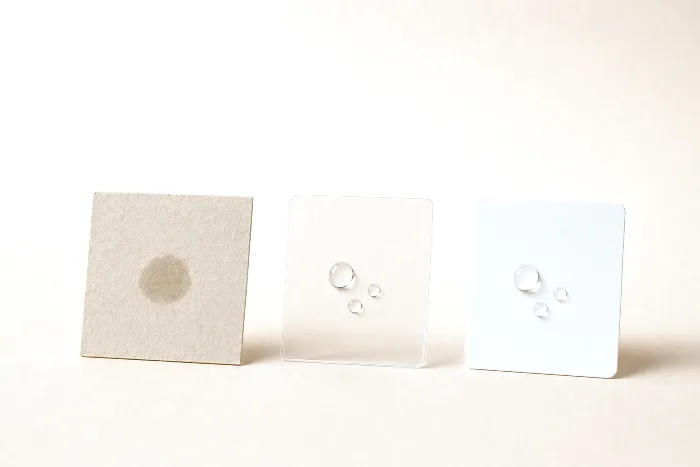
Face stocks divide into two families: papers, which print beautifully and cost less but absorb moisture, and films, which resist water and oil and flex without tearing. Within each family the variants trade off print surface, durability, and look.
| Material | Water/oil resistance | Conformability | Best for |
|---|---|---|---|
| Uncoated paper | Poor — absorbs both | Good on gentle curves; tears at tight radii | Dry goods, shipping and barcode labels, craft looks |
| Semi-gloss paper | Low — coating sheds light splashes, edges still wick | Good on gentle curves | The default retail label: food, supplements, e-commerce |
| Textured / estate paper | Poor unless varnished; some are wet-strength treated | Moderate — heavier stocks resist wrapping tight curves | Wine, spirits, craft beverage, premium dry goods |
| White BOPP | Very good — sheds water and oil | Moderate — fine on cylinders, resists compound curves | Bath, kitchen, refrigerated food, anything near a sink |
| Clear BOPP | Very good | Moderate | The "no-label look" on glass and clear PET bottles |
| Metallized BOPP | Very good | Moderate | Metallic shelf impact without foil stamping |
| Vinyl (PVC) | Very good | Excellent — stretches over squeeze bottles and compound curves | Squeezable tubes and bottles, outdoor and durable goods |
| PET (polyester) | Excellent — plus chemical and heat resistance | Low — stiff; best on flat or simple cylindrical surfaces | Chemical drums, electronics, appliance and asset labels, harsh outdoor service |
A few practical notes the table can't carry. Semi-gloss paper is the volume default for a reason: it's the cheapest stock that still prints crisp process color. But paper's weakness is edges — even a coated face wicks water at the die-cut edge, which is why a paper label on a cold bottle wrinkles from the outline inward. Clear BOPP demands more from the artwork: anything not backed by white ink prints translucent, so the dieline needs a deliberate white-ink layer. Metallized BOPP turns every unprinted area into mirror — you get foil-like effects by knocking out ink, not by adding it. Vinyl is the conformability champion but the least sustainable film here, and many converters now steer squeeze applications to conformable polyethylene or "squeeze-grade" BOPP variants where they can. PET is the stock you specify when the label must outlive abuse — solvents, abrasion, heat, years outdoors.
Adhesives: permanent, removable, and freezer
Adhesives are specified by how aggressively they grab, what surfaces they grab, and the temperature range they tolerate — both at application and in service. The typical types:
- Permanent — the default. Bonds within hours to the point that removal tears the face or leaves residue. General-purpose permanents assume a clean, dry, room-temperature surface; low-energy surfaces like HDPE and powder coats may need a "high-tack" permanent formulated for them.
- Removable — engineered to peel cleanly for weeks or months: price labels, promotional stickers, returnable containers. Removability is always a compromise with initial grab, so test on the actual surface.
- Freezer / all-temperature — standard adhesives stiffen and lose tack in the cold. Freezer-grade adhesives stay bonded well below freezing, and all-temp variants can be applied to already-chilled or lightly frosted surfaces. If the product lives in a cooler, cold chain, or freezer, this is not optional — it's the difference between a label and a flag.
Two questions catch most adhesive mistakes. First: what is the surface, exactly? Glass, PET, HDPE, bare metal, and shrink-sleeved containers all bond differently, and a squeezed-out silicone or oil film on the container defeats any adhesive. Second: what temperature is the container at application? A permanent adhesive applied to a room-temperature jar that later goes into a cooler usually survives; the same adhesive applied to a jar straight out of a cold-fill line often never bonds at all.
Liners: glassine vs PET (and why they matter)
The liner feels like an afterthought until the labels hit an applicator. The two common families:
- Glassine / calendered paper — the traditional, economical liner. Fine for hand application and most machine application at moderate speeds.
- PET film liner — thinner, stronger, and more dimensionally stable. Thinner means more labels per roll and fewer roll changes; stronger means fewer web breaks at high application speeds; stability means more consistent dispensing when the label peels off the tip of the applicator plate.
If your labels are applied by hand, liner choice barely matters. If they run on automatic applicators — especially small labels at speed, where the die-cut label must release from the liner at exactly the right moment — liner caliper and release consistency directly set your line's jam rate. It's also where the construction's waste lives, which we'll get to below.
Five environment tests to run before you choose
Don't choose a material from a swatch book — choose it from the product's worst day:
- Moisture. Will the container see condensation, an ice bucket, a shower, or a dishwasher? Sustained wet means film, full stop. Occasional splash can survive on coated paper with a protective finish.
- Oil. Cooking oils, essential oils, and greasy hands stain paper permanently — and oil residue on the container at labeling defeats adhesives. Oily products get film faces and a fill-line that keeps the label zone clean.
- Chill and freezer. Cold attacks the adhesive more than the face. Refrigerated products need a face that tolerates condensation (film, or wet-strength paper) and freezer products need a freezer-grade adhesive applied before the deep chill.
- Squeeze and flex. A stiff label on a squeezable container wrinkles, darts, or pops off. If the container deforms in use, specify a conformable film — vinyl or a squeeze-grade film stock — and avoid heavy laminates that fight the flex.
- Outdoor UV. Sunlight fades inks and embrittles papers. Durable outdoor service points to PET or vinyl faces, UV-stable inks, and a protective overlaminate.
The most common miss is testing the label at room temperature on a clean bench when the real product is labeled cold, wet, or oily.
Sustainability: the honest version
Pressure-sensitive labels have a structural sustainability problem worth naming plainly: the liner. Every label dispensed leaves behind a release-coated web that is neither face nor package, and silicone-coated glassine and PET liners are not accepted in ordinary curbside recycling. Industry programs exist to collect and recycle spent liners — the label trade associations listed below maintain current guidance — but participation is the exception, not the rule. If liner waste matters to your operation, ask your converter about liner take-back before you ask about "eco" face stocks.
On the face side, the honest framing is recyclability-compatible, not "recyclable": certain film face-and-adhesive constructions are designed to release cleanly or travel harmlessly with a PET or HDPE container through the recycling stream, and washable-adhesive constructions exist for returnable glass. Paper faces on paper packaging are generally the friendliest pairing. What to avoid is the reflexive claim — a recycled-content face stock does not make the labeled package recyclable, and a PVC label can compromise the recyclability of an otherwise recyclable PET bottle. Match the label construction to the container's end-of-life route, and verify specific constructions against the recognition programs the associations below reference, since guidance evolves.
Matching material to printing and finish
Material and print method constrain each other. Papers are the most forgiving print surface — they take flexo, offset, and digital toner readily. Films are non-absorbent, so they rely on surface treatment (corona or top-coating) to hold ink; most label films are sold print-treated, but digital presses in particular care about having the right top coat for their ink chemistry. If you're printing digitally, confirm the stock is certified for your press family rather than assuming.
Finishing follows material, too. Paper faces usually want a varnish or laminate for scuff protection — unprotected paper scuffs in the shipping carton before it ever reaches a shelf. Films are tougher bare, but gloss laminates deepen color on white BOPP, and a matte laminate over film is the fastest route to a premium soft-touch feel. Textured estate papers are the exception: laminating one erases the texture you paid for, so they're protected with spot varnish instead. The full trade-offs — lamination vs varnish, foil, embossing — get their own article in label finishes: lamination, varnish & foil.
How PackOS pairs material with application
Material choice is a spec decision, and PackOS treats it like one. When you quote a label through the platform, the artwork and dieline are checked against the construction you've chosen — white-ink layers for clear film, bleed and safety for the die-cut shape, finish compatibility with the face stock — the same automated checks described on our technology page. Tell it the application — cold-chain jar, squeeze tube, outdoor bin — and the quote comes back with a face, adhesive, and liner matched to it, priced instantly. Try it with your own artwork via Quick Quote.
Frequently asked questions
What's the difference between BOPP and vinyl labels?
Both are water- and oil-resistant films, but they behave differently on the container. BOPP is stiffer and more economical — ideal for rigid bottles, jars, and jugs. Vinyl is softer and stretchier, so it conforms to squeezable containers and compound curves without wrinkling. If the container flexes in use, lean vinyl or a squeeze-grade film; if it's rigid, BOPP usually wins on cost.
Are paper labels waterproof?
No. Coated papers like semi-gloss shed light splashes, but paper absorbs water at its die-cut edges and wrinkles or delaminates when wet. A varnish or laminate improves resistance but doesn't seal the edges. For products that see condensation, ice buckets, or bathrooms, specify a film face stock such as BOPP.
What label material works in a freezer?
The face stock matters less than the adhesive. Standard adhesives lose tack in the cold, so freezer products need a freezer-grade or all-temperature adhesive, ideally applied before the product is chilled. Pair it with a film face, or a wet-strength paper, so condensation during thawing doesn't destroy the label.
What is a label liner and why does it matter?
The liner is the release-coated backing the label rides on until it's applied. Glassine paper liners are the economical default; PET film liners are thinner and stronger, giving more labels per roll and fewer web breaks on high-speed applicators. If labels are applied by hand, the liner barely matters; on automatic lines it directly affects jam rates.
Can labels be recycled with the container?
Sometimes. Certain label constructions are designed to be compatible with the container's recycling stream — releasing cleanly from PET bottles in the wash step, or traveling harmlessly with HDPE. Compatibility is specific to the face, adhesive, and container combination, so verify the exact construction against current industry recognition programs rather than assuming.