
Flexible packaging types: pouches, films & laminates
Flexible packaging — pouches, films, and laminates in place of rigid boxes and jars — is the fastest-growing corner of consumer packaging. This guide walks through the common formats, the laminate layers behind them, and when a pouch beats a box.
THE SHORT ANSWER
Flexible packaging is any package made from thin, bendable materials — plastic film, foil, paper, or a laminate of several of them — that takes its shape from the product inside rather than from a rigid wall. The family runs from stand-up pouches to rollstock to shrink sleeves, and most of it is built from a multi-layer laminate: a printable outer web, a barrier in the middle, and a heat-seal layer inside.
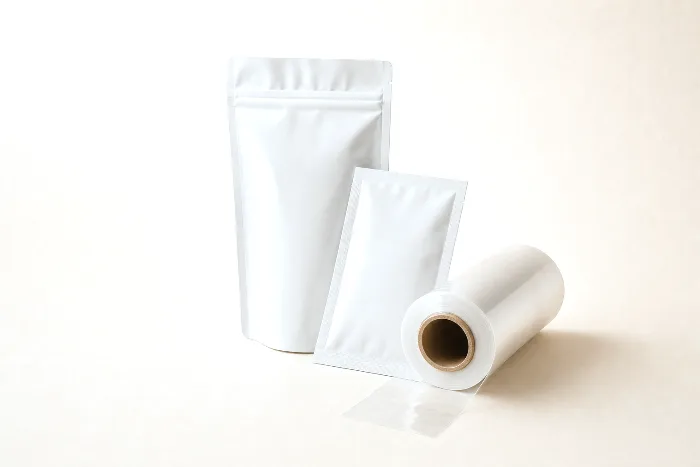
- Pouches — stand-up (Doyen), flat-bottom, side-gusset, three-side-seal, pillow, and stickpacks
- Rollstock — printed film on a reel a form-fill-seal line turns into packages inline
- Shrink sleeves & lidding — decoration and closure films for rigid containers
- The laminate — outer print web + barrier + sealant, bonded by adhesive or extrusion
What flexible packaging is — and why it took over
A flexible package is one whose walls bend. It's made from thin webs of plastic film, aluminum foil, paper, or — most often — a bonded laminate of several of those, rather than from rigid material like glass, metal, or molded plastic. Empty, it lies flat or folds down to almost nothing. Filled, it takes its shape from the product. Flexible packaging is one branch of the wider discipline covered in the complete guide to packaging design; this article zooms in on the flexible family — what the formats are, what they're built from, and when to reach for one.
Why has it grown so fast? The reasons are structural:
- Weight. A stand-up pouch can hold the same product as a rigid jar or can at a fraction of the packaging weight — less material to buy, and less mass to ship.
- Cube and freight. Empty pouches ship and store flat, so you move far more of them per pallet before filling. Filled, a pouch wastes less void space than a rigid container. Both trim freight cost.
- Shelf presence. A pouch is a printable billboard on every face, with a silhouette that stands out from the rigid containers around it.
- Barrier per micron. Modern laminates deliver oxygen, moisture, and light barriers in a wall a fraction of a millimeter thick — enough to give many products a long ambient shelf life with no rigid container at all.
The trade-offs are just as real: flexible packaging is harder to recycle than a single-material bottle, and it protects far less against crushing. We'll get to when it wins and when it doesn't.
The formats, from stand-up pouch to lidding film
"Flexible packaging" is a big tent. Here are the formats you'll actually be asked to spec, what each one is, and where it fits.
| Format | What it is | Best for |
|---|---|---|
| Stand-up pouch (Doyen) | A pouch with a folded bottom gusset — the Doyen style — that spreads open so the pack stands on shelf. | Coffee, snacks, pet food, powders, and (with a spout) liquids sold standing up. |
| Flat-bottom / box pouch | A five-panel pouch with a true flat base and side gussets, giving a rigid, box-like stance and large print panels. | Premium coffee and pet food that want a structured, boxy look with a firm stand. |
| Side-gusset pouch | A pillow-style bag with tucked gussets on both sides that expand for volume — the classic coffee-bag shape. | Whole-bean coffee and bulk snacks — high fill volume over shelf presence. |
| Three-side-seal pouch | A flat pouch sealed on three edges (two sides plus the top), from one folded web or two webs. | Flat, low-volume goods — single servings, samples, wipes. |
| Pillow pouch | The simplest form: one web closed with a back (fin or lap) seal and two end seals, forming a pillow. | High-speed snack and confection runs on form-fill-seal lines. |
| Stickpack / sachet | Single-dose formats — a narrow tube (stick) or a small three- or four-side-seal packet (sachet). | Single servings of powders, gels, and liquids — supplements, drink mixes, condiments. |
| Rollstock (form-fill-seal) | Not a finished pouch — printed laminate film on a reel that a filling line forms, fills, and seals inline. | High-volume automated lines filling their own packages rather than buying them pre-made. |
| Shrink sleeve | A printed film tube that shrinks tight to a container's contour under heat, decorating it 360°. | Full-body decoration of bottles and cans, tamper bands, multipack bundling. |
| Lidding film | A sealable film, roll-fed or die-cut, that closes a tray or cup — peelable or weld-sealed. | Sealing thermoformed trays and cups — fresh food, dairy, ready meals. |
Pouches are the center of gravity here, and the stand-up is the one most brands start with. For the sizes, materials, and closures that go into speccing one, see our stand-up pouch spec guide.
Inside the laminate: the layer stack
Most flexible packaging isn't a single material — it's a laminate, two or more thin webs bonded into one sheet so each layer does a single job. Read a laminate from the outside in:
- Outer / print web. The face you see and print. Usually a strong, printable film like PET (polyester) or OPP, or a layer of paper. It carries the graphics — often reverse-printed on its inner surface so the ink is sandwiched and protected — and gives the pack stiffness and gloss.
- Barrier layer. The middle, and where shelf life comes from: a layer that blocks oxygen, moisture, light, and aroma. Common barriers are aluminum foil, a metallized film (a micro-thin vaporized-aluminum coating), or a clear barrier such as EVOH or an oxide coating (AlOx/SiOx) when you want to see the product.
- Sealant / inner web. The layer against the product. It's a heat-seal film — usually polyethylene (PE) or cast polypropylene (CPP) — that melts under a heated seal bar to weld the package shut and hold the seal.
How those webs are bonded matters as much as the layers themselves:
- Adhesive lamination glues the webs with a liquid adhesive (solvent-based, solventless, or water-based) cured between rollers. It's the most common and most versatile way to combine dissimilar films.
- Extrusion lamination bonds the webs with a molten curtain of polymer (usually PE) extruded between them, which both glues and adds a functional layer — often building the sealant in the same pass.
A finished laminate is written as a stack: PET / foil / PE reads outer-print / barrier / sealant. The more demanding the product — oxygen-sensitive food, aggressive contents, a retort cook step — the more layers get added to the stack.
Mono-material vs. multilayer: the recyclability tension
The same layering that makes a laminate perform is what makes it hard to recycle. A conventional multilayer laminate of, say, PET + foil + PE can't be pulled apart back into clean streams, so most curbside systems can't process it.
The response is mono-material structures: laminates engineered so every layer belongs to the same polymer family — all-PE or all-PP — typically pairing oriented and cast grades of the same resin with a barrier coating in place of a foil. These are recyclable in principle through store film drop-off streams, at the cost of some barrier, some stiffness, and a tighter sealing window. It's a genuine engineering trade-off rather than a slogan, and we cover it in depth in recyclable pouches & mono-material packaging.
Closures at a glance
Flexible packaging opens, pours, and recloses with a small kit of welded-in features:
| Closure | What it does |
|---|---|
| Press-to-close (PTC) zipper | An interlocking plastic track welded across the top; press to reseal by hand. The default reclosable feature. |
| Slider | A plastic slider that rides the zipper track for easier one-handed open and close, at higher cost. |
| Spout / fitment | A molded spout welded into a seal for pourable or drinkable liquids, closed by a screw cap. |
| Tin-tie | A bendable paper-and-wire strip folded over to close coffee and bakery bags. |
| Tear notch / laser score | An easy-open start point cut into the seal, or a laser-weakened line for a clean, straight tear. |
| Degassing valve | A one-way valve that lets freshly roasted coffee release carbon dioxide without letting oxygen back in. |
When flexible beats rigid — and when it doesn't
Flexible packaging is the right call when:
- The product is light or flowable — snacks, powders, liquids, granules.
- Weight, cube, and freight cost are priorities.
- Shelf life comes from a barrier, not from structure.
- Full-surface print and a distinctive silhouette help sell it.
Reach for rigid instead when:
- The product needs crush and puncture protection — fragile goods, some hardware.
- It has to stay rigid on shelf or in use — certain cosmetics and spirits, or anything with a pump or complex dispensing.
- Recyclability through mainstream single-material streams is a hard requirement.
- The line or the product demands a rigid container — heavy liquids, hot-fill, some retort processes.
Plenty of products split the difference: a rigid outer with a flexible liner, or a paperboard carton wrapped around a pouch. The format is a means to an end — match it to how the product is filled, shipped, sold, and disposed of.
How PackOS builds pouch dielines and 3D proofs
Flexible packaging is where a lot of the hard geometry lives, and it's built into PackOS. Upload artwork or a spec for a pouch and PackOS detects the format — stand-up, flat-bottom, side-gusset, three-side-seal — and rebuilds the dieline parametrically from the real dimensions, placing the seals, gussets, tear notch, and zipper correctly rather than guessing at them. From there it lays the flat artwork onto the panels, folds it into a photoreal 3D proof, and prices it — because once the pouch geometry and the laminate are understood, the material area and the production route both follow. You can watch the reconstruction run on the technology page, or try it on a real file with Quick Quote.
Frequently asked questions
What is flexible packaging?
Flexible packaging is any package made from thin, bendable materials — plastic film, foil, paper, or a laminate of several of them — that takes its shape from the product inside rather than from a rigid wall. Pouches, rollstock, shrink sleeves, and lidding films are all flexible formats.
What is the difference between a stand-up pouch and a flat-bottom pouch?
A stand-up pouch stands on a folded bottom gusset, the Doyen style, that spreads open when the pouch is filled. A flat-bottom or box pouch has a true flat base and usually side gussets, giving a boxier, more rigid stance and larger flat print panels. The flat-bottom style stands more firmly but costs more to make.
What are the layers in a flexible packaging laminate?
Read a laminate from outside in: an outer print web such as PET or paper that carries the graphics and stiffness, a barrier layer in the middle such as foil, metallized film, or a clear barrier like EVOH that blocks oxygen, moisture, and light, and a sealant layer inside, usually polyethylene, that heat-seals the package closed.
Is flexible packaging recyclable?
A conventional multilayer laminate that mixes different polymers with foil is hard to recycle because the layers cannot be separated back into clean streams. Mono-material pouches, engineered so every layer belongs to the same polymer family such as all-PE or all-PP, are designed to be recyclable through store film drop-off streams, trading some barrier and stiffness for recyclability.
When should I use flexible packaging instead of rigid?
Choose flexible when the product is light or flowable, when weight, cube, and freight cost matter, and when shelf life comes from a barrier rather than from structure. Choose rigid when the product needs crush and puncture protection, must stay rigid in use, or has to be recyclable through mainstream single-material streams.