
Jerky packaging: keep it safe, shelf-stable, and sellable
Jerky reads as tough, but it fails fast in the wrong bag: get the barrier and the oxygen right and it sits on a shelf for months; get them wrong and it turns rancid or grows mold. Here is how meat snack packaging actually has to be built.
THE SHORT ANSWER
Jerky packaging is a high-oxygen-barrier pouch — usually a foil or metallized laminate — paired with an oxygen absorber and a resealable zipper. Residual oxygen drives rancidity and any moisture that gets in risks mold, so the whole job is keeping air and water out of a product that has almost no moisture of its own left to lose. The essentials:
- Barrier first — a high-oxygen-barrier structure (foil, metallized PET, or an EVOH/nylon laminate), not a plain poly bag
- An oxygen absorber — almost always, sized to the trapped air, to mop up the oxygen left after sealing
- A reseal — a press-to-close zipper or a hanging header bag, because most jerky is eaten over several sittings
- Correct labeling — beef and poultry jerky is regulated by USDA FSIS, which governs the inspection legend, net weight, and more
Two free tools do the math on this page: try the oxygen absorber calculator to size the scavenger for your headspace, and the pouch size calculator to right-size the bag.
Why jerky packaging is a barrier problem
Jerky is meat that has been salted, sometimes cured, sometimes smoked, and dried down until it is shelf-stable. That last part changes the packaging job: the product is already dry, so the bag is not there to keep moisture in — it is there to keep two things out, oxygen and water vapor. Reframed that way, jerky packaging is a barrier problem before it is a graphics problem, which is why a beautiful bag printed on the wrong film still fails.
What makes a properly dried piece of jerky safe to sit at room temperature is its low water activity (written aw) — the amount of free water available to microbes and spoilage reactions. A widely referenced threshold in FDA's Food Code framing is that foods at or below roughly 0.85 water activity are generally treated as shelf-stable rather than potentially hazardous — but that is a value to verify with the authority and validate for your specific process, not a number to assume. If moisture leaks back in through a weak film or a bad seal, water activity climbs and mold becomes possible on a snack that looked bone-dry the day it shipped.
Oxygen and moisture: the two things that spoil jerky
Jerky has two independent failure modes, and good packaging has to answer both:
- Oxygen → rancidity. The fats in the meat oxidize when exposed to oxygen, producing the stale, cardboard, "old" off-flavors that make a shopper put the bag down. Sealing the bag does not solve this on its own — it traps a pocket of air, and the oxygen in that air keeps reacting until it is used up. Removing that residual oxygen is the absorber's job.
- Moisture → mold and sogginess. If water vapor permeates through the film (or wicks through a channel in a bad seal), water activity rises, texture softens, and mold can grow. That is why the bag needs a moisture barrier, not only an oxygen barrier.
Those two properties are measured separately: oxygen transmission rate (OTR) for oxygen, and moisture vapor transmission rate (MVTR, sometimes WVTR) for water vapor. A film can be excellent at one and mediocre at the other, so jerky wants a structure that is strong on both. For the broader primer on how these laminates are built, see our overview of flexible packaging types — coffee faces the same twin enemies, which is why coffee packaging looks so similar. And before any of it helps, you have to remove the oxygen you sealed in: our oxygen absorber calculator sizes that for you.
Barrier materials for jerky bags
Most jerky ships in a laminate — several thin layers bonded together, each doing a job (print surface, barrier, sealant). Here is how the common structures compare. Treat the ratings as typical, directional comparisons; the real OTR and MVTR depend on the specific film, its thickness, and the lamination, so ask your film supplier for the spec sheet.
| Structure | Oxygen barrier | Moisture barrier | Look | Note |
|---|---|---|---|---|
| Foil laminate (PET/foil/PE) | Very high | Very high | Opaque | The default for long shelf life; also a full light block. Not curbside-recyclable. |
| Metallized PET | High | High | Opaque, metallic | Lower cost than foil, close barrier; the metallized layer can lose barrier if flexed or creased hard. |
| Clear high-barrier (PET/EVOH or nylon/PE) | Med–High | Medium | Clear — shows product | Lets shoppers see the jerky. EVOH's oxygen barrier drops when wet, so it is paired with a moisture layer. |
| Recyclable mono-material (barrier-coated PE or PP) | Medium | Medium | Varies | Store-drop-off recyclable options exist — a genuine barrier-vs-recyclability trade-off. |
| Plain poly (LDPE) | Low | Low–Med | Clear | Not enough barrier for shelf-stable jerky on its own. |
The recurring tension is barrier versus recyclability: foil and metallized structures protect best but are multi-material and hard to recycle, while a recyclable mono-material pouch is easier to recycle but usually needs a barrier coating to get close. There is no universally right answer — it depends on your shelf life, your channel, and your sustainability commitments, which our sustainable packaging guide unpacks.
Jerky bag types: stand-up, flat, and hanging
Barrier decides survival; the bag format decides how it sells and how the shopper uses it. The common jerky bag types:
| Bag type | Best for | Reseal | Shelf presence |
|---|---|---|---|
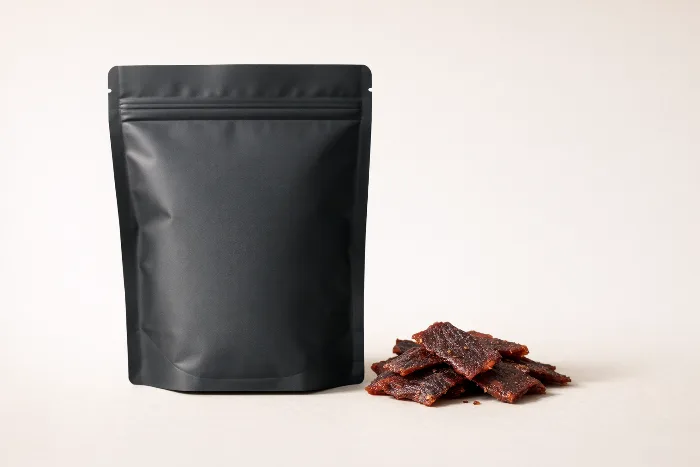
| Stand-up pouch (Doyen or K-seal) | Retail hero SKUs | Press-to-close zipper | Stands upright, big print face |
| Flat pouch / flat-bottom | Multipacks, thinner counts | Optional zipper | Lays flat, lower cost |
| Hanging header bag | Clip strips, pegboard, impulse | Usually single-use | Hangs from a euro-slot |
- The stand-up pouch with a press-to-close zipper is the retail default — it stands on shelf, presents a large graphics panel, and reseals, which matters because most jerky is eaten across several sittings. See the stand-up pouch spec guide for dimensions and closures.
- A flat pouch is cheaper and stacks well for multipacks or thinner net weights, at the cost of shelf presence.
- A hanging header bag punches a euro-slot hole in the top seal for pegboard and clip-strip merchandising — good for small, impulse counts near the register.
- Most formats add a tear notch for easy opening. Whatever the style, the seal is part of the barrier: a channel leak in the seal is just as fatal as a hole in the film. If your bags are failing, our teardown of why pouch seals fail covers the usual causes.
Sizing the oxygen absorber
An oxygen absorber is a small sachet of iron powder that chemically consumes the oxygen trapped in the bag after sealing. Sizing it is simple arithmetic once you know the headspace. Air is about 20.9% oxygen, so the oxygen you need to remove is roughly the volume of trapped air multiplied by 0.21, plus a margin for the oxygen that permeates through the film over the product's shelf life. Absorbers are rated in cubic centimeters (cc) of oxygen they can consume.
- Undersize it and residual oxygen lingers, so the fats oxidize and the jerky goes rancid early.
- Oversize it and you are paying for capacity you will never use.
- Skip the barrier and the absorber is pointless — in a leaky or low-barrier bag it exhausts itself against a constant supply of incoming air and never catches up. The barrier and the absorber are one system, not two separate decisions.
Some lines also nitrogen-flush before sealing to push most of the oxygen out first, then use a smaller absorber to finish the job. To get the cc figure for your own bag, put your headspace volume into the oxygen absorber calculator; to right-size the bag itself around your fill weight and jerky's density, use the pouch size calculator.
Labeling jerky: USDA FSIS basics
Beef, pork, and poultry jerky are meat and poultry products, which means they are regulated by the USDA Food Safety and Inspection Service (FSIS), not the FDA. In general, the label must carry the USDA mark of inspection (the inspection legend, with the establishment number), an accurate product name, the net weight, an ingredient statement in descending order, an allergen declaration, and the producer's name and address, with nutrition information as applicable; some products additionally require safe-handling instructions. Plant-based "jerky" and certain non-amenable species can fall under FDA jurisdiction instead. The food-contact materials that touch the meat are governed separately under FDA regulations — see our overview of food packaging regulations.
This is general guidance, not legal or regulatory advice. Meat- and food-labeling requirements change and vary by product, species, and market. Confirm the current rules directly with USDA FSIS and FDA — and, for co-packed product, with your establishment's inspector — before you print. If you sell into food and beverage broadly, our food & beverage industry page shows how PackOS handles these formats.
Shelf life: what actually determines it
There is no single "jerky lasts X months" number, and any supplier who offers one without knowing your product is guessing. Shelf life is the combined result of several levers:
- Formulation — water activity, salt, cure, and any preservatives set the biological baseline.
- Barrier — the OTR and MVTR of the film decide how fast oxygen and moisture creep back in.
- Oxygen management — an absorber and/or a nitrogen flush removes the oxygen you sealed in.
- Storage — heat and light accelerate rancidity, so distribution and shelf conditions matter.
A high-barrier pouch with a correctly sized absorber commonly reaches many months of shelf life; a marginal bag can cut that dramatically. The honest move is to validate a specific date with a real shelf-life or challenge study on your actual product and packaging, rather than copying a number off a competitor's bag.
How PackOS quotes jerky packaging
PackOS treats a jerky pouch as a structured spec, not a flat picture. Upload your artwork or a die file and it detects the pouch structure, dimensions, seal and zipper features, and the barrier laminate, then turns that into an instant quote and a photoreal 3D proof. Because we quote flexible packaging directly, you get a real number for your bag rather than a fabricated range — and the same preflight behind our packaging preflight checklist catches file problems before they reach the press. You can watch the reconstruction on the technology page, or run it on a real file with Quick Quote.
Frequently asked questions
Does jerky packaging need an oxygen absorber?
Almost always. Sealing a bag traps air, and the oxygen in it keeps oxidizing the fats in the meat, causing rancidity. An oxygen absorber scavenges that residual oxygen. It only works inside a high-oxygen-barrier bag — in a leaky pouch it exhausts itself against incoming air, so the barrier and the absorber are one system.
What is the best material for jerky bags?
A high-oxygen-barrier laminate. Foil laminates give the strongest barrier and a full light block; metallized PET is a lower-cost near-equivalent; a clear PET/EVOH or nylon structure lets shoppers see the product but needs a moisture layer to protect the oxygen barrier. Plain poly bags do not have enough barrier for shelf-stable jerky on their own.
How do you size an oxygen absorber for jerky?
Air is about 21% oxygen, so the oxygen to remove is roughly the trapped headspace air volume multiplied by 0.21, plus a margin for oxygen that permeates through the film over the shelf life. Absorbers are rated in cubic centimeters of oxygen. Undersizing leaves residual oxygen; oversizing wastes money. Our oxygen absorber calculator does the math from your bag volume.
Who regulates jerky labeling?
Beef and poultry jerky is regulated by USDA FSIS, not the FDA, so the label generally carries the USDA mark of inspection with an establishment number, along with the product name, net weight, ingredients, and allergen statement. Plant-based or certain non-amenable-species jerky may fall under FDA instead. Requirements change, so confirm the current rules with the authority.
How long does packaged jerky last?
There is no fixed number. Shelf life depends on the formulation (water activity, salt, cure), the barrier of the bag, whether an oxygen absorber or nitrogen flush is used, and storage conditions. A high-barrier pouch with an absorber commonly reaches many months; a marginal bag can cut that sharply. Validate a specific date with a real shelf-life study rather than assuming one.