
Coffee packaging: bags, valves & freshness
Coffee is one of the most packaging-sensitive products on the shelf: it starts fighting the clock the moment it leaves the roaster. This guide covers why coffee needs a degassing valve and a high-barrier bag, the formats roasters actually use, and how to keep beans fresh from roast to cup.
THE SHORT ANSWER
Coffee packaging has one job no other food format shares: it has to let carbon dioxide out while keeping oxygen, moisture, light, and heat away from the beans. That is why a proper coffee bag pairs a high-barrier laminate with a one-way degassing valve. The rest is format and finishing:
- One-way valve — vents the CO2 that freshly roasted beans release, without letting oxygen back in
- High barrier — foil or metallized structures block oxygen, moisture, light, and aroma loss
- Format — stand-up, box-bottom, side-gusset, and quad-seal bags each trade shelf presence against cost
- Reclose — tin-ties and zippers keep an opened bag fresh, which matters most for whole bean
Why coffee is a hard packaging problem
Coffee is a living, changing product. From the second the beans leave the roaster they are on a one-way trip toward staleness, and packaging is the main thing standing between a fresh roast and a flat cup. Four enemies degrade coffee: oxygen, which oxidizes the aromatic oils and turns them stale and cardboard-like; moisture, which the beans readily absorb and which speeds staling; light, especially UV, which breaks down flavor compounds; and heat. Ground coffee is far more vulnerable than whole bean, because grinding multiplies the surface area exposed to all four.
Then there is the complication unique to coffee: freshly roasted beans off-gas. Roasting sets off chemical reactions that keep producing carbon dioxide for days — sometimes a couple of weeks — after the beans come out of the drum. That gas has to go somewhere. Seal fresh coffee into an airtight, high-barrier bag with no way to vent, and the bag inflates like a balloon and can split a seal. That is the paradox at the heart of coffee packaging: the bag has to keep oxygen out while letting carbon dioxide escape. Coffee belongs to a broader family of barrier-sensitive foods — it is one slice of our complete guide to food & beverage packaging — but that vent-but-don't-admit requirement is what makes it its own discipline.
The one-way degassing valve, explained
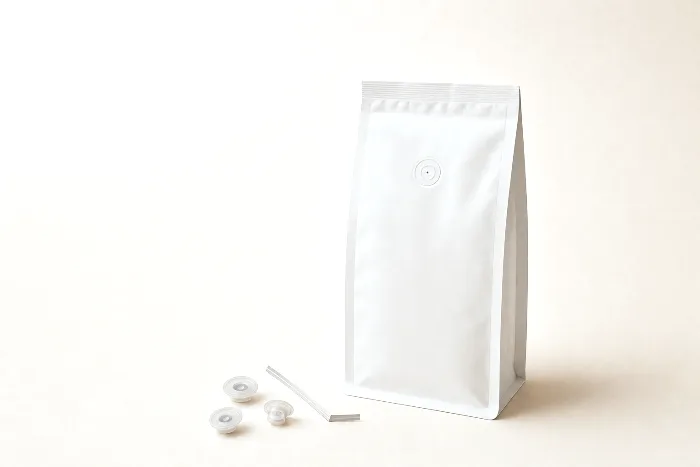
The elegant answer to the paradox is the one-way degassing valve — the small round or oval fitting you see on almost every bag of specialty coffee. Inside it is a flexible membrane, often with a film of food-grade oil, that sits over a vent hole. When carbon dioxide builds up inside the bag, the internal pressure lifts the membrane and the gas escapes. As soon as the pressure equalizes, the membrane reseals, so outside air — and the oxygen and moisture it carries — cannot get back in. It is a check valve for a coffee bag.
That one part changes the whole workflow. Without a valve, roasters have to rest coffee in bins or open containers for a period after roasting so it can shed its CO2 before it gets sealed — which exposes the beans to oxygen exactly when they are most aromatic. With a valve, coffee can be packed within hours of roasting and finish degassing safely inside the sealed bag. The valve is also why you can squeeze a fresh bag and get a burst of aroma: you are pushing gas out through it. Valves are typically heat-welded to the film during bag-making and are specified by their flow rate and the pressure at which they open — a spec worth matching to how fast a given roast off-gasses and how quickly it will be packed.
Barrier structures: foil, metallized, and clear
A valve is only useful if the rest of the bag is a genuine barrier. Coffee bags are almost always laminates — two or more thin layers bonded together, each doing a different job: an outer film that carries the print and toughness, a barrier layer in the middle, and an inner sealant layer that welds to itself to close the bag. The barrier layer is what separates a bag that holds freshness for months from one that fades in weeks. The trade-offs mirror the wider world of flexible packaging types, but a few structures dominate coffee.
- Foil laminate — a thin aluminum foil layer gives the highest barrier against oxygen, moisture, light, and aroma loss, and it is completely opaque. It is the benchmark for long shelf life. The downside: the aluminum makes the structure effectively unrecyclable in normal streams, and foil can flex-crack if handled roughly.
- Metallized film — instead of foil, a microscopically thin layer of aluminum is vapor-deposited onto a plastic film (usually PET). It approaches foil's barrier at a fraction of the weight and cost and resists flex-cracking better, though its barrier is a little lower and can drop where the film is creased.
- Clear / high-barrier transparent — for roasters who want a window so shoppers can see the beans, transparent structures use coatings (such as vapor-deposited aluminum or silicon oxide) or high-barrier polymers to claw back some of what foil provides. They never quite match foil, so they trade a little shelf life for shelf appeal.
- Kraft or paper-look — the natural-craft aesthetic many roasters favor is usually a printed paper or paper-look outer laminated to a barrier and sealant liner inside; the paper is cosmetic, the liner does the real work.
Because light degrades coffee too, opacity is a feature, not a limitation — a fully printed opaque bag protects flavor better than a clear one. A window is a marketing decision with a freshness cost, and worth taking on purpose rather than by default.
Coffee bag formats compared
Once the material is settled, the format decides how the bag looks on the shelf and how efficiently it fills and ships. Four formats cover the vast majority of retail coffee.
| Format | Shelf presence | Notes |
|---|---|---|
| Stand-up pouch (Doyen) | Good | A bottom gusset opens into an oval base so the bag stands; economical, familiar, and easy to fit with a zipper. The everyday workhorse — see our stand-up pouch spec guide. |
| Box-bottom / flat-bottom | Premium | A rectangular base and crisp side panels; it stands tall and square with up to five printable faces. The current specialty favorite; costs more to produce. |
| Side-gusset | Classic | A tall, narrow bag with folded sides — the traditional coffee-bag silhouette. High fill efficiency, usually finished with a tin-tie. |
| Quad-seal | Premium | Four vertical corner seals create a boxy shape with sharp edges and generous panels for graphics; sturdier and more structured than a side-gusset. |
Tin-ties, zippers, and reclose
Reclosure matters more for coffee than for most foods, because a bag of whole beans or ground coffee is used over days or weeks — and every reopening is another dose of oxygen. The common options:
- Tin-tie — a bendable metal strip along a fold-over top; the customer rolls the top down and folds the wire to hold it. Simple, cheap, and iconic on side-gusset bags, though it is a light closure, not an airtight one.
- Press-to-close zipper — an interlocking plastic profile that reseals firmly; the standard on stand-up and box-bottom bags. Pocket-zipper variants tuck the profile out of sight for a cleaner top edge.
- Tear notch — a small nick in the seal that gives a clean starting point for opening, usually placed just above the zipper so the reclose feature survives the first open.
For whole-bean coffee that will be ground at home over time, a good zipper is worth the small added cost; for single-use, sample, or gift formats, a tin-tie or a plain heat seal may be enough. The closure is a freshness decision as much as a convenience one.
Recyclable coffee bags, honestly
Sustainability is where coffee packaging gets genuinely hard, and it is worth being straight about the trade-offs rather than leaning on a green sticker. The very thing that makes a coffee bag good at its job — a laminate of different materials, often including aluminum — is what makes it hard to recycle, because most recycling streams need a single, separable material.
The realistic paths, each with a caveat:
- Mono-material bags — structures built entirely from one plastic family (all polyethylene or all polypropylene) can be recyclable through store drop-off or film streams where those exist. The catch is that their barrier is generally lower than foil, and the valve, zipper, and any label have to be compatible with the same material to keep the bag recyclable. We cover this in depth in our guide to recyclable mono-material pouches.
- Store drop-off — even conventional PE-based bags may be accepted at store film-collection points rather than curbside; availability varies by location.
- Compostable films — paper-and-bioplastic structures marketed as compostable often require industrial composting facilities and specific conditions; home-compostable is a higher and rarer bar. Read the certification, not just the word on the front.
The right answer depends on the roaster's shelf-life needs, volume, and the recycling infrastructure their customers actually have. There is no single "sustainable coffee bag" — only informed trade-offs between barrier, cost, and end-of-life.
How PackOS handles coffee packaging
Whether a brand is choosing between a box-bottom bag with a zipper and a side-gusset bag with a tin-tie, PackOS treats the bag as a structured spec, not a guess. Upload existing artwork or a bag spec and it detects the format, dimensions, gusset, valve, and closure, rebuilds an editable parametric dieline, and produces a photoreal 3D proof and an instant quote — the same way it handles the rest of our work with food and beverage brands. Because coffee sits inside the broader flexible-packaging world, the material, barrier, and finishing choices all feed the price. You can watch the reconstruction run on the technology page, or price a real bag with Quick Quote.
Frequently asked questions
Why do coffee bags have a one-way valve?
Freshly roasted coffee releases carbon dioxide for days after roasting. A one-way degassing valve lets that CO2 escape so the bag does not swell or burst, while staying shut against outside oxygen and moisture. It lets roasters pack coffee soon after roasting instead of resting the beans in open air and losing aroma.
Do you have to let coffee degas before bagging it?
Not if the bag has a one-way valve. The valve vents the carbon dioxide as it builds, so roasters can fill and seal soon after roasting. Without a valve, coffee usually has to rest for a period so it does not pressurize a sealed bag, which costs both freshness and space.
What is the best barrier material for a coffee bag?
Foil laminates give the highest barrier against oxygen, moisture, light, and aroma loss, which is why they are common for coffee. Metallized films come close with less weight, and clear or kraft-look structures trade some barrier for a window or a paper feel. The right choice balances shelf life, shelf appeal, and recyclability goals.
Are coffee bags recyclable?
Most high-barrier coffee bags are multi-material laminates that are not accepted in curbside recycling. Mono-material bags made from a single plastic family can be recyclable through store drop-off or specialized streams, but they usually offer somewhat lower barrier and need a matching valve and zipper. Compostable options exist but often require industrial composting rather than home compost.
What is the difference between a stand-up pouch and a box-bottom coffee bag?
A stand-up pouch uses a bottom gusset that opens into an oval base so the bag stands on shelf, and it is economical and familiar. A box-bottom, or flat-bottom, bag has a rectangular base and crisp side panels that give it a premium, boxy shelf presence and five printable faces. Box-bottom bags generally cost more to produce.