
Loose leaf tea packaging: protect the aroma, size the bag
Loose leaf tea is fragile in a way most groceries aren't — its whole value is aroma, and aroma escapes. The right pack is the difference between a bag that still smells like the shop and a bag of hay. Here's how to protect it, and how to size it.
THE SHORT ANSWER
Loose leaf tea packaging protects against three enemies — moisture, light, and aroma loss — so it wants a resealable barrier pouch or a lined tin. Tea also has a very low bulk density, so a given weight needs a surprisingly large bag. The practical shortlist:
- Barrier — a foil or metallized laminate blocks moisture, oxygen, and light; plain kraft or clear film does not
- Reseal — a press-to-close zipper or an airtight lid, because tea is used a little at a time
- Size — chosen by volume, not just weight; loose leaf is bulky and light
- Look — kraft outside for the natural feel, foil liner inside for the real protection
What loose leaf tea packaging has to do
Loose leaf tea packaging has one job that sets it apart from almost every other dry grocery: it has to keep an aroma from leaving. A whole-leaf tea's value lives in a handful of volatile compounds that evaporate, oxidize, and get absorbed by whatever is nearby — a bag that keeps the tea dry but lets the smell drift out has still failed. So the pack is a barrier problem, a light problem, and a volume problem at once, and your format has to solve all three without looking cheap on a shelf.
That is a different brief from a printed stand-up pouch holding pretzels, and close to — but not the same as — coffee packaging. Coffee degasses CO₂ after roasting and usually wants a one-way valve; tea does not degas, so it rarely needs one, but it is bulkier per gram and even more prone to picking up outside odors. This guide is part of our broader guide to food and beverage packaging, focused on the choices specific to loose leaf.
Sizing a tea bag? Skip ahead to the pouch size calculator to turn a target fill weight into pouch dimensions for tea's low bulk density — then come back for the barrier and format decisions, which matter just as much.
The three enemies: moisture, light, and aroma
Good loose leaf tea packaging is defined by what it keeps out and what it keeps in. Three forces work against a dried leaf, and a format is only as good as its weakest defense against them.
| Enemy | What it does to tea | The packaging defense |
|---|---|---|
| Moisture | Rehydrates the leaf, dulls flavor, and risks mold in humid storage | A moisture-barrier laminate plus a tight reseal; keep it closed between uses |
| Light & UV | Fades color and degrades aromatics, especially in green, white, and herbal teas | An opaque material — foil laminate, lined kraft, or a tin; avoid clear jars long-term |
| Aroma loss & transfer | Aromatics escape outward; strong outside odors (spice, coffee, cardboard) migrate inward | A high-barrier film with a fully welded seal; paper alone lets aroma pass both ways |
Oxygen belongs on that list too — it drives the slow oxidation that flattens flavor over months. It matters most for green and lightly oxidized teas; for a long shelf life, add an oxygen absorber sachet, as you would for sensitive confections or nuts. For fully oxidized blacks it is usually optional.
Pouch vs tin: which format fits
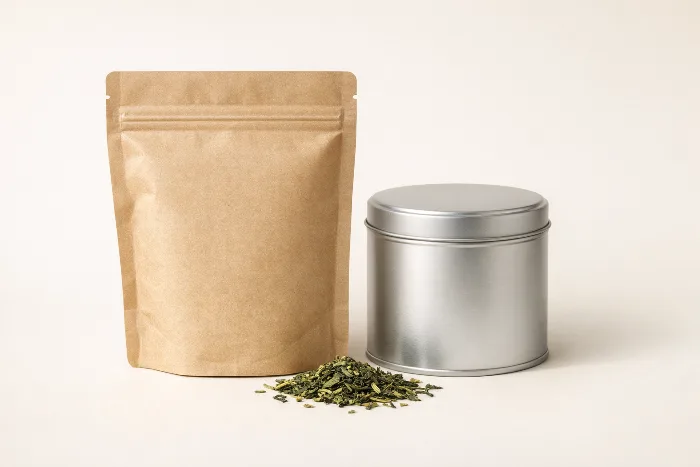
Four formats cover almost all retail loose leaf: the barrier stand-up pouch, the metal tin (usually with an inner liner), the glass jar, and the plain paper bag. They trade off barrier, reseal, feel, and cost differently. We quote flexible packaging and make rigid containers, so treat the table below as an honest trade-off, not a nudge toward one format.
| Format | Barrier | Reseal | Feel | Relative cost |
|---|---|---|---|---|
| Barrier stand-up pouch | High with a foil/metallized laminate | Press-to-close zipper | Modern, flexible, printable | Low–moderate; lightest to ship |
| Metal tin + liner | High and opaque; depends on the lid and inner bag | Friction or airtight lid | Premium, rigid, reusable | Higher; heavier to ship |
| Glass jar | Good for moisture/oxygen, poor for light unless amber or opaque | Airtight lid | Display-forward, refillable | Higher; heavy and fragile |
| Plain paper bag | Low — not a moisture or aroma barrier on its own | Fold or tin-tie | Rustic, short-term | Lowest; for fast sell-through |
The honest summary: a barrier pouch gives the best barrier-per-dollar and the lowest shipping weight, which is why most modern tea brands lead with it. A tin wins on shelf presence, reusability, and complete light blocking, but it usually needs an inner liner to match a pouch's barrier — the tin alone is rarely airtight. A glass jar looks beautiful but should be amber or kept out of light, and it is the worst to ship. A plain paper bag suits only tea brewed within days or weeks. Many brands split the difference: a premium tin for the hero SKU and refill pouches for repeat buyers — the broader trade-off is in pouch vs rigid packaging.
Why the bag is bigger than you think
The single most common mistake in loose leaf tea packaging is ordering a bag that is too small. Tea has a very low bulk density — a light, twisty whole-leaf oolong can occupy several times the volume of the same weight of a fine-cut black. You buy pouches by dimension but sell tea by weight, so size the bag by volume, then confirm it holds your target weight of your specific tea.
- Bulk density varies widely by tea. Fine, broken, or CTC-style leaf packs dense; whole-leaf greens, whites, oolongs, and herbal tisanes with big petals or bark are airy and take far more room.
- Fill by volume, not by a coffee benchmark. A pouch sized for a given weight of coffee will overflow with the same weight of many loose teas.
- Leave headspace. A resealable pouch needs slack above the fill line to fold and re-close — and to add an oxygen absorber if you use one.
The reliable way is to work from your tea's actual packed density: measure the volume your target weight occupies, then pick a pouch whose internal volume comfortably exceeds it. Our pouch size calculator does that math from dimensions and fill, and the standard pouch sizes chart maps the common stock sizes. When in doubt, size up: an under-filled bag looks fine, an over-filled one will not seal.
Resealability and daily use
Tea is used a little at a time over weeks, so resealability sits near the top of the spec: the barrier only helps if the customer can re-close the pack to something near airtight.
- Press-to-close zipper — the default on stand-up pouches; simple, familiar, and good enough for the life of a retail bag.
- Airtight tin or jar lid — the best long-term reseal, and the reason tins feel premium; pair it with an inner liner for the barrier.
- Tin-tie or fold-top — fine for kraft bags meant to be finished quickly, but not an airtight closure.
- One-way degassing valve — a coffee feature you usually do not need for tea, since tea does not off-gas; skip it unless you are packing a freshly blended, volatile product.
If a reseal keeps failing — a zipper that will not close, or a seal that peels — the cause is usually a fill or seal issue rather than the closure itself; our notes on why pouch seals fail and pouch leak troubleshooting walk through the usual culprits.
Kraft look vs foil barrier
Kraft is the signature look of artisan tea — warm, matte, natural. But kraft is a look, not a barrier: uncoated kraft paper does not stop moisture or aroma. Brands get both with a laminate — a kraft outer ply for the feel, bonded to an aluminium-foil or metallized inner layer for the barrier, with a heat-seal film inside. From outside it reads as a simple tea kraft pouch; inside, it performs like foil.
That construction is a genuine trade-off with recyclability. A foil or mixed-material laminate protects the tea best but is hard to recycle, because you cannot separate the plies. Mono-material structures — an all-polyethylene or all-polypropylene pouch — recycle far more easily but generally deliver a lower barrier, so they suit teas with a shorter shelf life or a less delicate aroma. We cover that tension in recyclable mono-material pouches, and the wider menu in flexible packaging types. You are choosing where on the barrier-versus-recyclability line your product sits.
A metallized layer (a micro-thin, vaporized-aluminium coating) gives most of foil's protection at lower cost and resists flex-cracking better than solid foil, which can develop pinholes and delamination if abused. For most teas metallized is the sweet spot; solid foil is reserved for the most aroma-critical products.
Labeling and food-contact basics
Whatever the format, the material that touches the tea has to be food-contact safe, and the printed pack has to carry the required consumer information. In the United States, food-contact materials are regulated by the FDA, and packaged tea — as a food — generally carries standard label elements such as the product identity, net weight, ingredients (which matter for blends and flavored teas), any allergen statement (relevant for herbal blends that contain nuts, for example), and the responsible company's name and address.
This is general guidance, not legal or regulatory advice. Labeling and food-contact requirements change and vary by market, and the details depend on your specific product and where you sell it. Confirm the current rules with the FDA (or your local authority), and a qualified reviewer where the stakes are high, before you print. For the broader picture, see our overview of food packaging regulations; this article names the relevant authority and category only, and states no specific threshold as fact.
One tip that is easy to miss: keep the net-weight statement, barcode, and legal copy inside the pouch's safe area, clear of any seal or fold, and leave room for a lot / best-by date applied after filling.
How PackOS quotes tea packaging
PackOS turns a tea packaging spec into a real quote quickly. Upload artwork, a previous pack, or just your target weight and format, and it detects the structure — pouch style, dimensions, closure, material build-up — and rebuilds it as an editable, parametric model, so changing the fill or bag size reflows the whole spec and produces an instant price. You can see the detection on the technology page, and because we manufacture flexible packaging and rigid containers through Calyx Containers, the quote reflects real production, not a placeholder.
The fastest way to price your own tea pouch or tin is to run it: start a Quick Quote with your format and target fill, using the pouch size calculator first if you are still choosing the bag size. If cost is the main question, our breakdown of pouch cost drivers explains what moves the number.
Frequently asked questions
What is the best packaging for loose leaf tea?
The best loose leaf tea packaging is a resealable, high-barrier pouch or a tightly lidded, lined tin. Both block moisture and light, while a foil or metallized laminate blocks the most and plain paper or clear glass protects the least. Match the barrier to how long you need the tea to stay fresh.
Do you need a barrier pouch for loose leaf tea?
For anything you want to keep fresh for months, yes. Tea loses aroma and picks up moisture and outside odors through low-barrier materials, so a foil or metallized laminate — not plain kraft paper alone — is what actually holds flavor. A kraft pouch with a foil or metallized liner gives you the natural look and the barrier together.
What size pouch do I need for loose leaf tea?
More than you would guess, because tea has a very low bulk density. A given weight of loose leaf takes up far more volume than the same weight of coffee or sugar, so you have to size the bag by volume, not just weight. Use a pouch size calculator and confirm it against your actual tea's fill.
Is a tin or a pouch better for loose leaf tea?
It depends on your priority. A pouch is lighter, cheaper to ship, easy to reseal with a zipper, and delivers a strong barrier through a foil laminate. A tin feels premium, is rigid and reusable, and blocks light completely, but it costs more, is heavier to ship, and usually needs an inner liner to match a pouch's barrier.
Can loose leaf tea be packaged in kraft paper?
Plain kraft paper on its own is not a moisture or aroma barrier, so unlined kraft suits only tea that will be brewed quickly. For real shelf life, use a kraft pouch with a foil or metallized inner liner — you keep the natural kraft look outside and get a genuine barrier inside.