
Stand-up pouch sizes: an honest sizing chart
Search "standard pouch sizes" and you get chart after chart of tidy numbers. The honest version: those are common sizes, not standards, and the weight one holds depends entirely on what you put in it. Here is how to read the charts — and how to size a pouch to your actual product.
THE SHORT ANSWER
There is no universal "standard" stand-up pouch size. Common sizes cluster by fill weight, but the same pouch holds different weights of different products, because a pouch holds a fixed volume and every product has a different bulk density. Size from your product, not from a chart:
- Common ≠ standard — the sizes below are widely available stock sizes, not a governed spec
- A "4 oz pouch" means 4 oz of a specific product — usually coffee; granola or powder differ a lot
- Capacity is volume — weight = volume × bulk density, plus headspace and a gusset
- Confirm units — width × height, gusset listed separately, inches or millimeters agreed with your converter
Why there's no universal pouch size standard
It's worth saying plainly, because most "size charts" imply otherwise: there is no official standard for stand-up pouch sizes. Unlike a bottle neck finish — where a code like 24-410 is a real dimensional standard that decides which cap fits — or a GMA pallet footprint, pouches have no governing body publishing a size grid. Film suppliers and converters each offer a menu of stock sizes, and over time a handful of those became de facto common. That's what the charts online actually are: aggregations of popular stock sizes, not a spec anyone is required to hit.
The Flexible Packaging Association represents the industry, but it doesn't mandate a table of pouch dimensions the way thread standards govern closures. So treat every chart — including the one below — as a starting point to sanity-check against your own product, not a rule. This article is part of the complete guide to packaging sizes, where the recurring theme is exactly this: common sizes exist everywhere, true standards are rare, and the reliable move is to size from the object and the math.
Common stand-up pouch sizes by fill
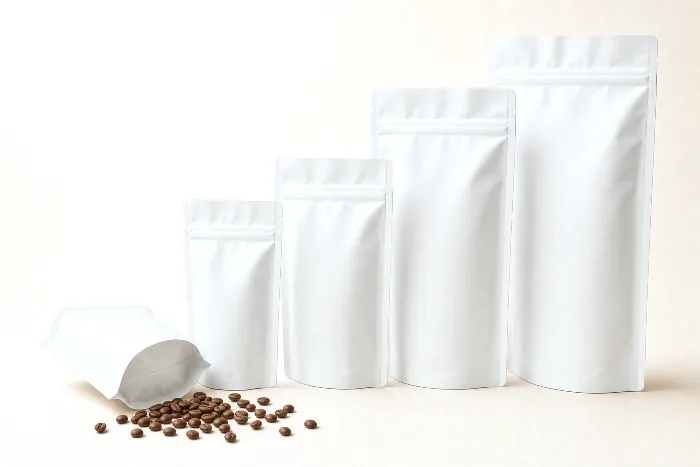
Here are stand-up pouch sizes you'll see quoted most often, in inches and millimeters, with a common bottom gusset for each. The weight labels assume a medium-density product like whole-bean coffee — a widely used benchmark — so read them as common, not a standard, and verify against your fill.
| Common name (coffee fill) | Common size — W × H + bottom gusset (in / mm) | Also commonly used for |
|---|---|---|
| 2 oz | 3.5 × 5 in + 2 in gusset / 89 × 127 mm + 50 mm | Tea, spices, samples, single-serve |
| 4 oz | 4 × 6 in + 2 in gusset / 102 × 152 mm + 50 mm | Coffee, tea, snacks, supplements |
| 8 oz (½ lb) | 5 × 8 in + 3 in gusset / 127 × 203 mm + 76 mm | Coffee, granola, pet treats |
| 12 oz | 6 × 9 in + 3.5 in gusset / 152 × 229 mm + 89 mm | Coffee, trail mix, protein |
| 16 oz (1 lb) | 7 × 10 in + 3.5 in gusset / 178 × 254 mm + 89 mm | Coffee, protein powder, jerky |
| 2 lb | 8 × 12 in + 4 in gusset / 203 × 305 mm + 102 mm | Bulk coffee, flour, pet food |
| 5 lb | 10 × 15 in + 4.5 in gusset / 254 × 381 mm + 114 mm | Bulk grains, protein, pet food |
A few honest caveats. Dimensions are usually written width × height with the gusset separate, and different suppliers measure the gusset slightly differently (total fold vs. depth). "Mylar bags" — the foil or metallized pouches sold for long-term storage — follow exactly the same sizing logic; the material changes, not the geometry. And the numbers above are round: real stock lists drift by a fraction of an inch between vendors, which is one more reason to confirm rather than assume.
Why a "4 oz pouch" isn't a fixed size
This is the part the charts skip. A pouch doesn't hold a weight — it holds a volume. The weight it ends up carrying is that volume multiplied by the bulk density of whatever goes inside, and bulk density varies enormously between products:
- Whole-bean coffee is the usual benchmark — moderately dense, with air gaps between beans.
- Ground coffee packs tighter than whole bean, so the same pouch holds more of it by weight.
- Granola, puffed snacks, and chips are light and bulky — a pouch "rated 8 oz coffee" might hold only a few ounces of them by weight while looking full.
- Powders, salt, and dense supplements are heavy for their volume — the same pouch can carry considerably more weight, and may look under-filled.
So a "4 oz pouch" really means "a pouch that holds four ounces of a specific reference product." Put a different product in it and the weight changes. This is why any chart that maps a single fill weight to a single pouch size is, at best, a rough coffee-shaped approximation — and why the safe path is to size from volume, not from a headline number.
How to size a pouch to your actual product
Sizing a pouch well is a short, deliberate sequence. It trades a lucky guess off a chart for a pouch that fills cleanly, stands up, and seals:
- Find your fill volume. Take your target net weight and divide by your product's bulk density (weigh a known volume of your own product if you don't have a figure). That gives the volume the pouch must actually hold.
- Add headspace. Leave room above the fill for the seal and for settling — a slack fill wrinkles and seals badly, an over-tight fill stresses the seams. A modest headspace allowance is typical; more for products that settle or need a valve.
- Choose the gusset. A deeper bottom gusset adds volume and a bigger standing footprint without making the pouch taller. Two pouches with identical face dimensions can hold very different amounts depending on gusset depth.
- Set the face dimensions. Pick width and height so the filled pouch stands and displays the way you want, then confirm the finished specs — film structure, closures, tear notch, valve — with your stand-up pouch spec guide.
There isn't a single clean formula for a stand-up pouch's capacity the way there is for a box, because the Doyen base and the seal geometry make the internal volume a curve, not a rectangular prism. That's exactly the kind of thing worth locking into a written spec rather than eyeballing — capture your dimensions, gusset, and film in a spec sheet so every quote and proof references the same numbers.
Coffee, degassing, and product-specific exceptions
Coffee is the classic example of why fill weight and pouch size don't map one-to-one. Fresh-roasted coffee off-gasses carbon dioxide for days, so a coffee pouch generally needs a one-way degassing valve and a bit of extra headspace to let gas escape without inflating the seal. Whole bean also takes more volume than the same weight of ground, so the "1 lb coffee" pouch is really sized around whole-bean bulk. Our guide to coffee packaging walks through the valve, the film, and the headspace together.
Other products bend the sizing rules in their own ways:
- Chips and delicate snacks are often nitrogen-flushed and slack-filled for protection, so the pouch is sized for cushioning volume, not just product weight.
- Liquids and viscous products usually move to a spouted pouch, where the spout and fitment drive the geometry as much as the fill.
- Heavy powders and bulk goods may look under-filled at their rated weight — a signal to size down or choose a format with a flat, stable base.
Pouch structures and formats
"Stand-up pouch" is one format among several, and the format changes how much a given face size can hold. When you compare sizes, compare like with like:
- Stand-up (bottom-gusset / Doyen) — the default retail pouch; the bottom gusset opens into a base so it stands on shelf.
- Flat / three-side-seal — no gusset, lies flat; lower capacity for the same face size, good for thin or single-serve products.
- Side-gusset ("box" pouch) — gussets on the sides expand into a squared body; common for coffee and higher fills.
- Flat-bottom / box-bottom (quad-seal) — a rigid, self-standing base and printable side panels; premium shelf presence at higher volumes.
- Spouted — a fitment for pouring or resealing liquids and gels.
Film choice rides along with the format — barrier, thickness, and whether it's a laminate or a recyclable mono-material structure. If you're still deciding between formats, our overview of flexible packaging types lays out the trade-offs, and the point stands throughout: pick the structure that matches the product, then size it.
How PackOS builds the exact pouch dieline
A pouch "size" is really a dieline: face width and height, gusset depth, seal welds, tear notch, valve, hang hole, and zipper position all defined together. PackOS treats it that way. Upload existing artwork or a spec and it detects the pouch structure and rebuilds an editable, parametric dieline — change the fill or the gusset and the seals, panels, and features reflow to match. From that model it calculates the real material area and produces a photoreal 3D proof and an instant quote, so you're pricing the exact pouch that fits your product rather than the nearest number on a chart. See it run on the technology page, or try it on a real file with Quick Quote.
Frequently asked questions
Is there a standard stand-up pouch size?
No. There is no universal stand-up pouch standard the way there is for something like a bottle neck finish. There are common stock sizes that film suppliers and converters offer, and sizes tend to cluster by fill weight, but capacity depends on your product's density. Treat any size chart as common, typical values to verify against your own product, not as a mandate.
What size stand-up pouch do I need for a pound of coffee?
A pouch around 5 by 8 inches with a 3 inch bottom gusset commonly holds roughly a pound of whole-bean coffee, but it varies with the roast and the bean. Ground coffee is denser than whole bean, so the same pouch holds more by weight. Size to your actual product and leave headspace for the seal and, for coffee, a degassing valve.
Why does the same pouch hold different weights of different products?
Because a pouch holds a fixed volume, and every product has a different bulk density. A pouch that holds four ounces of coffee might hold only two ounces of a puffed snack or six ounces of a dense powder. Fill weight follows density, so any weight printed on a size chart assumes one specific product.
What is a gusset and how does it affect capacity?
A gusset is the folded panel, at the bottom or the sides, that expands to give a pouch volume and let it stand up. A bottom gusset, also called a Doyen style, opens into a flat base. A deeper gusset adds volume and footprint, so two pouches with the same width and height can hold very different amounts depending on gusset depth.
Are pouch sizes measured in inches or millimeters?
Both are used, so confirm the convention with your converter and stay consistent. North American suppliers often quote pouches in inches, while much of the flexible-packaging world works in millimeters. Dimensions are usually given as width by height, with the gusset depth listed separately.