
Packaging sizes: labels, pouches, boxes & bottles
People search for "standard packaging sizes" expecting a table of law-like specs. For most packaging, that table doesn't exist — there are common sizes and there is real math, but very few true standards. This guide separates the two so you can size a label, pouch, box, or bottle correctly instead of copying a chart.
THE SHORT ANSWER
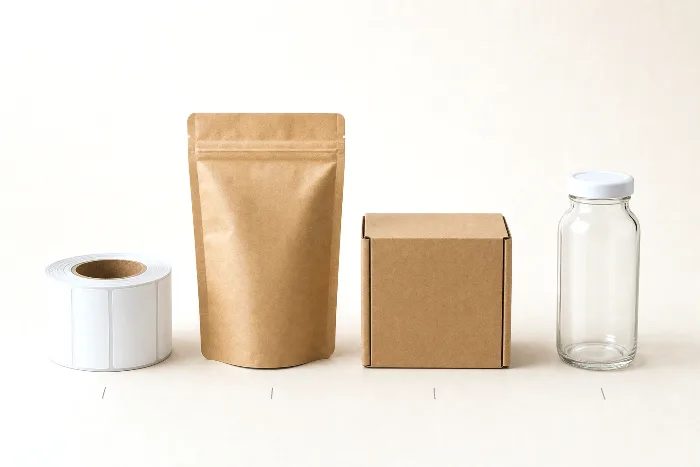
There are common packaging sizes, but very few true standards. A "4 oz pouch" or "the" wine-label size isn't a fixed spec — it's a cluster of common values that shifts with the product, the brand, and the manufacturing process. The reliable move is to size from the object and the math, not from a chart:
- Labels — a full wrap is the circumference (π × diameter) minus a small seam gap.
- Pouches — capacity is a density problem: the same volume holds very different weights of coffee, granola, or powder.
- Boxes — internal size is the product footprint plus clearance; then check that size against dimensional weight and pallet fit.
- Bottle neck finishes — the one place with a real dimensional standard: the number (like 24-410) that decides which cap fits.
Why "standard size" is mostly a myth
Type "standard label size" or "standard pouch size" into a search bar and you'll get charts that look authoritative. Most of them aren't describing standards at all — they're describing conventions. A size becomes "common" because printers, fillers, carriers, and shelves all converged on it, not because a standards body published it. That distinction matters the moment your product doesn't match the chart.
Two words get used interchangeably and shouldn't be:
- Common / typical — a value the market gravitates to. Safe to start from, but you still have to verify it against your real container, product, and line. A "4×6" shipping label is common because thermal printers and carrier systems expect it — but a jar label has no equivalent, because it depends entirely on the jar.
- Standard — a genuine, published dimensional spec that parts are built to interchange against. These exist, but they're rarer than the charts imply, and they cluster in logistics and closures rather than in labels and pouches.
Copying a competitor's size or a generic chart is where avoidable failures come from: a wrap label that's a quarter-inch short and won't close the gap, a pouch that ships half-empty because the fill weight didn't translate to volume, or a box that's technically "standard" and quietly over-ships on every order. Sizing from the object avoids all three. This pillar is the map; each package type has a deeper spoke below it in the full Sizing & Specs library.
Where a real standard actually exists
Standards do exist — it's worth knowing exactly where, so you trust them where they're real and size from first principles everywhere else. The genuinely standardized areas of packaging are mostly about things fitting other things: caps onto necks, cases onto pallets, barcodes into scanners.
| Element | Real dimensional standard? | What to size from |
|---|---|---|
| Label size | No — common sizes only | The container's circumference and panel geometry |
| Pouch size | No — common sizes only | Fill volume (weight ÷ density) plus headspace and gusset |
| Box dimensions | No for size; yes for styles & test methods | Product footprint plus clearance; style codes are standardized |
| Pallet footprint | Yes — regional/ISO conventions | Your market's dominant footprint, then cube the case pack to it |
| Bottle neck finish | Yes — a true dimensional standard | The finish number (e.g. 24-410) shared by bottle and closure |
| Barcodes | Yes — symbology & quiet-zone specs | The GS1 dimensions and minimum magnification for the symbol |
Corrugated is the interesting middle case. There's no standard that says a box must be 12×9×6, but the styles (the RSC and its relatives) and the test methods (edge crush, box compression) are standardized through bodies like the Fibre Box Association — which is why you can order "an RSC" and everyone knows the geometry, even though its dimensions are yours to choose. Label converters standardize process and quality practices through groups like TLMI, but not a master list of label sizes. You'll find the reference charts and definitions collected on our packaging reference page.
Sizing labels: circumference minus a seam gap
Label sizing has no standard, but it does have clean geometry. For a full wrap — a label that goes all the way around a cylindrical container — the width is the container's circumference, and circumference is π × diameter. From that you subtract a small seam gap (commonly around 1⁄8 in) so the two ends meet cleanly instead of overlapping into a bump, or you add a small overlap on purpose if you want a lapped seam. The height is the printable panel height minus a safety margin top and bottom.
A worked example, illustrative: a jar with a 3 in outside diameter has a circumference of roughly 3 × 3.1416 ≈ 9.42 in, so a full-wrap label lands near 9.3 in wide once you take out a seam gap. Change the diameter and the width moves with it — which is exactly why a chart of "jar label sizes" only helps if your jar happens to match the chart's jar.
Not every label is a full wrap. The three common approaches size differently:
- Full wrap — circumference minus a seam gap. Best coverage; unforgiving of diameter error.
- Front-and-back (two labels) — each sized to the flat panel width you want it to occupy, not the full circumference. Forgiving, with a visible gap on each side.
- Front-only spot label — sized to the readable face, kept well inside the curve so the edges don't lift.
Two cautions the geometry hides. Tapered containers (cups, some bottles) aren't true cylinders, so a rectangular label will wrinkle — it needs an arced die to sit flat. And small-diameter or tightly-curved containers fight a stiff face stock, which is where edge lift and flagging start. Both of those are material and die problems as much as size problems. For the container-by-container numbers, front/back panel sizing, and a common-sizes table, see label size for any container and the broader label sizes guide.
Sizing pouches: fill weight is a density problem
The single most common pouch-sizing mistake is treating fill weight as if it were a size. It isn't. A "1 lb coffee bag" and a "1 lb protein bag" are different sizes because what sets a pouch's size is volume, and the same volume holds very different weights depending on the product's bulk density. Whole-bean coffee is light and bulky; a fine powder is dense and compact; granola, gummies, and pet treats each pack differently again.
That's why capacity for a given pouch is honestly expressed as a range, not a single number — and why "there's no standard pouch size" is the accurate answer, not a dodge. To size a pouch to your actual product:
- Find the fill volume. Roughly, net weight divided by the product's bulk density gives the volume the contents will occupy. Measure it if you can — settled vs. loose density can differ a lot.
- Add headspace. Product settles, and you need room for the seal area, a degassing valve (coffee), or a zipper. A pouch filled to the brim won't seal or stand.
- Choose the gusset. A bottom (Doyen) gusset or box-bottom sets how the pouch stands and how much volume it gains; the gusset depth is part of the size, not an afterthought.
Once you know the volume, common width × height + gusset combinations cluster by fill — but treat any chart of them as "common, verify to your product," never as a spec. The mechanics of fill, headspace, and gusset ratio live in the stand-up pouch spec guide, and a chart of common sizes by approximate fill (with the density caveat spelled out) lives in the stand-up pouch sizes chart.
Sizing boxes: product plus clearance, then check freight
Boxes have common sizes and standardized styles, but the right internal size is still derived, not looked up. Internal dimensions equal the product footprint plus clearance — enough room to fit the product and any protection, and no more. The "and no more" is the part the generic size charts skip, because the size you choose doesn't just have to fit the product; it has to survive shipping and pay for itself in freight.
Two downstream effects turn box size into a cost decision:
- Dimensional weight. Carriers bill the greater of actual weight and dimensional weight (a volume-based figure). A box that's bigger than it needs to be can bump you into a higher billed weight even though the product didn't get heavier. Right-sizing is often the single cheapest way to cut parcel cost.
- Pallet fit. A case that doesn't cube efficiently onto your pallet footprint wastes space on every layer, which wastes a freight lane. The best case size is frequently the one that also palletizes cleanly.
So the sequence is: size to the product, then sanity-check the size against dimensional weight and pallet cube before you commit. Run the internal-vs-external math in the case size calculator, and see how a given size hits shipping cost in dimensional weight explained and how it stacks in boxes per pallet. For the common corrugated and mailer families laid out as a chart — with the freight note attached to each — see the standard box sizes chart, and see a real RSC dieline to understand where those dimensions come from.
Bottle neck finishes: the one true standard
After a whole guide of "there's no standard," here's the exception that proves the rule. The bottle neck finish is one of the few places in packaging with a genuine dimensional standard — and it exists precisely because a cap from one supplier has to seal a bottle from another. That interchange only works if the neck is built to a shared spec.
The spec is the finish number, written like 24-410. It has two parts:
| Part of the number | What it means | Example |
|---|---|---|
| First number | The outer diameter of the neck, in millimeters | 24 → roughly a 24 mm neck |
| Second number | A finish code for the thread style and cap height | 410 → a taller finish than 400, shorter than 415 |
So a 24-410 bottle takes a 24-410 closure; a 24-400 cap of the same diameter has a different thread height and won't seat the same way. The finish families (400, 410, 415, 425 and others) are recognized through closure and glass standards groups, which is why "24-410" means the same thing across suppliers. The practical rule: the closure must match the finish, so confirm the exact finish with both your bottle supplier and your closure supplier before you order either. The full breakdown — reading the number, matching a cap, and the GPI/SPI families — is in bottle neck finishes explained.
Let the tools do the math
None of this needs to be memorized. The reason the "size from the object" approach is reliable is that the math is simple and the tools already do it:
- Labels — enter your container diameter and height into the label size calculator and it returns the wrap width (with the seam gap) and panel height.
- Boxes — put your product dimensions and clearance into the case size calculator for internal and external sizes, then check the result against dimensional weight and pallet fit.
- Reference charts — when you just want the common values collected in one place, the packaging reference gathers the tables and definitions.
The tools take a diameter or a product footprint and give you a size you can actually order to. That's the whole point: a number derived from your object beats a number copied from someone else's.
How PackOS sizes packaging
PackOS sizes packaging the way this guide recommends — from the object, not from a chart. Upload artwork, a die file, or a specification and it detects the structure, measures the real dimensions, and rebuilds a parametric model of the label, pouch, or box. Because the model is parametric, changing one dimension reflows the rest — the wrap width tracks the diameter, the pouch panels track the fill, the box panels track the product. From that measured size it produces a photoreal 3D proof and an instant quote, since once the geometry is known the material area, the print, and the production route can all be calculated. You can watch the reconstruction run on the technology page, or try it on a real file with Quick Quote.
The full Sizing & Specs library
This pillar is the overview; each package type has a dedicated deep-dive with the numbers, the honest caveats, and the exact-math tool. Together they make up the Sizing & Specs cluster:
- Label size for any container — the wrap-width math, front/back panel sizing, and common sizes for jars, bottles, tins, and tubes.
- Stand-up pouch sizes chart — common sizes by approximate fill, presented as ranges because capacity depends on product density.
- Standard box sizes chart — common corrugated and mailer families, plus the dimensional-weight and pallet-fit angle the other charts skip.
- Wine & bottle label sizes — why there's no universal standard, the common front/back sizes, and the wrap math for the bottle you actually have.
- Bottle neck finishes explained — the one real dimensional standard: what 24-410 means and how to match a closure.
Frequently asked questions
Is there a standard size for packaging?
For most packaging there is no universal standard size — only common or typical sizes that cluster by use. Labels, pouches, and boxes all vary by brand, product, and process, so a size like a 4 oz pouch is a common range, not a fixed spec. The main exceptions are pallet footprints and bottle neck finishes, which are genuinely standardized. The reliable approach is to size from the actual object and the math rather than copy a chart.
How do I calculate the label size for a round container?
For a full wrap label, the width equals the container's circumference, which is pi times the diameter, minus a small seam gap so the ends do not overlap awkwardly — commonly about an eighth of an inch. The height is the printable panel height minus a safety margin top and bottom. For a front-and-back or front-only label, use the flat panel width instead of the full circumference. A label size calculator does this math for you once you enter the diameter and height.
What size pouch do I need for a given fill weight?
There is no single pouch size for a given weight because capacity depends on product density. The same pouch that holds a pound of coffee holds a very different weight of granola, powder, or gummies. Size a pouch from the fill volume your product actually occupies, plus headspace and gusset, rather than from a weight alone. Common sizes are published as ranges, so confirm the fit against your real product before committing to tooling.
What does a bottle neck finish number like 24-410 mean?
A neck finish number has two parts. The first number is the outer diameter of the neck in millimeters — so 24 means roughly a 24 mm neck. The second number is a finish code that describes the thread style and cap height, such as 400, 410, or 415. Together they tell you which closure will fit. The neck finish is one of the few genuinely standardized dimensions in packaging, but always confirm the exact finish with your bottle and closure suppliers.
Should I use a standard box size or a custom one?
Stock box sizes are cheaper and faster because the tooling already exists, but a stock size that is bigger than your product wastes material, adds void fill, and can raise dimensional-weight shipping costs. A right-sized box — stock or custom — cuts freight and protects the product better. The decision comes down to how much the closest stock size over-boxes your product and how your carrier bills dimensional weight.