
Label size for any container: the method and the numbers
"What size label do I need?" is the most common question we get, and it almost never has a catalog answer. There is no universal label standard — so you size the label to the container you actually have, using a little geometry.
THE SHORT ANSWER
Measure the container, then do the wrap math. For a full wrap-around label, the width is the container's circumference (π × diameter) minus about ⅛ inch so the ends butt together without overlapping. For a front-only or front-and-back label, use the flat printable panel minus a small safety margin on every edge. Label height is the straight wall of the container minus clearance at the top and bottom. Common sizes exist, but they are common — not a standard.
- Full wrap width = circumference − ~⅛ in seam gap (or + ~⅛–¼ in if you want an overlap)
- Front / back width = flat panel width − safety margin each side
- Height = straight cylindrical wall − top/bottom clearance
- There is no standard — measure your real container, or run the calculator
The method, in three steps
Sizing a label is not guesswork and it is not a lookup. It is three measurements and a bit of arithmetic. This is part of our complete guide to packaging sizes, and labels are the place where the "there is no standard" truth bites hardest — a "4 oz jar" from two suppliers can take two different labels.
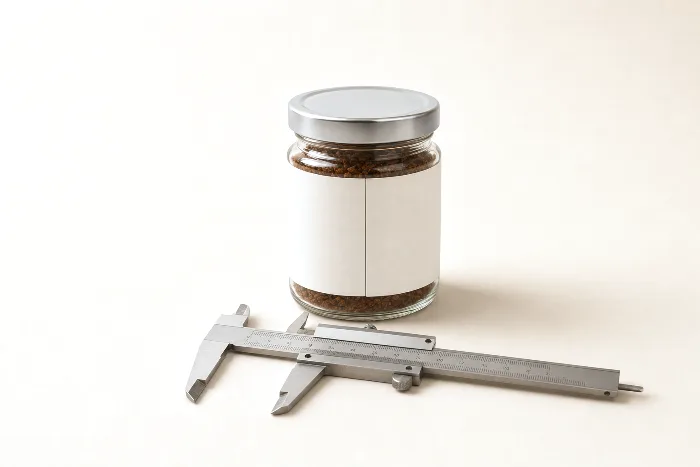
- Measure the diameter. For a round container, measure straight across the widest point of the labeling area (not the cap, not a base flare). Calipers are ideal; a ruler across the top works.
- Measure the label height available. Find the tallest band of straight, un-curved wall. You cannot reliably wrap a flat label over the shoulder of a bottle or the rounded lip of a jar, so measure only the usable straight section and subtract a little clearance top and bottom.
- Decide wrap style, then calculate the width. A full wrap uses the circumference; a front or front-and-back label uses the flat printable panel. The next two sections give you the numbers.
The wrap-width math
The whole thing rests on one formula from grade-school geometry: the circumference of a circle is π times its diameter. For a cylindrical container, the circumference is the width of a full wrap-around label.
So the wrap width is:
- Circumference = π × diameter ≈ 3.14 × diameter
- Butt seam (ends meet, no overlap): wrap width = circumference − ~⅛ in (≈ 3 mm)
- Overlap seam (one end laps the other, more durable): wrap width = circumference + ~⅛–¼ in
Here is an illustrative worked example — the numbers are for demonstration, so use your own measured diameter in practice. Say you have a straight-walled cylindrical jar measuring 2.5 in across the label area:
- Circumference = 3.14 × 2.5 ≈ 7.85 in
- For a clean butt seam, subtract ⅛ in → wrap width ≈ 7.72 in
- If the straight wall is 3 in tall and you leave about ⅛ in clearance top and bottom, label height ≈ 2.75 in
That gives you a roughly 7.72 × 2.75 in wrap label. The seam gap matters: too little and the ends overlap and bubble; too much and you get a visible stripe of bare container. About ⅛ in is a sensible starting point for a butt seam, but confirm it against a real sample, because material thickness and application method both move the number.
Full wrap vs front-and-back vs front-only
Before you calculate a width, decide how much of the container you want to cover. The choice changes both the math and the material you should pick.
| Style | Width is based on | Best for | Trade-off |
|---|---|---|---|
| Full wrap | Circumference − seam gap | Maximum branding area; hiding the seam; cylinders you can measure accurately | Needs an accurate circumference and a conformable material; unforgiving on taper |
| Front & back | Two flat panels, each sized to the usable face | A clean "front" and an ingredients/back panel; leaving the container visible on the sides | Two labels to apply and register; gaps show the container between them |
| Front only | One flat panel − safety margin | Small containers, samples, minimal branding | Least printable area; edges can flag if pushed onto curvature |
A rule of thumb: the flatter and more measurable the container, the more comfortably you can go full wrap. The more curved, tapered, or small-diameter it is, the more a front-only or front-and-back approach saves you from edges that lift. If you want the standard dimensions and naming conventions behind these, see our companion label sizes guide.
Common label sizes by container
Below are label sizes that show up often on popular containers. Read this as a starting point, not a spec sheet: these are common, not a standard. Two jars sold as the same volume can differ by a few tenths of an inch in diameter, which is enough to change the wrap. Always measure before you order.
| Container | Typical label style | Common size (approx., not a standard) |
|---|---|---|
| Small round jar / balm tin (1–2 oz) | Full wrap or lid label | ~5–6 in wide × 1–1.5 in tall; lid ~1.5–2 in round |
| Straight-sided jar (4 oz) | Full wrap or front & back | Wrap ~6.5–7 in × 2–2.5 in |
| Mason / wide-mouth pint jar | Front panel or partial wrap | Front ~3–4 in × 2–3 in |
| Boston round bottle (2–4 oz) | Full wrap or front & back | Wrap ~5–6 in × 2 in; front ~1.5–2 in × 2–3 in |
| Dropper / tincture bottle (1 oz) | Full wrap (thin) | ~3–3.5 in × 1–2 in |
| Lip-balm / cosmetic tube | Full wrap | ~2–2.5 in × 0.7–1 in |
| Standard water / beverage bottle | Full wrap or shrink sleeve | Wrap ~8–9 in × 3–4 in |
Notice how wide the ranges are — that is the point. A published "mason jar label size" is a convenience, not a rule, because there is no body that standardizes label dimensions the way there is for, say, bottle neck finishes. Treat the chart as a sanity check on your own measurement, not a substitute for it.
Curved and tapered containers change the math
The clean π × diameter formula assumes a straight-walled cylinder. Real containers are rarely that tidy, and two shapes in particular need care.
- Tapered / conical containers (cups, some tubs, shoulders on bottles): the diameter changes over the height, so a rectangular label wrapped around a cone wrinkles. These want a curved (arc-shaped) label designed for the taper, or a shorter label that stays on the near-straight band.
- Small-diameter containers (lip balms, vials, thin droppers, tubes): the tighter the radius, the more a stiff label fights the curve and lifts at the trailing edge. This is called flagging, and it is a sizing and material problem as much as an application one — see label flagging on curved and small containers for the full fix.
Two practical guards: give a full wrap enough overlap that the trailing edge is glued down onto label face, not bare container, and choose a thin, conformable face material for anything under roughly an inch and a half in diameter. A label that is dimensionally perfect but too stiff for the radius will still peel.
Let the calculator do it
You do not have to do this by hand. Our free label size calculator takes your container's diameter and height, applies the wrap math with a seam gap or overlap, and returns a label size you can hand to a printer — including bleed and safety allowances so the file is print-ready. It is the fastest way to turn "I have this bottle" into "this is the label."
If you would rather capture the whole specification — material, finish, quantity, and size in one place — build it in the label sizes guide or drop your artwork into Quick Quote and let PackOS reconstruct the dimensions from the file.
Wine, candles, and other special cases
A few categories carry their own habits, even though none of them impose a true dimensional standard:
- Wine & spirits. Bottle shapes vary widely between Bordeaux, Burgundy, and specialty bottles, and mandatory regulatory copy influences how much label you need. Common front labels cluster in a range, but "the" wine label size is a myth — see wine bottle label sizes.
- Candles. Straight-walled glass vessels wrap easily, but heat and condensation change which material holds; size the wrap to the straight body below the wax line and pick a heat-tolerant face.
- Jars with steep shoulders. Do not try to carry a wrap up over the shoulder — measure only the cylindrical body, and put secondary copy on a lid label if you need more room.
The through-line is the same in every case: measure the real object, decide the wrap style, and let the geometry give you the number.
How PackOS sizes labels
When you upload artwork or a die file, PackOS detects the label's cut shape, measures its real dimensions, and rebuilds it as a parametric dieline — so if you change the container diameter, the wrap width, bleed, and safety all reflow together instead of forcing a manual redraw. From that it produces a 3D mockup on your actual container and an instant quote, because once the size and material are known, the print area and production route are calculable. You can watch that reconstruction on the technology page, or try it on a real label with Quick Quote.
Frequently asked questions
What size label do I need for a jar or bottle?
Measure the container's diameter and height. For a full wrap, the label width is the circumference (pi times the diameter) minus about an eighth of an inch so the ends do not overlap; for a front-only label, use the flat printable panel minus a safety margin. Height is the straight wall of the container minus a little clearance top and bottom. There is no single standard size — it depends on your exact container.
How do I calculate label width for a full wrap?
Multiply the container diameter by pi (about 3.14) to get the circumference, then subtract roughly an eighth of an inch for a butt seam so the label ends meet without overlapping. If you want the ends to overlap for durability, add about an eighth to a quarter inch instead. Always confirm the result against your real, measured container.
Is there a standard label size for jars and bottles?
No. Common sizes cluster around popular container shapes, but there is no universal label-size standard the way there is for bottle neck finishes. Treat published size charts as common, typical values and size the label to the container you actually have.
What is a mason jar label size?
It depends on the jar. There is no fixed mason jar label size; a wide-mouth pint commonly takes a front-panel label a few inches wide and a few inches tall, but the accurate way is to measure your jar's diameter and wall height and run the wrap math or a calculator. Treat any chart number as typical, not a rule.
Should I use a full wrap or a front-and-back label?
A full wrap gives the most printable area and hides the seam, but it needs an accurate circumference and a conformable material. Front-and-back or front-only labels are more forgiving on curved, tapered, or small-diameter containers and use less material, but they leave the container visible between them. Choose based on how much branding you need and how curved the surface is.