
Standard box sizes chart — and why the "standard" size can cost you
There are dozens of "common" box sizes and almost no true standards. This chart lists the sizes you'll actually see — and then does the thing the other charts skip: it shows how each size hits your freight bill.
THE SHORT ANSWER
Common box sizes exist, but there is no mandated "standard" — and defaulting to a familiar size usually means shipping air. The cheapest box is the smallest one that safely fits your product, because parcel carriers bill on dimensional weight (outside volume), not just the weight of what's inside. Use the chart below to find a common size, then right-size against freight and pallet fit.
- No universal standard — the chart shows common/popular sizes, not mandates
- Boxes are sized by inside dimensions — length × width × depth
- Size drives cost — oversized boxes raise dimensional weight and waste pallet space
- Right-size, don't default — start from the product, then check the freight math
Is there really a standard box size?
Not in the way most people assume. There is no legal or universal mandate that a shipping box must be a particular dimension. What people call "standard box sizes" are really common sizes — the ones box makers keep in stock, carriers optimize their networks around, and warehouses have learned to order without thinking. They're popular because they're popular, not because a standards body decreed them.
A few things near a box are standardized. Corrugated board grades and construction are described by industry conventions (the Fibre Box Association's rules and the box maker's certificate). Pallet footprints are genuinely standardized — the 48×40 in footprint dominates North American grocery and retail. But the box itself between the product and the pallet is a free variable, and treating a familiar size as a rule is exactly how brands end up paying to ship empty space. This article is part of our complete guide to packaging sizes, where the recurring theme is the same: common sizes are a starting point, not a spec.
The common box sizes chart
Here are box dimensions you'll see over and over, grouped by the two families that cover most shipping: regular slotted containers (cube-ish shippers) and mailers (flatter, self-locking boxes). Dimensions are given as inside length × width × depth in inches, the way the corrugated industry quotes them. Treat this as common and typical, not a standard — any size can be made to order.
| Common box (L×W×D in) | Family | Typical use | Note |
|---|---|---|---|
| 6×6×6 | RSC | Small cubes, mugs, candles, jars | Popular "small cube" |
| 8×6×4 | RSC | Books, small electronics, single units | Very common single-item box |
| 10×8×6 | RSC | Apparel sets, kits, multi-packs | Workhorse mid-small |
| 12×9×6 | RSC | Shoes, bundled goods | Close to a shoebox footprint |
| 12×12×12 | RSC | Assorted, subscription boxes | The classic 1 cu ft cube |
| 16×12×12 | RSC | Bulkier kits, homewares | Fits a half of a 48×40 layer well |
| 18×18×16 | RSC | Lightweight, bulky items | Watch dimensional weight |
| 24×18×18 | RSC | Large, light goods | Often DIM-weight dominated |
| 6×4×3 | Mailer | Small hard goods, accessories | Roll-end or literature mailer |
| 9×6×3 | Mailer | Cosmetics, small apparel | Easy-open self-locking lid |
| 12×9×4 | Mailer | Flat goods, print, soft apparel | Low profile, stackable |
| 12×12×3 | Mailer | Framed prints, boards, plates | Protects flat, fragile items |
Use the chart to land near a size, not to lock one in. The next sections explain why the family, the inside-versus-outside distinction, and the freight math matter more than the round number.
RSC vs mailer: the two families on the chart
Most "standard" charts blur two very different structures together. They ship, fold, and cost differently:
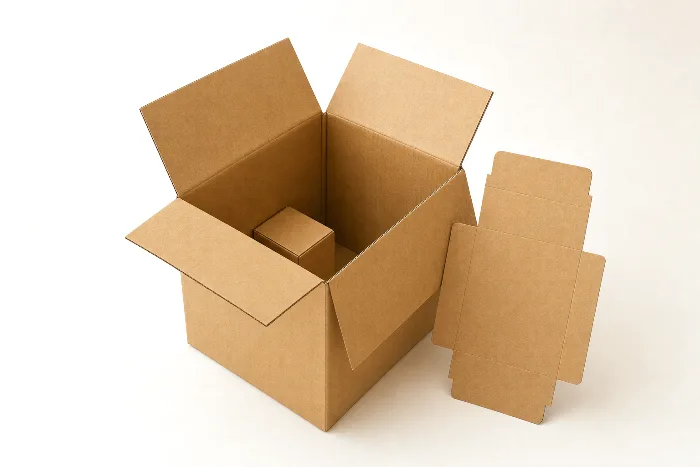
- Regular slotted container (RSC) — the classic brown shipping box. All flaps are the same length and the two outer flaps meet in the middle on the top and bottom. It's material-efficient (one blank, no waste), strong, and cheap, which is why it's the default corrugated shipper. See the live geometry on our regular slotted container reference.
- Mailer — a roll-end or literature-style box folded from a single blank with a self-locking lid and usually built-in side walls. It opens like a book, needs little or no tape, presents the product nicely, and suits lighter, flatter items and direct-to-consumer unboxing.
As a rule of thumb: reach for an RSC when the contents are heavy, dense, or stacked deep, and a mailer when the item is light, flat, or the unboxing experience matters. Both are die-cut from a flat blank — if you want to understand how that blank is drawn and why the panels have to line up, start with what a dieline is. Cartons that fold from paperboard rather than corrugated follow the same logic; our folding carton styles guide covers those.
Inside vs outside: which dimension are you buying?
This is the detail that quietly wrecks orders. By convention, a corrugated box is specified by its inside dimensions — the usable space your product drops into — in the order length, width, then depth. The outside dimensions are slightly larger because the board has thickness, and that difference grows with heavier flute grades and double-wall construction.
Which one you care about depends on the question:
- Will my product fit? — that's an inside-dimension question.
- What will it cost to ship, and how many fit a pallet? — those are outside-dimension questions, because carriers and pallets see the box's exterior cube.
When you're translating a product size into a box order, do it deliberately: take the product, add clearance and any protective material, and that gives you the inside dimensions. Our case size calculator handles that conversion — and the reverse, working out how many primary units fit a given case — so you're not guessing at the seam between "fits" and "ships cheaply." If board strength is also in question (tall stacks, humid warehouses), pair it with corrugated box strength so the size you pick can actually carry the load.
The freight catch every box-size chart skips
Here's what a plain size chart won't tell you: the box you default to is often the most expensive thing about the shipment. Parcel carriers don't bill purely on how heavy your package is. They bill on the greater of actual weight and dimensional weight — a figure derived from the box's outside volume. A light product in an oversized box gets charged as if it were heavy, because the box is taking up space the carrier could have sold to someone else.
The divisor is set by each carrier and service, changes periodically, and differs between domestic and international — so treat any single number as approximate and confirm the current one on your carrier's rate card. The mechanics, worked through with examples, live in dimensional weight explained. The practical takeaway is simple: every extra inch of box dimension you don't need is inflating a volume-based charge. Run a candidate size through the dimensional weight calculator before you commit to it.
Size hurts a second time on the pallet. Boxes that don't tile cleanly onto a 48×40 footprint leave gaps, cut the number of cases per layer, and raise your freight-per-unit on the truck as well as the parcel. A common cube like 12×12×12 stacks predictably; an odd size can strand a whole column of empty space. Work out how a given box lays up in boxes per pallet, and if pallet-to-truck economics drive your program, Ti-Hi, BCT and freight class connects box strength, stacking, and how carriers classify the load.
How to right-size instead of defaulting
Right-sizing isn't exotic; it's a short, repeatable sequence. Do it once per SKU and the savings compound over every shipment:
- Start from the product, not the shelf of boxes. Measure the item (or the arranged group of items) at its largest points.
- Add the clearance and protection you actually need. A snug fit plus the minimum cushioning gives you the target inside dimensions — not a generous "round up to be safe" number.
- Find the nearest common size on the chart. A stock size is cheaper and faster than custom, so snap to one if it's close without wasting space.
- Check the outside dimensions against dimensional weight. Run it through the dimensional weight calculator; if DIM weight beats actual weight, a smaller box or a lower profile may pay for itself immediately.
- Confirm it stacks. Verify the case tiles onto a pallet layer without stranding space using boxes per pallet.
- Only then go custom if the math says so. If no stock size fits well, a made-to-order box that kills the wasted cube often beats a "free" standard size over the life of the SKU.
The point isn't to chase the perfect box for its own sake. It's that the difference between a defaulted size and a right-sized one is paid on every unit you ever ship, so it's worth getting right once.
How PackOS sizes the box
PackOS treats box size as a calculated result, not a dropdown pick. From a product spec or an existing die file, it builds a parametric box model — change a dimension and the whole blank, the panels, and the glue or seal areas reflow with it — so the size you're pricing is a real, manufacturable structure rather than a round number. Because the model knows the outside cube, it can surface the freight and pallet consequences of a size at the same moment you choose it, instead of on the first invoice. You can see the reconstruction and logistics math on the technology page, or try it on a real product with Quick Quote — the goal is that "what size box" and "what will it cost to ship" become one answer, not two.
Frequently asked questions
Is there an official standard for box sizes?
No. There is no legal or universal mandated standard for box sizes. There are common, popular sizes that box makers, carriers, and warehouses use often, but any dimension can be made to order. Corrugated boxes are conventionally specified by their inside dimensions, in the order length by width by depth.
Should box dimensions be measured inside or outside?
For corrugated boxes, dimensions almost always refer to the inside of the box, because that is the space your product has to fit into. The outside dimensions are slightly larger because the board has thickness, and those exterior dimensions are what matter for pallet fit and dimensional weight.
Why does box size affect my shipping cost?
Parcel carriers bill on the greater of actual weight and dimensional weight, which is calculated from the box's outside volume. A box that is larger than it needs to be raises the dimensional weight and can also waste space on the pallet, so an oversized standard box costs more to ship even when the product inside is small.
What is the difference between an RSC and a mailer box?
A regular slotted container, or RSC, is the classic shipping box whose flaps meet in the middle on the top and bottom; it is strong and economical for a wide range of products. A mailer folds from a single blank with a self-locking lid, opens like a book, and is designed for lighter, flatter items and easy opening.
How do I pick the right box size instead of defaulting to a standard?
Start from the product, add the clearance and protection you need, and that gives the inside dimensions. Then check the outside dimensions against dimensional weight and how the case stacks on a pallet, and adjust to remove wasted space. A calculator does this math quickly so you buy the smallest box that safely fits.