
FEFCO codes explained: how corrugated box styles are named
If you have ever received a box spec that just says 0201 and wondered what the number meant, you have met the FEFCO system. It is the shorthand the corrugated industry uses to name box styles so a converter anywhere in the world builds the same shape.
THE SHORT ANSWER
FEFCO codes are a four-digit standard for naming corrugated box styles: the first two digits set the design group, the last two the exact style. The system is published by FEFCO — the European Federation of Corrugated Board Manufacturers — and used internationally, so 0201 means the same Regular Slotted Container to any converter, in any language. A quick way to read one:
- First two digits — the design group (02 slotted, 03 telescope, 04 folder/tray, 05 slide, 06 rigid, 07 ready-glued, 09 fitments)
- Last two digits — the specific style within that group
- 0201 — the Regular Slotted Container (RSC), the everyday shipping box
- The code names the shape only — you still specify size, board grade, and flute separately
Try the corrugated box weight calculator →
What FEFCO codes are
FEFCO codes are the international shorthand for corrugated box styles. Each style is a four-digit number — formally part of the FEFCO/ESBO International Fibreboard Case Code, published jointly by FEFCO and the European Solid Board Organisation. The number describes how a box is cut and folded: the flap arrangement, the joints, the slots, and whether it comes as one piece or several. It does not describe the box's size or the strength of the board.
That distinction is the whole point. Say "a box with a lid" and you have said almost nothing — there are dozens of ways to build one. Say 0301 and a die-maker in Germany, a buyer in Ohio, and a co-packer in Mexico all picture the same telescoping lid-over-body construction. The FEFCO code carries the geometry so the words don't have to.
Why a four-digit standard exists
A number is language-neutral, and corrugated is a global supply chain. A standardized code means the shape survives translation, survives being re-quoted at a second plant, and survives the game of telephone between a brand, a broker, and a factory. When you reorder a box a year later, quoting the FEFCO code removes any question about which of several similar styles you actually had.
Corrugated earns its own numeric system because there are simply more structural variants than in paperboard. Folding cartons tend to be named descriptively — reverse tuck, straight tuck, auto-bottom — as we cover in folding carton styles. Corrugated box styles explained purely in words would be endless, so the industry indexed them. A few things a FEFCO code standardizes:
- The construction — one-piece vs. multi-piece, glued vs. folded vs. slide-together.
- The closure — meeting flaps, overlapping flaps, a separate lid, or self-locking corners.
- The joint — how the blank is fastened (glued, taped, or stitched at the manufacturer's joint).
- The intent — a shipper, a display tray, a partition, or converted roll/sheet stock.
The FEFCO groups: what the first two digits mean
The first two digits place a box in a design group — a family of related constructions. This is the most useful thing to memorize, because it tells you roughly what a code is before you look up the exact style. Here are the main groups as defined in the FEFCO catalogue.
| Group | Family | What it is |
|---|---|---|
| 01 | Commercial rolls & sheets | Converted board stock — rolls, sheets, and cut blanks — rather than a finished box. |
| 02 | Slotted boxes | One-piece body with top and bottom flaps, joined on a single manufacturer's joint. The 0201 RSC lives here. |
| 03 | Telescope boxes | Two or more pieces — a separate lid (and sometimes base) that telescopes over a body. |
| 04 | Folder-type boxes & trays | One piece where the base and walls fold up from a flat blank, often with no glue — book wraps and display trays. |
| 05 | Slide-type boxes | Inner tray or frame that slides into an outer sleeve, matchbox-style. |
| 06 | Rigid (Bliss) boxes | Two separate end panels plus a wrap, stitched or glued into a strong, square box. |
| 07 | Ready-glued cases | One piece, pre-glued at the plant, shipped flat and erected by opening — fast to set up. |
| 09 | Interior fitments | Partitions, dividers, pads, and liners that protect product inside a box. |
Learn those eight families and most of a FEFCO code list becomes readable at a glance: anything starting 02 is a slotted shipper, anything starting 09 is an insert, and so on. FEFCO maintains the authoritative catalogue of every standard design and its exact geometry.
Reading a code: 0201, 0203, 0427 and friends
Once the group tells you the family, the last two digits pin down the specific style. Here is what a 0201 box is, plus a few of its neighbors, so FEFCO box styles explained in the abstract become concrete.
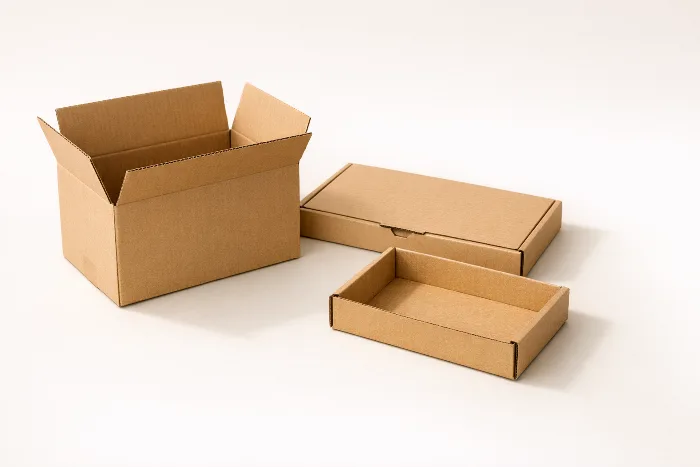
- 0201 — Regular Slotted Container (RSC). The default shipping box. All four flaps are the same depth, the outer flaps meet at the center, and the blank is joined on one manufacturer's joint. It ships flat and wastes almost no board, which is why it is the most common corrugated box in the world.
- 0203 — Full Overlap Slotted Container (FOL). Like an RSC, but the outer flaps overlap the full width of the box, giving a double layer of board across the top and bottom. That adds stacking strength and edge protection — useful for heavy or top-loaded product.
- 0427 — a folder-type tray. A one-piece 04-group blank whose walls fold up and lock at the corners with no glued body, the kind of shallow tray used for displays and easy-pack shippers.
A short reference of everyday corrugated box style codes:
| Code | Style | Typically used for |
|---|---|---|
| 0201 | Regular Slotted Container (RSC) | General shipping — the everyday brown box |
| 0203 | Full Overlap Slotted Container (FOL) | Heavier or top-loaded product needing extra flap strength |
| 0300 / 0301 | Telescope box (lid over body) | Two-piece boxes where you want a separate lid |
| 0427 | Folder-type tray | Display trays and shallow, easy-to-pack shippers |
| 0711 | Ready-glued case | Fast set-up shippers erected by opening a pre-glued blank |
These names and geometries come from the FEFCO catalogue; the exact design of any given code is defined there rather than by the converter, which is precisely what makes the code portable.
FEFCO code vs. a custom die
A FEFCO code is a catalogue style. If your product fits one, quoting the code is the fastest, cheapest, and most repeatable path, because the tooling is standard and every plant already knows the design. You still set the dimensions — a 0201 can be any size — so most orders are simply a standard style plus your own inside measurements.
You reach for a custom die — a bespoke structural drawing rather than a catalogue code — when the catalogue can't express what you need. That is a normal, common decision, and it is the same custom-vs-stock trade-off we walk through in custom vs. stock packaging. Rough guidance on which way to lean:
- Use a FEFCO code when a standard shipper, tray, or telescope box does the job — most transit and case packing.
- Use a FEFCO code with modified dimensions when the shape is standard but the size is unusual; it is still a code plus your L × W × D.
- Go custom for retail-ready structures, integrated inserts, unusual closures, or die-cut windows that no catalogue style covers.
How a FEFCO code fits into an order
Here is the trap: a FEFCO code alone is not a complete box spec. Because the code names only the shape, a buildable order pairs it with several other facts. A complete corrugated spec generally reads:
- FEFCO style code — the construction (e.g. 0201).
- Internal dimensions — length × width × depth, measured inside, because the contents have to fit. If you are unsure which is which, see how to measure a box.
- Board grade & flute — the corrugated construction (single-, double-wall, and the flute profile).
- Performance — a strength target such as ECT or a Mullen burst rating; our guide to corrugated box strength covers how those translate to stacking.
- Print & finishing — plain, printed, or die-cut features.
Once the style and dimensions are set, the downstream math follows: board area and estimated weight (the corrugated box weight calculator does this from the blank), how many fit on a pallet in our boxes per pallet guide, and how the cube affects dimensional weight and freight class. Picking a common footprint early — see our standard box sizes chart — keeps all of that efficient. This is part of our broader guide to packaging logistics.
How PackOS uses box-style codes
PackOS is built to read structure, not just artwork. When you upload a die file or a drawing, it classifies the construction and, where a standard style applies, recognizes it — a 0201 is understood as a 0201 — then rebuilds it as a parametric model, so changing a dimension reflows the panels, flaps, and joints correctly. From the style plus the dimensions it computes the board area, renders a proof, and returns an instant quote, because once the box style and size are pinned down the material and production route can be calculated. You can see the detection run on the technology page, or price a real box now with Quick Quote. It is one piece of our wider packaging design guide.
Frequently asked questions
What does a FEFCO code mean?
A FEFCO code is a four-digit number that names a corrugated box style. The first two digits identify the design group and the last two identify the specific style within it. For example, 0201 is the Regular Slotted Container, the standard shipping box. The system is published by FEFCO and used internationally, so the same code means the same shape to any converter.
What is a 0201 box?
A 0201 is the Regular Slotted Container, or RSC — the most common corrugated shipping box. All four flaps are the same depth, the outer flaps meet in the middle, and the box is joined on a single manufacturer's joint. It ships flat and is economical because the blank has almost no wasted board.
What do the FEFCO group numbers mean?
The first two digits are the design group. 02 is slotted boxes, 03 is telescope boxes, 04 is folders and trays, 05 is slide boxes, 06 is rigid Bliss boxes, 07 is ready-glued cases, and 09 is interior fitments like partitions and pads. Group 01 covers commercial rolls and sheets rather than finished boxes.
Is a FEFCO code the same as board grade or ECT?
No. A FEFCO code describes the structural style — the shape and how the box folds. Board grade, flute, and strength measures like ECT or Mullen describe the material. A complete spec needs both, plus the internal dimensions, because the code names the shape but not the size or the strength.
Do I have to use a FEFCO code to order a box?
No, but it removes ambiguity. If your box matches a catalogue style, quoting it as a FEFCO code plus internal dimensions and board grade is faster and cheaper because the tooling is standard. If your box is a unique shape, you need a custom die and a structural drawing instead of a catalogue code.