
Custom vs stock packaging: which is right for you?
Every growing brand hits the same fork: buy packaging that already exists and make it yours with a label, or commission packaging built from scratch to your exact spec. This guide walks the full spectrum — and the hybrid most brands should start with.
THE SHORT ANSWER
Stock packaging is a pre-made container, bag, or box you buy off the shelf in standard sizes. Custom packaging is manufactured to your own dimensions, structure, material, and print. Stock is faster and available in small quantities but limits your shape and branding. Custom fits your product exactly and owns the shelf, but it carries tooling costs and larger minimums. For most early brands the smart middle ground is stock packaging with a custom label — near-stock speed and minimums, real brand presence.
- Stock — off-the-shelf, low minimums, fast, limited shape and branding
- Custom — made to your spec, full brand control, tooling plus larger minimums
- Stock + custom label — the hybrid most new brands launch on
- Custom pays off as volume, differentiation, or an exact fit justify the tooling
- One quote, both paths — an instant quote prices stock-plus-label and fully custom side by side
The custom-vs-stock spectrum
"Custom or stock" sounds like a yes/no question, but in practice it's a continuum. Between a plain catalog item and a package designed entirely from scratch sit two middle options that most brands actually choose. This piece is part of our buyer's guide to packaging cost, and the cost story is easiest to follow along that spectrum:
- Stock (as-is). Buy a standard container, pouch, or box from a catalog and use it exactly as it ships. No design, no tooling, no minimum beyond the pack count.
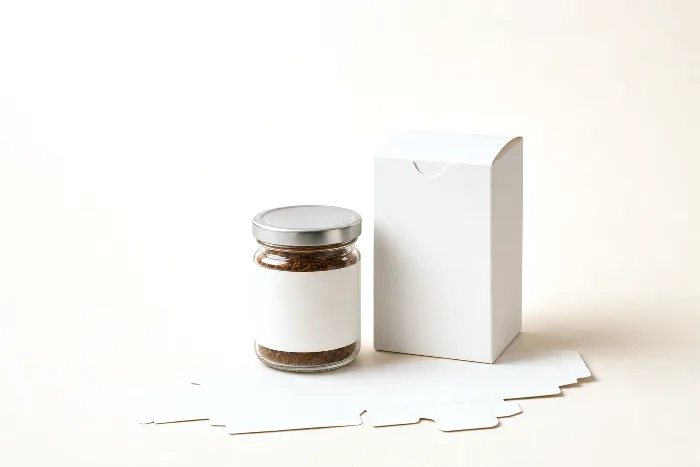
- Stock + custom label or print. Buy the stock body, then brand it with your own label or printed film. This is what most people mean by "private label."
- Semi-custom. A stock structure with custom elements — a stock die with your own print, a stock bag built to a size within a set range, or a stock bottle with a custom color and decoration.
- Fully custom. Structure, dimensions, material, and graphics all made to your spec. This requires custom tooling — cutting dies, printing plates, and sometimes a mold.
The further right you move, the more the package becomes yours — and the more of the setup cost you take on directly. Understanding where that setup cost lives is the whole game.
What "stock" packaging really means
Stock packaging is manufactured in standard sizes and styles, in volume, and warehoused. When you order, you draw from inventory that already exists. Catalog stand-up pouches, common folding-carton and mailer sizes, and off-the-shelf bottles and jars are all stock formats.
The advantages are real and worth naming plainly:
- It's available now. No tooling to build, no die to cut — the lead time is essentially pick-and-ship plus whatever decoration you add.
- Minimums are small. Because the manufacturer already amortized their setup across a big production run, you can buy a modest quantity and still get a sensible price.
- Risk is low. Stock is the cheapest way to test a product, a size, or a market before you commit to anything permanent.
The trade-offs are just as real. The shape is fixed, so your product may rattle inside it or waste space it doesn't need. Your branding is limited to whatever you can add on top of a form someone else designed. And because the same catalog item is available to everyone, it can't differentiate you on the shelf.
What "custom" packaging really means
Custom packaging is built to your dimensions, structure, material, and graphics. Getting there means creating tooling: a custom cutting die for a carton, pouch, or label; printing plates for the artwork; and, for rigid containers, sometimes a mold. Those are one-time costs, plus the setup labor of getting a press dialed in for the first good sheet — the make-ready.
What you get for that investment is control. A custom package fits the product exactly, which cuts void fill, can improve protection, and often reduces dimensional weight — the number carriers actually bill on. You get full branding across the whole structure rather than a label stuck to a generic body, the freedom to differentiate with a distinctive shape or unboxing, and ownership of a design nobody else can buy. The costs are the upfront tooling, a longer first lead time, and larger minimums needed to spread that setup across enough units. Our deep dive on printing plates and tooling costs unpacks where those one-time charges come from.
The trade-offs, side by side
Here's how the four points on the spectrum compare on the factors that usually decide the call. There are no universal numbers here — every format and volume is different — so read this as direction, not a price sheet.
| Approach | Speed to first order | Minimum order | Brand control | Tooling needed |
|---|---|---|---|---|
| Stock (as-is) | Fastest | Smallest | Lowest — shape and look are set by the catalog | None |
| Stock + custom label | Fast | Small | Medium–high — your graphics on a stock body | Label only (often digital, minimal) |
| Semi-custom | Moderate | Moderate | High | Some — shared or partial tooling |
| Fully custom | Slowest | Largest | Highest — structure and print are yours | Full — dies, plates, sometimes a mold |
Notice the pattern: speed, minimums, and tooling all move together. The more the package is truly yours, the more setup you carry and the more units you need to make that setup worthwhile. That's the tension every decision below is really balancing.
Why stock plus a custom label wins early
For most brands starting out, the sweet spot isn't at either end — it's the hybrid: a proven stock body branded with a custom label or printed film. It's popular for good reasons.
First, it keeps minimums low. You're not paying to tool a custom structure, so you're not forced to buy a structure's worth of units to amortize it — the biggest driver of a high minimum simply isn't there. Our explainer on packaging MOQs walks through why setup cost and minimums are two sides of the same coin.
Second, it's fast. The stock body is already in inventory, and labels — especially on digital presses — can be produced in small quantities without the plate make-ready a long conventional run requires. That means you can launch quickly and iterate the artwork without re-tooling every time. Our complete guide to label printing covers the methods and where each one makes sense.
Third, it still delivers real shelf presence. A well-designed label or full-body sleeve does most of the branding work a buyer notices. In effect, the label carries the make-ready that would otherwise sit in the whole package — a much smaller, much more flexible commitment. This is exactly the private-label play, and it's why so many brands live here far longer than they expect to.
When fully custom pays off
Custom stops being a luxury and starts being the cheaper, better choice when one or more of these forces show up:
- Volume. Tooling is a one-time cost spread across every unit you make. The more units, the smaller each one's share of that cost — until the per-unit price of custom can dip below stock-plus-a-label, while also fitting the product better. See plates and tooling costs for how that amortization works.
- Differentiation. When the package itself is part of how you compete — a structure or unboxing a stock item can't reproduce — custom buys you something a competitor can't just order from the same catalog.
- Exact fit. Right-sizing to the product trims material and void fill, sharpens protection, and lowers dimensional weight on every parcel — a saving that compounds across a whole shipping program.
Custom also gives you control over the material itself — for example, moving to a recyclable mono-material structure or a specific barrier — and continuity of supply, since the tooling is yours. None of that is free, but at the right volume the math and the brand story both point the same way.
A decision framework
You don't need a spreadsheet to get this mostly right. Work through these questions in order and the answer usually falls out:
- How certain are you about the product and its volume? Early, uncertain, or still testing points to stock or stock-plus-label.
- Does a stock item actually fit your product? If it rattles, wastes space, or protects poorly, that's a nudge toward custom.
- Is the packaging part of the brand experience? If the structure and unboxing are core to how you compete, custom earns its keep.
- What volume can you commit to? Higher, committed volume lets tooling amortize; low volume keeps it stranded.
- How fast do you need it? An urgent launch favors stock-plus-label now, with custom as a follow-on.
Read as a table, the signals line up like this:
| Signal | Lean stock + label | Lean fully custom |
|---|---|---|
| Order volume | Low or uncertain | High and committed |
| Fit in stock sizes | Fits well enough | Poor fit, wasted space |
| Brand differentiation | Nice to have | Core to the brand |
| Time to launch | Urgent | Flexible |
| Design stability | Still iterating | Locked in |
The most important thing to remember: this isn't a one-time, permanent choice. Plenty of brands run it as a timeline — launch on stock with a custom label, prove the product and the volume, then graduate to fully custom once the design is settled and the numbers support the tooling. You get to move along the spectrum as you grow.
How PackOS quotes both paths
Because PackOS models a package parametrically — the real dimensions, structure, material, and print — it can price the stock-plus-label route and the fully custom route from the same product spec or artwork. That means you can see where tooling and make-ready actually land on the unit cost, and at roughly what volume custom overtakes the hybrid, instead of guessing. You can follow how that pricing is built on the technology page, or put your own product through it with Quick Quote and compare both paths in about a minute.
Frequently asked questions
What's the difference between stock and custom packaging?
Stock packaging is a pre-made container, bag, or box you buy from a catalog in standard sizes. Custom packaging is manufactured to your own dimensions, structure, material, and print. Stock is faster and available in small quantities; custom fits your product exactly and gives you full brand control, but it carries tooling costs and larger minimum orders.
Is stock or custom packaging cheaper?
It depends on volume. Stock has almost no setup cost, so it is cheaper for small quantities and early testing. Custom packaging adds one-time tooling and make-ready costs that are spread across the run, so its per-unit cost falls as volume rises. At high enough volume, custom can end up costing less per unit than stock plus a label, while also fitting the product better.
What is private label packaging?
Private label packaging is stock packaging that you brand as your own, usually by applying a custom label or print to an off-the-shelf body. It gives you a branded product quickly and at low minimums because you are not paying to tool a custom structure, only the label. It is the most common starting point for new brands.
When should I switch from stock to custom packaging?
Consider switching when your volume is high enough that tooling costs spread thin across the run, when a stock size no longer fits your product well, or when a distinctive structure becomes part of how your brand competes. Many brands launch on stock with a custom label and graduate to fully custom as volume and design stability grow.
Do custom packaging minimums make it out of reach for small brands?
Not necessarily. Minimums exist because tooling and press setup are fixed costs that need to be spread across enough units to make sense. Small brands often start with stock plus a custom label to stay under those minimums, then move to custom once their volume supports it. An instant quote is the fastest way to see where the minimum for a given format lands.