
SBS vs CRB vs CUK: the three folding-carton paperboards
Nearly every folding carton on a shelf is made from one of three paperboards. Pick the wrong one and the box looks cheap, cracks on the fold, or fails in the cold case. Here is what SBS, CRB, and CUK actually are — and how to choose between them.
THE SHORT ANSWER
SBS vs CRB vs CUK: SBS is the bright premium sheet, CRB the economical recycled board, and CUK the strong kraft board. All three are coated folding-carton paperboards, but they differ in fiber source, brightness, strength, and cost — so the right choice depends on your product, not on which board is "best":
- SBS (solid bleached sulfate) — virgin bleached fiber, the brightest white and best print surface; premium and food-facing.
- CRB (coated recycled board) — recycled fiber with a coated top and a gray back; the lowest cost, ideal for dry goods.
- CUK (coated unbleached kraft) — virgin kraft fiber, natural brown; the strongest and most moisture-tolerant, for beverage, frozen, and heavy loads.
- Caliper and basis weight, not the grade alone, set stiffness — always specify both.
What SBS, CRB, and CUK actually are
Paperboard is the stiff, foldable sheet that folding cartons — the printed retail boxes for toothpaste, cereal, cosmetics, cannabis, and frozen dinners — are cut and creased from. It is not corrugated (that is the fluted brown shipper); paperboard is a solid, single-ply sheet, usually between about 12 and 24 points thick, printed and then die-cut into a folding carton style. This article is part of our complete guide to packaging design.
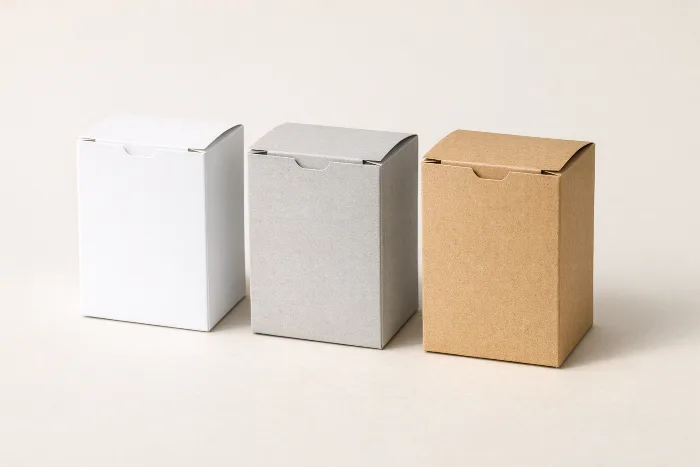
Three grades dominate North American carton work, and the whole SBS vs CRB vs CUK decision comes down to the two things that separate them: what the fiber is made from, and how the surface is coated. A cross-section of each board tells the story — a bright bleached core, a gray recycled core, or a brown kraft core, each capped with a thin mineral coating on the print side.
- SBS — solid bleached sulfate. Virgin wood pulp, fully bleached white, clay-coated. The premium grade.
- CRB — coated recycled board. Recovered (recycled) fiber, clay-coated on top, gray or brown underneath. The value grade.
- CUK — coated unbleached kraft. Virgin kraft pulp left unbleached, coated on the print side. The strength grade. (You will also see it called SUS, for solid unbleached sulfate.)
A fourth grade, uncoated recycled board (URB), shows up in set-up boxes and backing, but for printed retail cartons the working choice is almost always one of these three.
SBS: the bright premium sheet
SBS (solid bleached sulfate) is made from virgin chemical wood pulp that has been fully bleached, then clay-coated — on one side (C1S) or both (C2S). The result is the brightest, whitest, smoothest carton board you can buy, and it prints with the highest fidelity: clean highlights, tight registration, and a surface that takes foil stamping, embossing, and spot varnish beautifully.
Because it starts from clean virgin bleached fiber, SBS is the board most often used in direct food contact, and it is the default for premium and regulated categories: cosmetics, pharmaceuticals and nutraceuticals, confectionery, health-and-beauty, and any carton where a bright white base and a luxury feel matter. It is also the strongest performer for a crisp white interior. The trade-off is cost: SBS is generally the most expensive of the three grades because virgin bleached pulp is the priciest furnish.
CRB: the economical recycled board
CRB (coated recycled board), sometimes called coated recycled paperboard, is manufactured from recovered paper fiber — old cartons, boxes, and cuttings — with a clay coating applied over the top ply to give it a printable surface. The back stays a natural gray. It is the economical, sustainability-forward choice: it carries recycled content, and it is the board behind an enormous share of everyday dry-goods cartons — cereal, crackers, tissue, dry mixes, and general retail boxes.
The compromises follow from the fiber. Recycled fibers are shorter and more processed than virgin ones, so at the same caliper CRB is generally less stiff and has lower wet strength than SBS or CUK, and its brightness and interior color are lower. None of that matters for a dry, light product on a warm shelf, which is exactly where CRB earns its place. If you need more stiffness from a recycled board, you specify a heavier caliper — a common move in the custom-versus-stock conversation.
CUK: the strong kraft board
CUK (coated unbleached kraft) is made from virgin kraft (sulfate) pulp that is left unbleached, so the board keeps the long, strong fibers and the natural brown color of kraft, with a clay or pigment coating on the print side for graphics. Those long virgin fibers give CUK the highest tear resistance and wet strength of the three grades, which is why it is the board of choice where the load is heavy, cold, or damp.
Classic CUK applications are beverage multipack carriers (the wrap that holds a six-pack of cans or bottles), frozen-food cartons that sweat in the freezer and thaw in the cart, and hardware or heavy retail boxes. The natural brown back also reads as "kraft" and rustic, which some brands want on purpose. Cost typically sits between CRB and SBS: more than the recycled board, less than the fully bleached sheet.
SBS vs CRB vs CUK, side by side
Here is the SBS vs CRB vs CUK comparison in one view. Treat strength and cost as relative directions between the three grades, not absolute figures — actual stiffness depends on caliper, and price depends on your run, market, and moment.
| Board | Look | Strength | Best for | Relative cost |
|---|---|---|---|---|
| SBS solid bleached sulfate | Brightest white, smoothest print surface, both sides clean | Good stiffness; virgin fiber | Premium retail, cosmetics, pharma, confectionery, direct food contact | Highest |
| CRB coated recycled board | Coated top, gray back; lower brightness | Lower stiffness & wet strength for a given caliper | Dry goods — cereal, crackers, tissue, general retail | Lowest |
| CUK coated unbleached kraft | Coated print side, natural brown back | Strongest — high tear and wet strength | Beverage carriers, frozen, heavy or damp loads, kraft looks | Middle |
The pattern is easy to hold in your head: reach for SBS when appearance and food-facing whiteness lead, CRB when cost and recycled content lead, and CUK when strength and moisture lead.
Food contact and recyclability
Two questions come up on almost every carton project: is the board safe against my product, and can the finished pack be recycled? Both answers depend on the grade and on what you laminate or coat onto it.
- Food contact. SBS and CUK are both virgin-fiber boards and are commonly specified for direct food contact. CRB is made from recycled fiber, which can carry trace contaminants; for direct contact with dry or fatty foods it is common to add a functional barrier (an inner liner or coating) to limit mineral-oil migration. Which board and construction is appropriate depends on the food and the process — confirm a given board's food-contact status with the mill and against current U.S. Food and Drug Administration guidance.
- Recyclability. All three are paper-based and are widely accepted in the paper recycling stream, per the Paperboard Packaging Council and paper-industry sources — provided you have not turned the carton into a hard-to-recycle laminate with a plastic, foil, or heavy wax layer. CRB additionally embodies recycled content on the way in. If sustainability is a priority, weigh the recycled fiber of CRB against the recoverability of the finished structure, and see our sustainable packaging guide.
Food and recycling rules vary by product, market, and jurisdiction and change over time. Treat this as general guidance, not legal or regulatory advice — verify requirements with the relevant authority and your converter. For the food side specifically, our overview of food packaging regulations covers the naming-of-names (FDA, food-contact substances) without pretending to be your compliance department.
How to choose the right paperboard
You do not need a pulp-chemistry degree to choose. Walk your product through four questions and the SBS vs CRB vs CUK answer usually falls out:
- Does it touch food, or need a bright white, premium look? Lean SBS. Its bleached surface and food-facing pedigree are hard to beat for cosmetics, confectionery, and shelf-standout retail.
- Is it a dry, light product where cost and recycled content matter most? Lean CRB. It is the workhorse of the cereal-and-crackers aisle for a reason.
- Will it get heavy, cold, or wet? Lean CUK. Beverage carriers and frozen cartons live and die on its wet strength.
- How stiff does the finished carton need to feel? That is a caliper question, not just a grade one. A heavier point value adds stiffness within any grade, and the board's basis weight drives the carton's shipping weight — you can sanity-check that with our board and box weight calculator.
Two honest caveats. First, PackOS (built by Calyx Containers, which manufactures packaging at scale) makes and quotes folding cartons across all three grades, so we have no reason to steer you toward one — the right board is the one that fits the product. Second, the grade is only half the spec; once you have picked a board, lock in the caliper, coating (C1S vs C2S), and finish, and capture it all in a converter-ready spec sheet so nothing gets lost between design and press. If you are still choosing the structure itself, start with folding carton styles and how a dieline turns that flat board into a box.
How PackOS uses board specs
Board grade is one of the parameters PackOS reads and reasons about when it turns your artwork or spec into a quote. When it detects a folding carton, it captures the structure and dimensions, and the board grade and caliper feed directly into the material area, the print route, and the price — the same way the dieline drives the geometry. Because SBS, CRB, and CUK differ in cost and availability, naming the grade up front is what makes an instant quote accurate rather than a guess. You can see the detection run on the technology page, or put a real carton in front of it with Quick Quote and get a price back in about a minute.
Frequently asked questions
What is the difference between SBS, CRB, and CUK paperboard?
SBS (solid bleached sulfate) is virgin bleached board — the brightest, smoothest, and most premium, and it is commonly used for direct food contact. CRB (coated recycled board) is made from recycled fiber with a gray back — the most economical, best for dry goods. CUK (coated unbleached kraft) is virgin unbleached kraft — the strongest and most moisture-tolerant, used for beverage carriers and heavy or wet loads.
Which paperboard is best for food packaging?
SBS and CUK are both made from virgin fiber and are commonly used for direct food contact. CRB uses recycled fiber, which can require a functional barrier for direct contact with dry or fatty foods because of mineral-oil migration. Suitability depends on the food and the process — confirm the specific board's food-contact status with the mill and current FDA guidance. This is general guidance, not regulatory advice.
Is CRB weaker than SBS and CUK?
For the same caliper, CRB generally has lower stiffness and wet strength than virgin SBS and CUK, because recycled fibers are shorter. That is why CRB suits dry, lighter retail goods, while CUK — with long virgin kraft fibers — is chosen for heavy or moist loads. You can offset a weaker grade by specifying a heavier caliper.
What does clay-coated mean on paperboard?
Clay coating is a thin mineral layer applied to the printing side of the board to create a smooth, bright surface that holds ink crisply. All three grades are typically clay-coated on the print side; SBS is often coated on both sides (C2S), while CRB and CUK usually have a coated top and an uncoated back.
How is paperboard thickness measured?
Paperboard thickness is measured as caliper — the thickness in thousandths of an inch, called points or pt (for example, 18 pt equals 0.018 inch) — or by basis weight in grams per square meter. Caliper and grade together set the stiffness of the finished carton, so specify both.