
Stand-up pouch spec guide: dimensions, materials & closures
The stand-up pouch has become the default format for coffee, snacks, supplements, pet treats, and cannabis flower — light, shippable, shelf-ready, and printable on every face. But "a pouch" hides a stack of decisions: size, gusset style, film structure, barrier, and closure. This guide walks through each one.
THE SHORT ANSWER
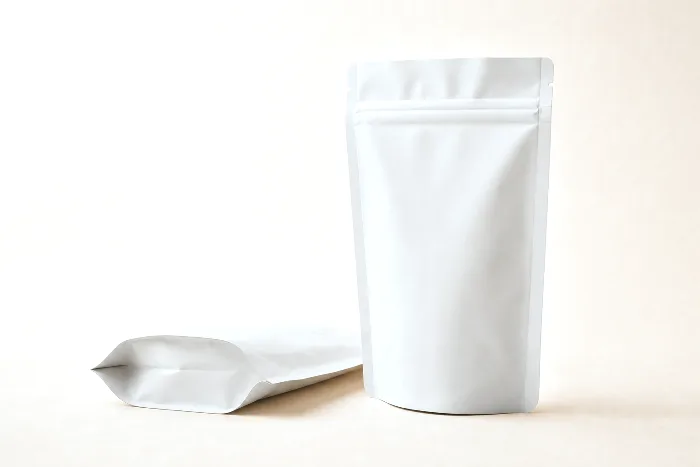
A stand-up pouch is a flexible package made from two printed film panels sealed around a folded-in bottom gusset, so it stands on its own once filled. The specification that defines one comes down to four choices:
- Dimensions — width, height, and gusset depth, which together set the fill volume
- Structure — the laminated film plies (e.g. PET/PE) and any barrier layer
- Closure — how it reopens and reseals: press-to-close zipper, slider, child-resistant, or tin-tie
- Finish — matte or gloss lamination, windows, and embellishments
What a stand-up pouch is
A stand-up pouch (SUP) is a flexible package built from a front and back face panel sealed together down both sides and across a folded-in panel at the base. When empty it lies flat; when filled, that base panel — the gusset — opens into an elliptical footprint that lets the pouch stand upright on a shelf. Because it ships and stores flat, a pouch uses a fraction of the material and freight of a rigid jar or can, which is a big part of why the format has spread across food and consumer goods.
The dominant style is the Doyen pouch — a rounded bottom gusset named after the format's originator. Variants exist: the flat-bottom (box) pouch with a five-panel, quad-seal construction; side-gusset bags; and spouted pouches for liquids. But the Doyen stand-up is the workhorse of retail, and it's the focus here.
The anatomy of a stand-up pouch
Every stand-up pouch is built from the same handful of features. Knowing their names makes speccing a pouch — and reading a supplier's drawing — far easier.
- Front and back panels — the two printable faces. The front usually carries the primary brand and product identity; the back holds legal copy, ingredients, and the barcode.
- Bottom (Doyen) gusset — the folded panel at the base that unfolds when the pouch is filled, forming the standing footprint.
- Side seals — the vertical welds down each edge that join front to back. Their width is part of the spec because it eats into the printable panel.
- Bottom seal — the curved weld that shapes the gusset and holds the base closed.
- Top seal — applied on the fill line after the pouch is filled. On a reclosable pouch it sits above the zipper.
- Tear notch — a small V-cut or laser score near the top for a clean, tool-free first open.
- Hang hole — a die-cut round hole or euro-slot ("sombrero") so the pouch can hang on a peg in retail.
- Zipper / reclose — an extruded plastic track welded across the inside near the top so the pack reseals after opening.
- Header — the strip above the zipper that's torn off on first open; it often carries the hang hole and keeps the pack tamper-evident until opened.
Common stand-up pouch sizes
Pouches are specified as width × height × bottom-gusset depth, usually in inches or millimetres. There's no fixed catalogue — a converter makes the pouch to fit your product. And because fill weight depends entirely on product density (whole-bean coffee, dense gummies, and airy granola fill the same pouch to very different weights), treat the figures below as typical ranges, not guarantees. Always confirm capacity with a real fill test.
| Application | Typical size (W × H) | Typical fill |
|---|---|---|
| Sample / single-serve | ~3–4 in × 5–6 in | Up to about 1 oz |
| Small retail / eighth | ~4 in × 6 in | A few grams up to ~2 oz |
| Quarter-pound (4 oz) | ~5 in × 8 in | ~4 oz of dry goods |
| Half-pound (8 oz) | ~6 in × 9 in | ~8 oz |
| Coffee (12 oz) | ~6.5 in × 10.5 in | ~12 oz whole bean |
| One-pound (16 oz) | ~7 in × 11.5 in | ~16 oz |
| Bulk | ~8–10 in × 12–16 in | ~2–5 lb |
Bottom-gusset depth typically runs about 3–4 in and grows with the pouch; a taller pouch needs a deeper gusset to stand without tipping. These figures are nominal starting points — a converter will fine-tune width, height, gusset, and seal allowance to your exact product and filling equipment.
Material structures
A pouch is almost never a single film. It's a laminate — two or more plies bonded together, each doing a job. The outer ply carries the print and gives the pouch stiffness; an optional middle ply adds barrier; and the inner ply is a heat-seal layer that welds the pouch shut. Which combination you choose is driven by how much the product needs protecting from light, oxygen, and moisture. The most common structures:
| Structure | Barrier | Best for | Recyclability |
|---|---|---|---|
| PET / PE (clear) | Moderate — moisture, some oxygen | Clear or windowed retail, dry goods | Low — multi-material laminate |
| Metallized PET / PE | High — light, oxygen, moisture | Coffee, snacks, light-sensitive goods | Low — multi-material |
| Foil (PET / alu / PE) | Highest — full light, gas, aroma | Long shelf life, aroma-critical, some pharma | Low — multi-material |
| Kraft / PE (± met-PET) | Low–moderate — paper outer, film liner | Natural and artisan branding | Low — mixed paper + film |
| Mono-material PE | Moderate–high with barrier coatings / MDO-PE | Recycle-forward brands, dry goods | Store drop-off (film stream) |
| Compostable (paper / PLA / cellulose) | Low–moderate | Certified-compostable programs | Industrial compost (certified only) |
Two honest caveats. First, higher barrier usually means more plies and less recyclability — there's a genuine trade-off between shelf life and end-of-life, and no structure wins on both. Second, "recyclable" rarely means curbside: flexible film is almost never accepted in household recycling, so even a well-designed mono-material pouch typically depends on store drop-off programs where they exist. The practical approach is to match the structure to the product's real shelf-life and light/oxygen sensitivity, then pick the most recyclable option that still protects it.
Closures
The closure is how the pack reopens and reseals after the top is cut or torn. The common options, roughly from simplest to most specialised:
- Press-to-close (PTC) zipper — the standard reclosable track; press the two profiles together to seal. Inexpensive, reliable, and by far the most common.
- Slider zipper — a plastic slider rides the track for easy one-handed open and close. Friendlier for some users, but bulkier and more expensive than a PTC zipper.
- Child-resistant (CR) zipper — a press-and-slide or align-and-pull mechanism certified to the US 16 CFR 1700.20 protocol. Required for cannabis and many household and pharmaceutical products — see our guide to child-resistant packaging requirements.
- Tin-tie — a folding paper strip with an embedded wire, common on coffee. It folds the top over and holds it shut, but isn't airtight, so it's often paired with a one-way valve.
- No reclose — a plain top seal opened at a tear notch, for single-use or single-serve packs where resealing doesn't matter.
For coffee specifically, a one-way degassing valve is often added so fresh-roasted beans can vent CO₂ without letting oxygen back in. The valve is a barrier feature, independent of whatever closure you choose.
Finishes and embellishments
The film's surface finish and decoration are the last layer of the spec, and they set the shelf feel of the pack:
- Lamination finish — gloss, matte, or soft-touch, set by the outer film or an over-laminate.
- Registered matte / gloss — spot matte over a gloss field (or the reverse) to make a logo or panel pop without foil.
- Metallic and holographic — metallized films, or cold and hot foil, for shine and highlights.
- Windows — an unprinted clear area on clear film, or a die-cut window with a clear patch, to show the product.
- Rounded corners and shaped dies — soften the silhouette or cut a custom outline.
Each of these interacts with the structure and the print method, so it's worth locking the finish before final artwork rather than bolting it on afterward.
Putting a spec together, in order
The five choices above aren't independent — they constrain each other, so the order you make them in matters. A reliable sequence:
- Start with the product and its shelf life. What are you protecting it from — light, oxygen, moisture, aroma loss — and for how long? This sets your barrier requirement before anything else.
- Choose the structure that meets that barrier at the lowest environmental cost you can accept. This is where the shelf-life-versus-recyclability trade-off gets settled, not later.
- Size the pouch to the fill. Set width, height, and gusset depth from a real fill test at your target weight, leaving headroom for the seal and the zipper.
- Pick the closure. Reclosable or single-use; press-to-close, slider, or — where regulation requires it — child-resistant. Add a valve if the product needs to de-gas.
- Add the finish and features. Lamination finish, windows, hang hole, tear notch, and any embellishments, chosen with the print method in mind.
- Lock the dieline and proof it. Build artwork on the finished dieline, respecting the seal and safety zones, and review a 3D proof before tooling.
Work the list top-down and each decision narrows the next, instead of forcing an expensive rethink when a late choice collides with an early one.
How PackOS builds a pouch spec
PackOS treats the pouch the way it treats every package — as a parametric model. Give it the dimensions (width, height, and gusset) or an existing artwork file, and it lays out the dieline: the two face panels, the Doyen gusset, the side and bottom seals, the tear notch, the hang hole, and the zipper line — all driven by the numbers, so changing the width reflows every seal and seam automatically. From that model it renders a photoreal 3D proof of the filled, standing pouch and calculates the material area, structure, and production route behind an instant quote. You can watch the reconstruction run on the technology page, or try it on a real file with Quick Quote.
Frequently asked questions
What is a stand-up pouch?
A stand-up pouch is a flexible package made from two printed film panels sealed around a folded-in bottom gusset. When filled, the gusset opens into a base so the pouch stands upright on a shelf. It ships and stores flat, using far less material and freight than a rigid jar or can, which is why it's popular for coffee, snacks, supplements, and cannabis.
What sizes do stand-up pouches come in?
There's no fixed catalogue — pouches are specified by width × height × gusset depth and made to fit the product. Typical retail sizes run from small single-serve pouches around 3–4 in wide up to bulk pouches 8–10 in wide holding several pounds, with common capacities at 4, 8, 12, and 16 ounces. Because fill weight depends on product density, treat any size-to-weight figure as a typical range and confirm it with a fill test.
What material should a stand-up pouch be?
It depends on what the pouch has to protect. Clear PET/PE suits dry goods that need to be seen; metallized or foil laminates add light, oxygen, and moisture barrier for coffee and light-sensitive products; kraft gives a natural look; and mono-material PE or PP is designed for recyclability. Higher barrier generally means less recyclability, so match the structure to the product's shelf-life needs, then pick the most recyclable option that still protects it.
What is a Doyen gusset?
A Doyen gusset is the rounded bottom gusset of the classic stand-up pouch — a folded-in panel of film across the base that expands when the pouch is filled so it can stand on its own. It's named after the format's originator and is the most common stand-up style, distinct from flat-bottom (box) and side-gusset pouches.
Can stand-up pouches be recyclable?
Some can. Mono-material PE or PP pouches are designed to be recycled in flexible-film streams, and certified-compostable structures exist. But most barrier pouches are multi-material laminates that aren't recyclable, and flexible film is rarely accepted curbside — even recyclable pouches usually rely on store drop-off programs. If recyclability matters, specify a mono-material structure and check what your local programs accept.