
Fin seal vs lap seal: the difference, actually drawn
Two flexible packages can look almost identical from the front and be built completely differently at the back seam. That back seam — how the film is joined into a tube — is the whole story behind fin seals and lap seals, and it quietly decides your film, your machine, and your look.
THE SHORT ANSWER
Fin seal vs lap seal: a fin seal joins film inside-to-inside and stands up like a fin; a lap seal overlaps inside-to-outside and lies flat. A fin seal needs a sealant layer only on the inside of the film. A lap seal needs a film that can seal on both faces (or a cold-seal adhesive), because it bonds an inside surface to an outside surface. Neither wins universally — the right seal follows your film structure, your machine, and the look you want.
- Fin seal — inside-to-inside weld; the seam stands up as a fin; sealant on the inside face only; the classic pillow-bag and flow-wrap seam
- Lap seal — inside-to-outside overlap; the seam lies flat; needs a both-sides-sealable film or cold seal; flatter back and near-continuous print
- Film width — a fin costs two extra plies for the standing seam; a lap costs only the overlap, so a fin seal uses more film for the same bag
- No universal winner — decide on film structure, machine, appearance, and leak tolerance, not on which sounds better
What a fin seal and a lap seal are
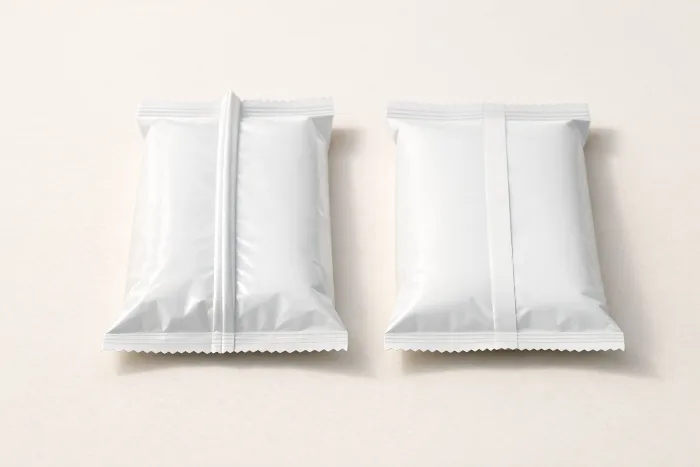
Almost every flow-wrapped bar, chip bag, and pillow pouch is a flat web of film wrapped into a tube and joined down the back. The only real question is how those two edges meet — and there are exactly two answers. That is the entire fin seal vs lap seal decision, and the cross-section diagram on this page shows it better than any paragraph can.
A fin seal brings the two edges of the film together with their inside (sealant) faces pressed against each other, then heat-seals them. Because the two edges are welded face-to-face, the sealed strip cannot lie down — it sticks out from the pack like a small fin, which is where the name comes from. You will also hear a fin seal called an edge weld seal, and the finished bag it makes is the classic pillow pouch seal. The fin is usually left standing, folded flat against the back, or crimped down.
A lap seal does the opposite: the two edges overlap, so the inside surface of one edge lands on the outside surface of the other. Sealed that way, the seam has nothing sticking up — it lies flat against the pack, like the lap of a shingle on a roof. That flat back is the reason people reach for a lap seal when they want a clean, continuous look. Understanding this seam is part of our complete guide to packaging design, because it is one of the first structural choices a flexible package forces on you.
Fin seal vs lap seal, side by side
Neither seal is "better." They trade off against each other, and the honest comparison is the one that names where each genuinely wins. A quick note on where we stand: PackOS quotes flexible packaging in both seal styles and sells neither one to you, so this is a straight trade-off, not a pitch for a seam.
| Aspect | Fin seal | Lap seal |
|---|---|---|
| How it joins | Inside-to-inside (sealant faces welded together) | Inside-to-outside (one edge overlaps the other) |
| Film requirement | Sealant layer on the inside face only | Sealable on both faces, or a cold-seal adhesive |
| Film use | More — the standing fin is two extra plies | Less — only the width of the overlap |
| Appearance | Raised fin on the back; can be folded or crimped down | Flat back; allows near-continuous print across the seam |
| Seal integrity | Robust: like material welded to like material | Depends on the outer surface sealing well; the overlap edge is a watch-point |
| Typically used on | Pillow bags and flow-wrap | Stick packs and overwraps |
The short version: a fin seal is the safe, forgiving default because it welds like film to like film; a lap seal buys you a flatter pack and a cleaner print field, but only if the film cooperates. If you are still deciding on the overall format before you get to the seam, our overview of flexible packaging types is the place to start.
Which films need which seal
The seal you can use is dictated by your film — specifically by which faces of the film can be heat-sealed. Most flexible packaging is a laminate: a printable, protective outer layer bonded to a heat-sealable inner layer. The inner (sealant) layer is what melts and fuses under the sealing jaws.
That structure maps cleanly onto the two seals:
- Fin seal — sealant on the inside only. Because a fin brings the two inside faces together, the film just needs its normal sealant layer facing in. That is how almost every standard laminate is already built, so a fin seal is the natural fit for a printed, barrier-laminated film.
- Lap seal — the outside has to seal too. A lap bonds an inside face to an outside face, so the outer surface must also be sealable. That means either a mono-material film such as polyethylene that welds to itself on any face, a laminate with a sealable outer coating, or a cold-seal adhesive that bonds by pressure instead of heat.
This is why lap seals pair naturally with recyclable mono-material films (they seal to themselves anywhere) and why a conventional print/barrier laminate usually defaults to a fin. If your structure isn't nailed down yet, the seam choice and the film choice should be made together — the same way you would size a stand-up pouch spec alongside its material.
How the seal changes your film width
Here is the practical consequence most people miss: the seal you choose changes how much film each bag consumes, because the flat web has to be wide enough to both wrap around the pack and form the seam. It is worth walking the geometry, because it is real, not a marketing claim.
Take a pillow bag whose flat face measures a width W across the front (so the tube's circumference is about 2W — front face plus back face). Call the fin height h and the lap overlap o. The flat web width you need works out to:
- Fin seal ≈ 2W + 2h. You need 2W to wrap around, plus the fin — and the fin is two plies of film, each of height h, standing up together. So the seam alone adds 2h of film.
- Lap seal ≈ 2W + o. You need 2W to wrap around, plus a single overlap of width o so the edges can lap over each other. The seam adds only o.
To make it concrete with illustrative numbers — these are examples, not fixed values, so use your own film's real fin height and overlap — say W = 100 mm, a fin height h = 8 mm, and a lap overlap o = 5 mm. The fin bag needs about 216 mm of web (200 + 16); the lap bag needs about 205 mm (200 + 5). Same finished face, but the fin seal spends roughly a centimetre more film per bag. Multiply that across a long run and the standing fin is a genuine, if modest, material line item — which is exactly the kind of trade-off that also shapes how a design is printed and stepped across the web in our guide to packaging print methods.
Where each seal shows up
Both seals are made on form-fill-seal machines — VFFS (vertical form-fill-seal, which drops product into a tube and seals it, the workhorse for pillow bags) and HFFS (horizontal form-fill-seal, the flow wrapper that wraps a moving product on its way through). What each machine and film combination tends to produce lines up like this:
- Fin seals dominate flow-wrapped products and vertical pillow bags — snack bars, chips, and most printed, barrier-laminated pouches — because the film folds so its inside faces meet and weld cleanly.
- Lap seals show up on stick packs, some sachets, and overwraps, where a flat back or a print that runs almost unbroken around the pack is worth the extra demand on the film.
The seam also interacts with the rest of the structure. A flat pillow bag has one back seam; add a bottom fold so the bag can stand and you introduce corner seals where the seam meets the gusset — a classic weak point worth understanding before you commit, which is exactly what what a gusset is on a pouch gets into. Whatever the format, the fin seal vs lap seal choice rides along with it, so it is best decided early rather than discovered at the sealing jaws.
How PackOS handles flexible seals
PackOS models a flexible package the way it is actually made — as film with a defined laminate structure, a seam style, and real dimensions — so the seal type isn't an afterthought bolted onto a picture. When it reads a pouch or bag, it accounts for the seam in the film area and the material math, which is what lets it turn a spec or a piece of artwork into an accurate, editable dieline and an instant quote. You can see how that detection and structure work is built on the design technology page.
The fastest way to settle a fin seal vs lap seal question for your own product is to put the real film and format through it. Start a Quick Quote with your artwork or spec and see the structure, the material, and the price come back together in about a minute.
Frequently asked questions
What is a fin seal?
A fin seal is made by bringing the two edges of a film together with their inside (sealant) surfaces facing each other and heat-sealing them, which leaves a small sealed flap that stands up like a fin. Because the seal is inside-to-inside, the film only needs a sealant layer on its inside face. It is the classic seam on pillow bags and flow-wrapped products.
What is the difference between a fin seal and a lap seal?
A fin seal joins the film inside-to-inside, so the sealed seam stands up like a fin. A lap seal overlaps the two edges so the inside of one meets the outside of the other, and the seam lies flat against the pack. A fin seal needs a sealant layer only on the inside of the film; a lap seal needs a film that can seal on both faces or a cold-seal adhesive, because it bonds an inside surface to an outside surface.
Does a fin seal or a lap seal use more film?
A fin seal uses more film. The standing fin is two extra plies of material, so for the same bag the flat film width is roughly the face circumference plus twice the fin height. A lap seal only adds the width of the overlap, so it uses less film for an equivalent bag. The exact difference depends on your fin height and overlap width.
Which films can be lap sealed?
Lap sealing needs the seam to bond the inside surface of one edge to the outside surface of the other, so the film has to be sealable on both faces or use a cold-seal adhesive. Mono-material films such as polyethylene that weld to themselves on any face lap seal well, as do films with a sealable outer coating. A standard laminate with a sealant layer only on the inside is better suited to a fin seal.
Are fin seals or lap seals used on flow wrappers?
Both can be, but fin seals are the norm on horizontal flow wrappers and on vertical form-fill-seal pillow bags, because the film is folded so its inside faces meet and weld. Lap seals appear where a flatter back or near-continuous print across the seam is wanted and the film can seal on both faces. The machine and the film together decide which seal is practical.