
How to measure a box: length × width × height, done right
Sooner or later every packaging job comes down to three numbers. Get their order wrong, or measure the wrong face of the box, and something that seemed to fit ends up rotated, oversized, or quietly inflating your shipping bill. Here is how to measure a box the way carriers, converters, and pallets expect.
THE SHORT ANSWER
How to measure a box: read length × width × height — the longest opening side is length, the shorter is width, the depth is height. Then decide whether you need inside dimensions (what fits) or outside dimensions (what ships), because the two answer different questions and only the outside set drives dimensional weight.
- Length — the longer side of the box's opening
- Width — the shorter side of the opening
- Height — the distance from the opening down to the base
- Inside vs outside — measure inside for product fit, outside for shipping, pallets, and DIM weight
Try the dimensional weight calculator →
The L×W×H convention: which side is which
There is a near-universal convention for how to measure a box: length × width × height, in that order. It sounds trivial, but the L × W × H order is exactly what trips people up, because "length" does not simply mean "the longest edge of the whole box." The convention is defined relative to the opening.
Set the box down the way it opens — flaps or lid facing up — and look at the rectangle of that opening. The two sides of the opening are length and width: length is the longer of the two, width is the shorter. Height is the third dimension, measured straight down from the opening to the base. That single rule holds for a shoe box, a corrugated shipper, and a folding carton alike, and it is the whole of the box dimensions length width height convention.
| Dimension | Which face | How to identify it |
|---|---|---|
| Length (L) | The opening | The longer of the two sides of the opening — the first number. |
| Width (W) | The opening | The shorter of the two sides of the opening — the second number. |
| Height (H) | The depth | The distance from the opening down to the base — the third number. |
Order matters because everyone downstream reads the numbers positionally. A carton quoted 12 × 9 × 6 is a different shape, print orientation, and pallet pattern than one quoted 9 × 12 × 6, even though the digits match. Carriers, case-packers, and your converter all assume length × width × height, so writing them in a different order is the most common reason a box arrives rotated or the wrong shape.
Internal vs external box dimensions
The second half of learning how to measure box dimensions is knowing which surface to measure. Every box has two dimension sets — internal (inside) and external (outside) — and confusing them is how a product that "should fit" doesn't, or how a shipping quote comes back higher than expected. The difference between internal vs external box dimensions is simply the thickness of the wall material, measured on every side.
- Internal (inside) dimensions — the usable space your product actually sits in.
- External (outside) dimensions — the footprint the box occupies in a case, on a pallet, and on a carrier's dimensioning scanner.
Use this to decide which set you need:
| What you're sizing | Inside or outside? | Why |
|---|---|---|
| Will the product fit? | Inside | The wall thickness eats into usable space; only the interior clears the product and void fill. |
| A box nested inside another box | Outside of the inner / inside of the outer | The inner box's outside must clear the outer box's inside. |
| Case pack & pallet fit | Outside | Cases and pallets stack on the outer footprint, board and all. |
| Shipping & dimensional weight | Outside | Carriers bill on the external cube of the parcel, not the space inside. |
How big is the gap? It equals the wall material on both sides. For a thin folding carton it is small — often well under a millimetre of board per wall. For single-wall corrugated it is a few millimetres per wall, and for double-wall corrugated it is larger still. Those are typical, approximate ranges; the exact caliper depends on the board grade and flute, which is one reason corrugated box strength and wall construction are worth understanding before you finalize a size.
How to measure a box, step by step
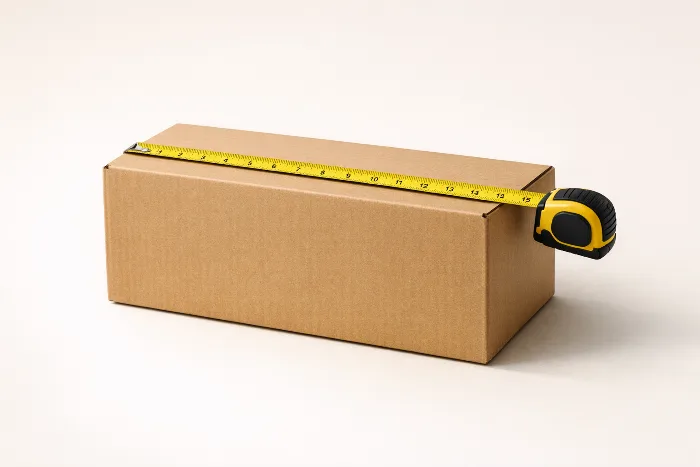
Here is how to measure a box from scratch, whether it is flat, freshly assembled, or already holding product. Work in one consistent unit — inches or millimetres — and keep the tape flat against each face:
- Orient the opening up. Set the box so the lid or flaps face up. The rectangle you see is the reference for length and width.
- Measure the length. Measure the longer side of the opening, wall to wall. This is your length — the first number.
- Measure the width. Measure the shorter side of the opening. This is your width — the second number.
- Measure the height (depth). Measure straight down from the opening to the base. This is your height — the third number.
- Choose inside or outside. For what fits, take these measurements on the inside faces; for shipping and DIM weight, take them on the outside faces. Write down which set you recorded so no one downstream guesses.
- Convert to dimensional weight if shipping. Multiply the outside length × width × height and divide by your carrier's dimensional divisor to see whether dimensional weight or actual weight will bill.
A practical habit: when your measurement lands between two stock sizes, round up to the next practical size rather than forcing a tight fit — a box a hair too small won't close, and one built exactly to the product leaves no room for a liner or void fill.
How dimensional weight uses your outside dimensions
This is the step most "how to measure a box" guides skip, and it is the one that quietly costs money. Parcel carriers don't only bill on how much your package weighs — they also bill on how much space it takes up, using a figure called dimensional weight (or DIM weight). It is calculated straight from your outside dimensions.
The mechanic is simple: multiply the external length × width × height, then divide by a dimensional divisor the carrier publishes. You are charged on the greater of that dimensional weight and the parcel's actual scale weight. UPS and FedEx both publish a current divisor for their services (a value commonly cited for many U.S. domestic services is 139, with other services and international shipments using different figures) — because carriers change these, confirm the current divisor and rules with your carrier rather than trusting a number you read once. The takeaway is directional and reliable: a box that is bigger than it needs to be pays to ship air.
That is why the inside-vs-outside distinction is not academic. Right-sizing the outside — trimming an oversized box down toward the product — is one of the most direct ways to lower parcel cost. Run your real numbers through the dimensional weight calculator, and read dimensional weight explained for the full picture of how the billing works. The same outside dimensions also drive how boxes stack: how many fit in a case, how those cases go onto a pallet, and the Ti-Hi, box strength, and freight-class math for LTL and truckload freight.
Measuring irregular, assembled, and mailer boxes
Not every box is a clean, empty rectangle waiting to be measured. A few common cases:
- An already-assembled box. Measure across the outside faces: the longer side of the top opening is length, the shorter side is width, and the vertical distance top to bottom is height. For inside dimensions, measure the usable interior from one wall to the opposite wall — it will be slightly smaller than the outside by the board thickness.
- A flat, knocked-down box. Measure a made-up sample if you can, because a flattened blank's panel layout doesn't read as L × W × H directly. If you only have the blank, identify the body panels and the depth panel and reconstruct the three dimensions from them.
- Mailers and poly mailers. Quote the usable inside dimension — measure to the inside of the seal or lip, not the outer edge, since the sealed margin isn't usable space. If you're weighing a mailer against a box, our poly mailer vs box comparison walks the trade-offs.
- Bulging or irregular loads. Measure to the widest point in each direction, because that is what a carrier's dimensioner captures. A box that bows once packed is measured at its bow, not its flat panel.
Whatever the shape, the goal is a set of three honest, repeatable numbers. When a measurement lands awkwardly between sizes, it helps to start from a standard box sizes chart rather than an arbitrary figure — measuring a box is far easier when you know the common sizes your product is likely to land on. For the wider view of choosing dimensions across formats, see our packaging sizes guide.
How PackOS measures a box for you
Measuring by hand is fine for one box. Across a catalog, the errors compound — a transposed length and width here, an inside number used where an outside number was needed there — and they surface as mis-quotes, re-orders, and pallets that don't cube out. PackOS models each package parametrically: it reads the real structure and its true length × width × height, keeps inside and outside dimensions as distinct, linked values, and reflows the whole model when one number changes. Because it already knows the outside dimensions, it can show where a box crosses onto dimensional weight and how units nest into a case and onto a pallet — the same packout and logistics math that governs the rest of your freight. You can follow how that modeling works on the technology page, or put a real SKU through Quick Quote to see the box measured, sized, and priced in about a minute. This how-to-measure-a-box discipline is one chapter of our broader packaging logistics guide.
Frequently asked questions
Which dimension is length, width, or height on a box?
With the box's opening facing up, length is the longer side of the opening, width is the shorter side of the opening, and height is the distance from the opening down to the base. Boxes are almost always written as length by width by height in that order, so keeping that convention avoids a rotated or mis-sized box.
Should I measure the inside or the outside of a box?
It depends on what you need. Measure inside (internal) dimensions when you care about what fits — the product, void fill, or a smaller box nested inside. Measure outside (external) dimensions for shipping, dimensional weight, and pallet or case fit. The gap between the two is the wall thickness, which is small for a folding carton and larger for double-wall corrugated.
What order do box dimensions go in — L x W x H?
The standard order is length by width by height (L x W x H). Length and width describe the opening — length is the longer side, width the shorter — and height is measured perpendicular to them, from the opening to the base. Writing the numbers in a different order is a common cause of a box that arrives rotated or the wrong shape.
How do I measure a box for dimensional weight?
Use the outside dimensions. Multiply the external length by width by height, then divide by your carrier's dimensional divisor to get the dimensional weight; you are billed on the greater of that and the actual weight. Carriers publish the current divisor, so confirm it with UPS, FedEx, or your carrier before you rely on a number.
How do I measure a box that is already assembled?
Measure an assembled box across its outside faces with a tape or ruler: the longer side of the top opening is length, the shorter side is width, and the vertical distance from top to bottom is height. For inside dimensions, measure the usable interior from one wall to the opposite wall, which is slightly smaller than the outside by the board thickness.