
Poly mailer vs box: cost, protection, and when to use each
A poly mailer or a corrugated box is the first packaging decision most ecommerce brands make — and the one they revisit most often. Both can be the right call. The trick is knowing which factor in your shipment actually settles it.
THE SHORT ANSWER
There is no universal winner — the deciding factor is the product itself. Reach for a poly mailer when the product is non-fragile, soft, or flat, and cutting weight, cube, and material cost matters. Reach for a box when the product is fragile, rigid, heavy, high-value, or when the unboxing moment is part of the brand. Everything else is secondary to that one call.
- Poly mailer wins for apparel, textiles, and other soft or flat goods that shrug off handling
- Box wins for anything breakable, rigid, or awkwardly shaped that needs a defined cavity and stacking strength
- Dimensional weight often favors mailers for soft goods — but a rigid item in a mailer can bill like a box
- Unboxing and sustainability cut both ways; neither format is automatically greener or more premium
What a poly mailer and a box each are
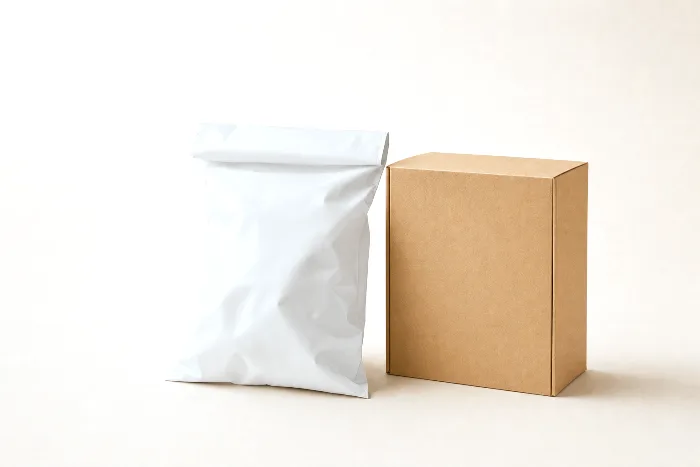
A poly mailer is a flexible plastic envelope — usually a co-extruded polyethylene film — with a self-seal adhesive strip. It has no rigid structure: it takes the shape of whatever you put inside it, ships flat, and stores flat. That is its whole personality. Because it has almost no packaging weight of its own and collapses around soft contents, it is the lightest, most space-efficient way to move a durable product from A to B.
A box — for parcel shipping, almost always a corrugated fibreboard carton — is the opposite trade. It adds weight and cube, but in return it gives the product a rigid shell: it resists crushing, holds a defined internal cavity for cushioning, stacks on a pallet, and presents a clean surface for a branded unboxing. A box is a structure; a mailer is a skin.
That single structural difference drives every downstream decision — protection, dimensional weight, presentation, and recyclability all flow from whether the package has a skeleton or not. This article is part of our guide to choosing the right packaging, and the mailer-versus-box call is one of the clearest examples of why there is rarely a single "best" answer.
The factors that actually decide it
Ignore the "which is cheaper" framing for a moment — it is the wrong first question, because the answer changes with your product and your carrier rates. The decision really comes down to five factors, roughly in priority order:
- Fragility. Can the product survive being tossed, stacked, and dropped with only its own durability plus a thin film around it? If yes, a mailer is on the table. If it can crack, dent, scratch, or crush, a box is doing real work.
- Shape and rigidity. Soft, flat, and conformable goods love a mailer. Rigid, boxy, or awkward shapes fight the film, concentrate stress at corners, and usually want a defined cavity.
- Dimensional weight. A mailer compresses soft contents into a smaller billable cube; a box holds a fixed cube whether it is full or not. For light-but-bulky goods, this is often where the cost difference actually lives.
- Unboxing and presentation. A box is a brand surface and a first impression. A mailer is functional and low-ceremony. If the open-the-package moment is part of the product experience, that weighs toward a box (or a premium mailer).
- Sustainability goals. Less material versus easier recycling is a genuine tension, not a slam dunk in either direction — more on that below.
Notice that four of those five are properties of the product, not the package. That is why the deciding factor lives with what you are shipping, not with a spreadsheet of package prices.
Poly mailer vs box: when each wins
Here is the honest, both-sides version. Each row names where that format genuinely wins — because for most brands the real answer is "mailers for some SKUs, boxes for others," not one format for everything.
| Factor | Poly mailer | Box (corrugated) |
|---|---|---|
| Product fragility | Best for durable, non-fragile goods that need little protection | Best for fragile, breakable, or dentable items that need a shell |
| Shape & rigidity | Wins for soft, flat, conformable products (apparel, textiles) | Wins for rigid, boxy, or awkward shapes needing a cavity |
| Dimensional weight | Often lower — collapses to a smaller billable cube for soft goods | Fixed cube, but predictable and protective of that space |
| Protection | Minimal on its own; leans on product durability or added cushioning | Structural — resists crushing, stacking, and compression |
| Unboxing / presentation | Functional and low-ceremony (premium mailers help) | A branded first impression; better for gifting and premium tiers |
| Storage & footprint | Ships and stores flat; tiny warehouse footprint | Bulkier to store, even knocked-down flat |
| Recyclability | Film — store drop-off, not curbside in most areas | Widely curbside-recyclable; commonly high recycled content |
| Material cost | Lower material use per unit for light goods | More material, but reusable protective value |
One thing worth saying plainly: PackOS quotes both poly mailers and corrugated boxes, and Calyx Containers manufactures rigid containers. We do not have a house bet riding on which one you pick — so treat this as an honest trade-off, not a sales pitch. The right choice is whichever your product actually needs, and for a lot of catalogs that means running both formats side by side.
The dimensional-weight angle
The most common reason people believe mailers are "cheaper to ship" is dimensional weight. Carriers bill the greater of actual weight and dimensional weight, and dimensional weight is derived from the package's cube. A soft product in a mailer collapses to a smaller billable cube than the same product rattling around in a box, so for light, squishy goods the mailer frequently bills lighter. That is a real mechanism, not marketing.
But it is a mechanism, not a guarantee — and this is exactly where invented savings numbers mislead people. A rigid product does not compress, so putting it in a mailer may bill nearly the same billable weight as a right-sized box while giving up all the protection. A tall, bulky-but-light item can trip dimensional weight in either format. The only way to know your number is to measure your actual product in each package and run it against your carrier's divisor.
So do that instead of trusting a blog's percentage: model your specific dimensions and weight with our dimensional weight calculator, and if the concept itself is fuzzy, our explainer on how dimensional weight works walks through the volumetric-divisor math. Two SKUs from the same catalog can land on opposite sides of this decision, which is why a general rule of thumb is worth less than your own numbers.
Protecting a product in a mailer
Choosing a mailer does not have to mean choosing no protection — it means moving the protection inside the mailer or into the product itself. Bubble-lined mailers, poly-bubble constructions, garment bags for fold-and-stack apparel, and internal wraps can all bridge part of the gap for semi-durable goods. What a mailer cannot easily replicate is a box's resistance to compression — the stacking load a package takes at the bottom of a pallet or a delivery van.
If your product is on the borderline — durable enough to consider a mailer, but not indestructible — think in terms of the three hazards every parcel faces: drop shock, vibration, and compression. Mailers handle drop and vibration acceptably for the right contents but offer little against compression. Our protective packaging guide covers void fill, cushioning, and edge protection so you can decide whether a lined mailer is enough or whether the product has crossed into box-and-cushion territory. For the broader ecommerce picture — right-sizing, damage rates, and channel fit — see our ecommerce packaging guide.
A quick gut check for the borderline case:
- Could this survive a shoulder-height drop onto a hard floor with only a film and its own build? If no, lean box.
- Will it be stacked under other parcels in transit and it cannot take that load? If yes, lean box.
- Is the item flat, soft, or already durable, and is shipping cost or storage footprint a real pressure? If yes, lean mailer.
- Is the open-the-package moment part of what the customer is paying for? If yes, lean box (or a premium mailer).
Sustainability: honestly, it depends
This is where confident, one-line answers usually fall apart. A poly mailer uses far less material by weight and ships lighter, which reduces transport emissions — a genuine advantage. But most poly mailers are polyethylene film that is not accepted in curbside recycling; it belongs in store drop-off streams, and real-world capture rates for film are low. A corrugated box uses more material, but it is one of the most widely recycled packaging materials, commonly carries recycled content, and is accepted almost everywhere curbside.
So "which is greener" depends on which impact you are optimizing — material and transport footprint, or end-of-life recyclability — and on what your customers can actually recycle where they live. Recycled-content films, paper-based mailers, and mono-material designs are all narrowing the gap, and both formats have honest sustainability stories. The defensible position is to state the trade-off plainly rather than crown a winner, and to match the format to a recovery pathway your customers can realistically use.
How PackOS helps you decide
PackOS is built to make this an evidence-based call rather than a guess. When you upload artwork, a spec, or an existing package, it detects the structure and dimensions, reconstructs the format, and prices it — so you can compare a mailer build against a right-sized box for the same product on the same basis, without a made-up break-even. You can see how the platform reasons about parcels, dimensional weight, and packaging economics on the logistics technology page, and you can push a real product through it with Quick Quote. The point is not to sell you one format — it is to hand you your own numbers for both.
Frequently asked questions
Is a poly mailer cheaper than a box?
Often, but not always, and never by a fixed amount. Poly mailers use less material and add almost no packaging weight, and they collapse soft goods into a smaller billable cube, which tends to lower dimensional weight. But a rigid product does not compress, so it can bill much the same in a mailer as in a right-sized box while losing protection. The honest answer is to measure your actual product in each format and run your own numbers rather than trust a percentage.
Can fragile items ship in a poly mailer?
Sometimes, with help. A bubble-lined or padded mailer plus internal cushioning can protect semi-durable items against drop and vibration. What a mailer cannot easily replicate is a box's resistance to compression — the stacking load at the bottom of a pallet or van. For anything genuinely breakable, rigid, or high-value, a box with cushioning is the safer choice.
Do poly mailers reduce shipping cost through dimensional weight?
They can. Carriers bill the greater of actual weight and dimensional weight, and dimensional weight is derived from the package's cube. A soft product in a mailer collapses to a smaller cube than it would occupy in a box, so it often bills lighter. A rigid or bulky-but-light product may trip dimensional weight in either format, so the effect depends entirely on your specific dimensions and carrier divisor.
Are poly mailers recyclable?
Most standard poly mailers are polyethylene film, which is generally not accepted in curbside recycling and instead needs store drop-off film streams, where capture rates tend to be low. Corrugated boxes, by contrast, are widely accepted curbside and commonly carry recycled content. Recycled-content films, paper-based mailers, and mono-material designs are narrowing the gap, so recyclability is a real point in a box's favor but not the whole sustainability story.
When should I use a box instead of a mailer?
Choose a box when the product is fragile, rigid, heavy, or awkwardly shaped, when it needs a defined cavity for cushioning, when it will be stacked under compression, when it is high-value, or when the unboxing experience is part of the brand. Choose a mailer when the product is soft, flat, or durable and cutting weight, cube, and storage footprint matters more than presentation.