
Protective packaging: void fill, cushioning, and dunnage
The box gets the attention, but what protects your product is everything you put inside it. This is how to choose void fill, cushioning, and bracing that gets goods there intact — without paying for material you don't need.
THE SHORT ANSWER
Protective packaging is everything inside the shipper — void fill, cushioning, blocking and bracing, and edge protection — that gets your product to the customer intact. The job is to defend against three real transit hazards — drop shock, vibration, and compression — using the least material that reliably passes a test. Too much is waste and dimensional weight; too little is damage.
- Void fill — stops the product moving inside the box; not engineered to absorb a hit
- Cushioning — absorbs shock for fragile or valuable items during a drop
- Blocking & bracing — locks heavy or shifting items in place
- Edge & corner protection — spreads stacking load and guards against crush
What protective packaging actually does
Every shipment has two packaging jobs. The primary package — the bottle, jar, pouch, or carton — holds and presents the product. The transit package — the corrugated shipper and everything inside it — has one job: deliver that product to the customer without damage. Protective packaging is the "everything inside it" part: the material you add to a box to control movement and absorb energy. This guide is part of our guide to packaging logistics, and it's the step most brands under-think until the first wave of damage claims arrives.
It exists because shipping is violent in ways a warehouse shelf never is. A parcel is dropped, thrown onto a belt, stacked under a pallet, and shaken for hours in a trailer. Packaging engineers reduce all of that to three hazards worth designing against:
- Drop and impact shock — the sudden deceleration when a box is dropped or set down hard. This is what shatters, cracks, and dents fragile products.
- Vibration — continuous low-level shaking in transit that loosens closures, abrades surfaces, scuffs finishes, and fatigues seams and joints over hours on the road.
- Compression — the static and dynamic top-load from being stacked, which crushes an under-built box from the bottom of the stack upward.
Good protective packaging answers each of these with the least material that still passes. Over-pack and you pay for material you don't need, add dimensional weight that raises the shipping bill, and hand the customer more to throw away. Under-pack and you pay in breakage, returns, and reputation. The entire discipline is finding the middle — enough protection to survive the trip, and not a gram more.
The protective packaging toolkit
Protective materials fall into a handful of functional families. The catch-all word for any of them is dunnage — the loose or shaped material added inside a package to fill space, brace, and protect. Each family solves a different hazard, so the first move is knowing what each one is actually for.
| Type | Protects against | Best for |
|---|---|---|
| Void fill (air pillows, crumpled paper, loose fill) | Product movement, minor jostling | Sturdy, lower-value items in a box that has empty space |
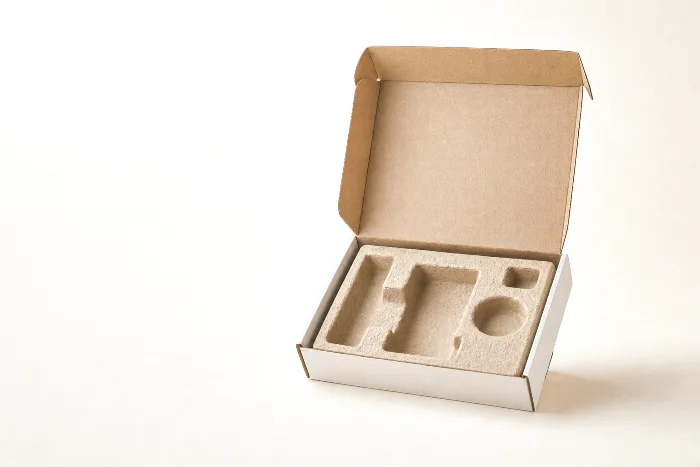
| Cushioning (foam, molded pulp, foam-in-place, inflatable) | Drop and impact shock | Fragile, heavy, or high-value products |
| Blocking & bracing (corrugated inserts, foam blocks) | Shifting of heavy or dense items | Heavy or oddly shaped goods that must not move |
| Edge & corner protection (angle board, corner pads) | Compression, edge crush | Palletized and stacked cartons |
| Suspension & retention (film membranes in a frame) | Shock and movement | Premium unboxing where the product "floats" in view |
Most shipments use two or three of these together — for example, a molded-pulp cushion cradling the product, blocking to keep a heavy base from sliding, and a little void fill on top to take up the last of the headspace. The art is in the combination, not in dumping one material into every gap.
Match the material to the hazard
The mistake most brands make is treating all filler as interchangeable. It isn't. Void fill does exactly one thing: it takes up empty space so the product can't move. It is not engineered to absorb a specific impact. If a durable product simply needs to stay centered and still, void fill — air pillows, crumpled kraft paper, or loose fill — is the right, lowest-cost, lowest-waste answer.
Cushioning is a different tool. It's designed to absorb and spread the energy of a drop so less of it reaches the product. Engineered foams (sheet, plank, or foam-in-place), molded pulp trays, and inflatable cushions have real, predictable shock-absorbing behavior. A fragile or heavy item needs cushioning under and around its vulnerable faces, not just fill in the gaps. Confusing the two — surrounding a fragile item in loose fill and calling it protected — is a leading cause of arrival damage.
Choosing between them comes down to a short set of questions you can answer before you order anything:
- How fragile is the product? The more fragile, the more you need true cushioning rather than fill, concentrated on the faces most likely to break.
- How heavy and dense is it? Heavy items build up more force in a drop and need blocking and bracing so they can't become a projectile inside the box.
- How much empty space is there? Large voids around a small product are the enemy — either right-size the box or fill the void so nothing accelerates before it hits a wall.
- What's the value and the unboxing? Higher value and a premium first impression justify suspension or retention packaging and a more conservative cushion.
- How is it shipped? Small-parcel gets dropped and thrown; palletized freight gets stacked and compressed. The hazard profile changes the answer — see poly mailer vs box for the small-parcel side of this call.
Right-size first: less box, less fill
The cheapest protective packaging is the box you didn't oversize. A product rattling around in a carton that's far too big needs a lot of fill to immobilize it, ships heavier under dimensional-weight rules, and is more likely to arrive damaged because the product has room to build up speed before it hits a wall. Right-sizing the shipper to the product removes the problem at the source: less void to fill, less material, lower freight, and a shorter drop distance inside the box.
Right-sizing also protects the box's own structural job — resisting the stack. A corrugated shipper only holds its rated strength if it isn't overstuffed, isn't crushed at the edges, and isn't left with unsupported spans that buckle under load. If your boxes are arriving caved-in, the cause is often board grade or stacking rather than the fill inside — walk through why boxes crush in shipping and the fundamentals in corrugated box strength before you add more cushioning to a compression problem. You can estimate a box's stacking headroom with the box compression calculator.
The order of operations matters: right-size the box, confirm the box can take the stack, then add only the protective material the product genuinely needs. Reaching for more foam to compensate for a weak or oversized box is how packages get expensive and wasteful without actually getting safer.
Test to a standard before you ship
You can't tell whether a pack survives by looking at it on the bench. The honest way to know is to test the finished, packed unit against a recognized transit-test standard — the kind published by ISTA (the International Safe Transit Association) and referenced across the industry. These protocols reproduce the real hazards in a lab: a sequence of drops from set orientations, a period of random vibration on a shaker table, and a compression load that mimics stacking in a trailer or warehouse.
Testing turns protective packaging from a guess into a decision. Run your candidate pack through the relevant drop, vibration, and compression sequence and you learn two things at once: whether the product survives, and whether you've over-built. If a lighter cushion or less fill still passes cleanly, that's real money and waste removed with evidence behind it. A few principles hold across almost every category:
- Test the whole unit as shipped — primary package, product, dunnage, and shipper together, sealed the way it will actually leave your dock.
- Match the test to the mode — a small-parcel profile and a palletized-freight profile stress the pack differently; test the one your product will really see.
- Change one variable at a time — so you know which change earned the pass, and which material you can safely take out.
- Re-test when anything changes — a new product weight, a new box vendor, or a switched foam can quietly break a pack that used to pass.
The mailer path: protection without a box
Not everything needs a corrugated box. Soft goods, apparel, books, and other non-fragile items often ship better — and lighter — in a padded or poly mailer. A mailer's protection comes from a padded liner or a bubble layer rather than an air gap around the product, so it works best when the product itself is durable and doesn't need to be held off the walls. The trade-off is real, and it runs both ways: mailers cut dimensional weight and material but offer little compression resistance, so anything crushable or breakable still wants a box.
The decision is worth making deliberately rather than by habit. Weigh fragility, dimensional weight, and the unboxing experience — the full comparison lives in poly mailer vs box, and the broader channel view is in our ecommerce packaging guide. When a mailer is right, it's often the leanest protective choice you can make; when it's wrong, it's the most expensive shortcut on the pick line.
How PackOS helps you protect and right-size
Protection starts with knowing the real dimensions of what you're shipping, because that's what sets the box size, the void to fill, and the freight math. When you upload artwork, a die file, or a spec, PackOS detects the structure and dimensions the primary package precisely — which is exactly the input a right-sized shipper and a sensible dunnage plan depend on. From there it prices the job and connects to the logistics side of the platform, so the same measured spec feeds your case, pallet, and freight calculations instead of being re-keyed. You can see how that fits together on the technology page, or run the numbers on a real product with Quick Quote. Get the primary package measured right, and every protective and logistics decision downstream gets easier — and cheaper.
Frequently asked questions
What is protective packaging?
Protective packaging is everything inside the shipper that keeps the product intact in transit — void fill, cushioning, blocking and bracing, and edge or corner protection. It absorbs shock from drops, damps vibration, and resists compression so the product arrives undamaged.
What is the difference between void fill and cushioning?
Void fill takes up empty space so the product cannot move inside the box; it is not engineered to absorb a specific impact. Cushioning is designed to absorb shock and protect fragile items during a drop. A sturdy product often needs only void fill, while a fragile one needs true cushioning.
How do I choose protective packaging?
Start with the product's fragility, weight, and value, then the shipping mode and how much empty space is in the box. Fragile or heavy items need engineered cushioning or blocking and bracing; sturdy items usually need only void fill and a right-sized box. Testing to a standard confirms the choice.
What is dunnage?
Dunnage is a general term for the loose or shaped material used to fill space, brace, and protect goods inside a package or container. It covers void fill, cushioning, blocking and bracing, and edge protection — anything added to stop movement and absorb impact in transit.
Can too much protective packaging be a problem?
Yes. Over-packing wastes material and money, adds dimensional weight and shipping cost, and creates more waste for the customer to dispose of. The goal is the least material that reliably passes your drop, vibration, and compression tests, not the most.