
E-commerce packaging: mailers, boxes & the unboxing moment
For a direct-to-consumer brand, the parcel on the doorstep is the only physical touchpoint the customer gets — and it has to survive a shipping network built for speed, not gentleness. E-commerce packaging is where protection, cost, and brand experience collide.
THE SHORT ANSWER
E-commerce packaging is packaging designed to travel through the parcel network as a single shipment and to be opened by the end customer — not palletized for a warehouse or merchandised on a shelf. That forces it to do three jobs at once, and the best designs balance all three rather than maximizing any one:
- Survive solo handling — drops, compression, vibration, and automated sortation with no case or pallet to protect it
- Stay small and light — right-sized to control dimensional-weight shipping cost and material use
- Make a first impression — because the customer, not a retail buyer, is the one who opens it
- Come back cleanly — returns are part of DTC, so many packs are designed to be reused for the trip back
How e-commerce packaging is different
Retail and wholesale packaging travels in a protected convoy. The primary pack — the box, bottle, or pouch a shopper picks up — ships to a distribution center or store inside a case, on a pallet, cushioned by its neighbors and wrapped in stretch film. It only has to look good on a shelf; the rough part of the journey is absorbed by the secondary and tertiary packaging around it.
E-commerce packaging has no convoy. Each order is its own shipment, picked and packed individually, then thrown onto a belt, stacked in a truck, dropped on a porch, and — critically — opened by the customer who bought it. The same pack is simultaneously the shipper (the tertiary layer that used to be a corrugated case), the protection (the cushioning that used to be dunnage), and the storefront (the brand moment that used to be a store). One package, three jobs. This article is part of our complete guide to packaging logistics, and it is the point where those logistics meet the customer directly.
The parcel gauntlet
A parcel in the small-package network gets handled far more roughly than a palletized load. Design assumes four kinds of abuse, in roughly this order of importance for most DTC goods:
- Drops. Small parcels get tossed, slid down chutes, and dropped from conveyor height — and the smaller and lighter the box, the more it gets thrown around rather than set down.
- Compression. Boxes are stacked in trucks and left in bins, so the pack has to hold a static load without crushing — this is where board strength earns its keep.
- Vibration. Long over-the-road hauls shake contents loose, work adhesives, and abrade surfaces that rub against each other.
- Sortation. Automated hubs run parcels across belts, rollers, and diverters at speed, which punishes protruding flaps, weak seals, and soft spots.
For corrugated shippers, surviving that gauntlet comes down to specifying enough board — the right flute and edge-crush value for the weight and stacking involved. That is its own topic; see our guide to corrugated box strength. The reassuring part is that you do not have to guess. ISTA publishes transit-test procedures — general-simulation series and carrier-specific series — that recreate drops, compression, and vibration in the lab. A package that passes the relevant ISTA procedure for its weight and route is far likelier to arrive intact, and testing to it is how serious brands stop shipping damage before it becomes a review problem.
Right-sizing to cut dimensional weight
The single biggest lever in e-commerce packaging economics is size. Carriers stopped billing purely by weight a long time ago, because a big, light box takes up truck space that a small, heavy one does not. Instead they bill on the greater of a parcel's actual weight and its dimensional weight — a volume-based figure. Ship a product in a box that is twice as big as it needs to be, padded out with void fill, and you can pay to move air.
Dimensional weight is computed by dividing the package's volume by a divisor the carrier publishes and periodically changes — the exact math, and how to work it in your favor, is covered in dimensional weight explained. The practical takeaway for packaging design is simple: the smallest package that still protects the product usually wins on every axis at once. A snug pack uses less material, holds less void fill, presents better when opened, and often falls into a lower billable weight. The failure mode to avoid is over-correcting — a box cut so tight that there is no room for cushioning trades a shipping saving for damage claims and reships. Right-sizing means matching the pack to the product plus the protection it genuinely needs, not shrinking blindly.
E-commerce packaging formats compared
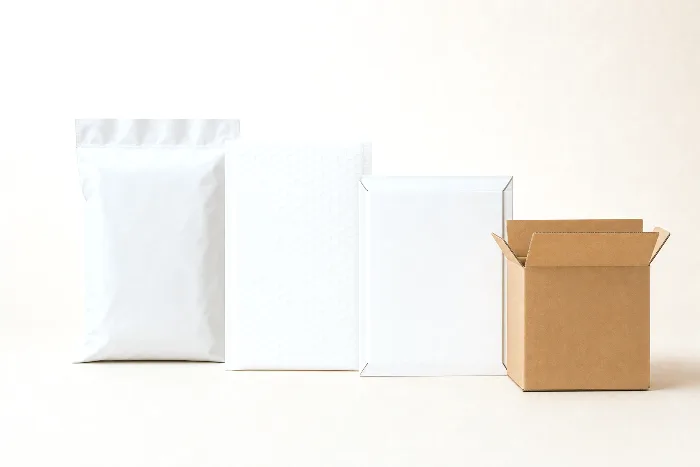
Most DTC shipments land in one of four formats. The right choice is driven by how fragile, how rigid, and how bend-sensitive the product is — and lighter formats save on shipping only when they still protect the contents.
| Format | Best for | Protection |
|---|---|---|
| Poly mailer | Soft, non-fragile, semi-flat goods — apparel, textiles, soft accessories | Low — abrasion and moisture only; no cushioning or crush resistance |
| Padded / bubble mailer | Small semi-fragile items — books, cosmetics in a secondary pack, hardware | Medium — light cushioning against drops and abrasion |
| Rigid mailer | Flat, bend-sensitive items — prints, documents, cards, some electronics | Medium — resists bending and folding, less so crushing |
| Corrugated RSC box | Rigid, fragile, or higher-value goods; multi-item orders | High — with void fill or a fitted insert, handles drops, compression, and vibration |
The corrugated shipper is the workhorse of the four — the everyday regular slotted container (RSC), scored into panels that fold into a box with slotted flaps. A common DTC pattern is to place a printed retail folding carton inside an RSC over-box with cushioning, so the carton arrives pristine for the shelf-or-gift moment while the shipper takes the beating. When you can drop a fragile product into a lighter mailer without risking it, you generally should — the shipping saving is real — but the moment the product can crush, bend, or break, the box earns its cost back in avoided damage.
The unboxing moment
Because the customer is the one who opens it, the inside of an e-commerce package is a brand surface that retail packaging never gets. The levers are familiar: a printed interior, tissue or crinkle fill, a simple insert or thank-you card, custom tape, and a snug, tidy fit that makes the product feel considered. Used well, they turn a routine delivery into something people photograph and share.
The discipline is restraint. Every added gram, layer, and mixed material has a cost — in unit price, in dimensional weight, and in recyclability. A branded outer box stuffed with loose fill reads worse on camera, and worse for the planet, than a right-sized pack with a printed interior and one clean insert. Design the inside, not just the outside, and weigh each flourish against what it adds to the invoice and to the recycling stream. Favoring mono-material, curbside-recyclable components keeps the experience premium without shifting the cleanup onto the customer.
- Do — right-size the pack, print the interior, add one meaningful insert, and use recyclable fill.
- Skip — oversized boxes, loose non-recyclable void fill, and layers of packaging that only exist to look full.
Designing for returns
Returns are not an edge case in DTC — for categories like apparel they are a routine second leg of the journey, and the packaging is expected to make it easy. That changes how you design the opening. A pack meant to be returned should not have to be destroyed to get into: resealable mailers with a second, dual-adhesive strip and boxes with a tear-tape-then-reseal closure let the customer send the item back in the same packaging it arrived in. It saves the customer a trip for a box, keeps the experience on-brand through the return, and cuts the packaging that would otherwise be thrown away on the first open.
The trade-off is that reusable closures and heavier films cost more per unit and can add weight, so a returns-friendly design makes most sense where return rates are genuinely high. Match the closure to the category: high-return apparel benefits from a dual-seal mailer; a one-way consumable rarely needs one.
How PackOS helps with e-commerce packaging
PackOS treats the pack as a system, not a single part. Upload artwork, a die file, or a spec and it detects the structure, rebuilds an editable parametric dieline, and dimensions it — which means it can compute the material area, the board grade, the finished parcel size, and therefore the billable weight that size implies, then price the whole thing. Because the model is parametric, resizing to shave a package down to right-size reflows the panels and re-prices in one move, so you can see the cost of every dimension before you commit to tooling. You can watch the reconstruction and packout logic run on the technology page, or run it on a real file with Quick Quote.
Frequently asked questions
What's the difference between e-commerce and retail packaging?
Retail packaging is designed to sit on a shelf and be shipped to the store in bulk on a pallet, protected by the cases and stretch wrap around it. E-commerce packaging travels alone through the parcel network, takes far rougher handling, and is opened by the end customer — so it has to be its own shipper, its own protection, and its own brand moment all at once.
Do I need a box, or is a mailer enough?
It depends on how fragile and how rigid the product is. Soft, non-fragile, and semi-flat goods like apparel usually ship fine in a poly or padded mailer, which is lighter and cheaper to send. Rigid, fragile, or higher-value products generally need a corrugated box with void fill or a fitted insert so nothing shifts or crushes in transit.
How does packaging affect my shipping cost?
Carriers bill on the greater of a parcel's actual weight and its dimensional weight, which is based on volume. An oversized box with lots of void fill can be billed as if it were much heavier than it is. Right-sizing the package to the product, and choosing a lighter format where protection allows, is one of the most direct ways to control shipping cost.
What is dimensional weight?
Dimensional weight is a volume-based weight that carriers use so that a large, light package is not billed only on how much it weighs. It is calculated by dividing the package's volume by a divisor the carrier publishes and periodically changes. You are charged on whichever is greater, the actual weight or the dimensional weight.
How do I make packaging that photographs well for unboxing?
Design the inside, not just the outside. A printed interior, a simple insert or card, and tidy, right-sized protection read far better on camera than a branded outer box stuffed with loose void fill. Keep it restrained and on-brand, and weigh every added element against its cost and its recyclability.