
Shipping candles in summer without melting them
Candles are one of the most heat-sensitive things you can put in a box. Between the warehouse, the truck, and the front porch, a summer shipment can spend hours above the temperature your wax was poured at — and arrive as a puddle. Here is how to plan around it.
THE SHORT ANSWER
Shipping candles in summer safely means planning around your wax's melt point, transit time, and weekend dwell — trucks and porches routinely hit 130–150°F. That is above soy wax and many paraffin grades, so the answer is not one trick but a few coordinated moves:
- Know your wax's melt point — soy typically softens first; paraffin and beeswax sit higher.
- Ship early in the week so parcels don't bake over a hot weekend in a facility or truck.
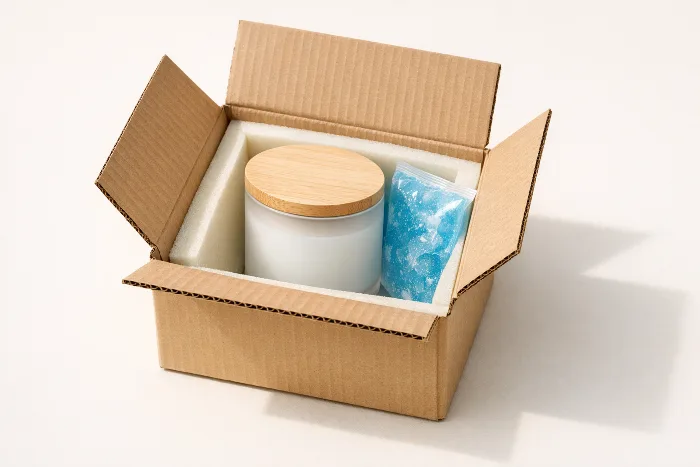
- Use faster service and insulation — an insulated liner plus a gel pack for the most vulnerable waxes.
- Offer hold-for-pickup or pause shipping to regions in an extreme heat event.
Try the candle melt-risk planner →
What happens inside a hot delivery truck
The reason shipping candles in summer is hard has nothing to do with the outside temperature on the forecast. A sealed metal truck, an unconditioned sortation facility, and a dark porch in direct sun all act like ovens: they trap solar and engine heat and hold it. It is widely documented in transport-testing work that the interior of a delivery vehicle or a package left in the sun can reach roughly 130–150°F even when the ambient air is far cooler. Treat that band as a typical worst case, not a guarantee — the real number depends on the region, the day, and how long your parcel sits.
That matters because a candle doesn't need to reach a rolling boil to be ruined. Long before wax fully liquefies it softens, slumps, and pulls away from the container wall; fragrance oil can sweat to the surface; and a poured top can go from smooth to cratered. So the practical question isn't "will it hit the melt point once" — it's "how many hours will this parcel spend in the danger zone, and can I shorten that window?" This is the same logic that governs all protective packaging decisions and any shipment of heat-sensitive products: control the exposure, not just the peak.
Candle shipping is part of the broader discipline of getting fragile, direct-to-consumer goods to the door intact — it sits alongside our ecommerce packaging guide and is one chapter of our guide to packaging logistics.
Wax melt points: know your number
Every plan starts with one fact: the candle melt point of the wax you actually pour. Different waxes behave very differently in heat, and blends and fragrance loads shift the number further. The ranges below are typical, published values for common waxes — use them to rank your risk, then confirm the exact figure with your wax supplier's technical sheet.
| Wax | Typical melt point range | Note |
|---|---|---|
| Coconut / soy blend | Often below pure soy | Very soft, low melt point — the most heat-sensitive common choice. |
| Soy | ~120–130°F (49–54°C) | Popular and clean-burning, but usually the first to slump in a hot truck. |
| Paraffin | ~120–150°F (49–66°C) | Wide range — container grades melt lower, pillar grades higher. |
| Palm | ~130–140°F (54–60°C) | Firmer than soy; still within summer transit temperatures. |
| Beeswax | ~144–147°F (62–64°C) | One of the highest common melt points, but not immune to porch heat. |
Verify before you rely on this. Melt points vary by grade, additive package, and fragrance load, and the figures above are typical ranges rather than a specification for your specific wax. This article is general guidance, not a product warranty — confirm your wax's actual melt point with its supplier, and remember that transit temperatures vary by carrier, route, and season. When two of these waxes overlap the 130–150°F transit band, assume they are at risk and plan accordingly.
The levers that keep candles from melting
There is no single fix for how to ship candles in hot weather; there are a handful of levers you combine based on the melt point, the route, and the forecast. Each one shortens the time your parcel spends in the danger zone or raises the temperature it can tolerate.
| Lever | What it does | When to use it |
|---|---|---|
| Ship early in the week | Avoids parcels dwelling in a hot facility or truck over the weekend | Always in summer — the cheapest, highest-impact move. |
| Faster / expedited service | Cuts total hours in transit, so fewer hours in the danger zone | Long routes, low-melt waxes, or destinations in a heat wave. |
| Insulated liner + gel pack | Slows heat gain and buys time against the peak temperature | Soy and blends, multi-day transit, hot-climate destinations. |
| Hold-for-pickup / locker | Keeps the parcel out of a sun-baked porch until collected | Extreme heat, or customers who can't retrieve promptly. |
| Seasonal pause / heat hold | Delays shipment to a region until conditions cool | Active extreme-heat events where melt is nearly certain. |
Most brands don't use every lever on every order. The skill is matching the lever to the risk: a beeswax candle on a one-day route may need nothing but early-week shipping, while a coconut-soy blend crossing several hot states may want expedited service and an insulated liner. Watching the destination forecast — not just your own local weather — is what separates a plan from a hope.
Insulation, weight, and shipping cost
Insulation is the most effective physical defense to keep candles from melting during shipping, but it isn't free. An insulated liner and gel packs add both mass and bulk, and bulk is what triggers dimensional weight — the carrier's practice of billing by the space a box occupies when it's light for its size. A well-insulated candle box can easily be charged on its dimensions rather than its actual weight, so oversizing the carton "to be safe" quietly raises the bill on every order.
The move is to right-size: use the smallest carton that fits the candle plus a thin insulating layer, keep the product snug so it can't shift, and reserve gel packs for the waxes and routes that truly need them. That same right-sizing keeps the box strong enough to survive the stack — a candle that arrives cool but crushed is no win, which is why it's worth understanding why boxes crush in shipping before you strip out protection. Balancing melt risk, crush protection, and dimensional-weight cost is a genuine trade-off; run the numbers rather than guessing.
Build your summer candle-shipping plan
A repeatable plan for shipping candles in summer comes down to a short checklist you can apply per order or per region. Work through it in order:
- Look up your wax's melt point and treat anything overlapping the 130–150°F transit band as at risk.
- Check the destination forecast, not just your origin weather — a cool warehouse shipping into a heat dome is the classic trap.
- Choose a ship day that avoids weekend dwell; earlier in the week is safer for multi-day service.
- Pick a service level fast enough to keep transit hours low for the route's expected heat.
- Add insulation only where it earns its cost — liner and gel packs for low-melt waxes, long routes, or heat events.
- Offer a heat-safe delivery option such as hold-for-pickup, and set a threshold at which you pause shipments to a region.
Rather than eyeball this, put your wax, route, and season into the candle melt-risk planner — it turns the checklist above into a melt-risk read so you can see which orders need expedited service or insulation and which are fine as-is. It's a faster, more honest answer than a blanket "always overnight everything" rule that inflates cost without reducing much risk.
How PackOS plans heat-sensitive shipments
PackOS models a package parametrically — the real dimensions, the material, the protection, and the way it packs out — so heat-sensitive shipping isn't an afterthought bolted on at the end. Because the platform already knows the carton size and how units nest into a case and onto a pallet, it can show where insulation pushes you onto dimensional weight and where right-sizing pulls you back off it, the same math that governs the rest of your freight. You can follow how that packout and logistics modeling works on the technology page, or put a real candle SKU through Quick Quote to see the box, the protection, and the shipping math together in about a minute. Get the package right and shipping candles in summer gets a lot simpler.
Frequently asked questions
How do I keep candles from melting during shipping in summer?
Match the shipping method to your wax's melt point and the route's transit time. Ship early in the week so parcels do not sit in a hot facility or truck over the weekend, use the fastest reasonable service during heat waves, and add an insulated liner with a gel pack for the most vulnerable waxes. For extreme heat, offer hold-for-pickup or pause shipping until conditions cool.
What temperature do candles melt at?
It depends on the wax. Soy wax is typically the most heat-sensitive and can start to soften and melt in roughly the 120 to 130°F range, while paraffin varies widely by grade and beeswax sits higher, often around 145°F. These are typical ranges, not guarantees — confirm the actual melt point with your wax supplier, because additives, fragrance load, and blends all shift it.
Is it safe to ship candles in hot weather?
Yes, candles can be shipped in hot weather, but only with planning. Delivery vehicles and porches routinely reach far higher temperatures than the outside air, so a candle that is fine on the shelf can melt in transit. Safe hot-weather shipping means choosing faster service, avoiding weekend dwell, and adding insulation for heat-sensitive waxes.
Should I stop shipping candles in summer?
Most brands do not need to stop entirely, but many pause or add safeguards during peak heat. A common approach is to keep shipping with faster service and insulation, watch the forecast for destination regions, and temporarily hold orders to areas in an extreme heat event. Pausing is a business decision that trades some revenue for far fewer melted-candle returns and refunds.
Do I need gel packs or a cooler to ship candles?
Not always. For higher-melt-point waxes on short, fast routes, right-sized packaging and early-week shipping may be enough. Gel packs and insulated liners help most for low-melt waxes like soy, long transit times, or destinations in a heat wave. The trade-off is added weight and size, which can raise dimensional-weight cost, so use them where the melt risk actually justifies it.