
How to choose the right packaging: an honest decision guide
Label or sleeve, pouch or bottle, mailer or box, digital or flexo — the internet is full of confident answers that contradict each other. That's because the question has no universal answer. Here's a framework for making each call from your own product, volume, and channel.
THE SHORT ANSWER
There is no single best package — it depends, and the deciding factor is which constraint your product pushes hardest against. Work through four questions in order and the right answer usually names itself:
- What does the product need to survive? — barrier, protection, shelf life
- How many units, and how many versions? — volume, SKU count, change frequency
- Where does it sell? — retail shelf, ecommerce parcel, marketplace
- What does the brand need to look like? — premium, sustainable, playful, plain
Answer those, then read the specific head-to-head comparison that settles your case. Every one names where each option genuinely wins — never a universal winner.
Why there's no single best package
Search "best packaging for my product" and you'll get a hundred confident answers that flatly disagree with one another. That isn't sloppiness — it's the nature of the question. The package that's perfect for a shampoo brand shipping pallets to a retail chain is the wrong package for a supplement startup mailing single units to customers, even when the liquid inside the two is nearly identical. The inputs are different, so the answer is different.
The right package is the one that clears four bars at once: it protects the product, it fits your volume and version count, it suits the channel it sells through, and it carries the brand you're building. Change any one of those inputs and the answer can flip. A stand-up pouch that wins on shelf presence and freight for one SKU loses to a rigid jar the moment the product needs to be re-closed and dipped into hundreds of times. Neither format is "better." They're answers to different questions.
So this guide doesn't crown a winner. It gives you a repeatable way to make each call deliberately, and it points you at the specific head-to-head comparison that settles your particular question. Every one of those comparisons is written the same honest way: name where each option genuinely wins, name what you give up, and never pretend one choice is free.
The four questions every packaging decision comes down to
Nearly every packaging choice resolves into the same four questions. Answer them in order, because the earlier questions rule out whole categories before the later ones get a vote. A gorgeous premium bottle is irrelevant if the product needs a high-barrier flexible film to reach its shelf life, and the most cost-efficient run in the world is worthless if it makes a package your channel won't accept.
- What does the product need to survive? Start here, always. Moisture, oxygen, light, aroma loss, crushing, and required shelf life set the barrier and protection floor. Some products need a laminate with a real oxygen and moisture barrier; some need rigid walls that won't crush in a case; some are happy in almost anything. This question alone eliminates whole formats before you spend a minute on looks or price.
- How many units — and how many versions? Volume and SKU count decide which manufacturing process is efficient, and how quickly one-time setup gets spread across the run. High, stable volumes reward processes with a low per-unit run cost even when their setup is higher. Many versions, small batches, or frequent artwork changes reward processes with low setup and fast changeover. Hold this tension in mind — it decides several format and print calls on its own.
- Where does it sell? A retail shelf, an ecommerce parcel, and a marketplace like Amazon each impose different rules. Shelf products fight for attention and stack in a case pack; parcel products get billed on dimensional weight and take a beating in transit; marketplace products face prep and labeling requirements. The channel often decides between a mailer and a box, or between shelf-ready and plain shipper, before anything else.
- What does the brand need to look like? Last, not least. Premium categories lean on heft, finish, and material honesty; challenger brands lean on big print areas and personality; value brands lean on the plainest thing that ships intact. Brand is a real constraint, not a tie-breaker to sprinkle on at the end — but it sits behind survival, volume, and channel because it can't override physics or economics.
Most arguments about packaging are really arguments about which of these four questions matters most for a given product. Name the binding constraint first, and the format debate gets much shorter.
A decision map: match your question to the right comparison
Once you know which question is doing the work, jump straight to the head-to-head that settles it. This map pairs the common decisions with the factor that usually decides them and the deep-dive that walks through both sides.
| Your decision | The factor that usually decides it | Where to read |
|---|---|---|
| Which decoration method at all (PS label, sleeve, direct print, IML) | Container shape, coverage, run size, recyclability | Label decoration methods compared |
| Shrink sleeve vs pressure-sensitive label | How much coverage and container shape you need | Shrink sleeve vs pressure-sensitive |
| Pouch vs rigid | What the product needs to survive, plus brand position | Pouch vs rigid packaging |
| Premade pouch vs rollstock | Volume and whether you run a filling line | Premade pouches vs rollstock |
| Poly mailer vs box | Product fragility and dimensional weight | Poly mailer vs box |
| Digital vs flexo printing | Run length and number of versions | Digital vs flexo label printing |
Notice the pattern: no row says "always pick X." Each names a factor, because the factor is what changes from product to product. If your product barely registers on a factor — say it's not fragile at all — that column stops mattering and a different one takes over.
Where we're coming from: an honest vantage
A quick disclosure so you can weigh what follows. Calyx, the company behind PackOS, manufactures rigid containers, and PackOS also quotes labels and flexible packaging. In other words, we make one of the formats in several of these comparisons and quote the others — so we have a genuine reason to present both sides fairly rather than steer you toward the thing we happen to make. We manufacture rigid and quote flexible, so the trade-offs on this site are an honest comparison, not a sales pitch. Where a format we make goes up against one we don't, we say so and name where each genuinely wins.
That's also why you'll notice we never settle a format fight with a price. The honest reason a pouch or a bottle or a mailer is right for you isn't a number we can print in an article — it's the interaction of your product, volume, and channel with a real quote at your real quantities. Cost is a driver you should absolutely weigh; it just isn't a fact we can fabricate on your behalf.
Reading a trade-off: where each option genuinely wins
Every comparison in the library uses the same shape, so once you can read one, you can read them all. Take the biggest format decision, pouch versus rigid, as the worked example. Here is what an honest, both-sides table looks like — each option wins some rows and gives up others, and neither column is "the answer."
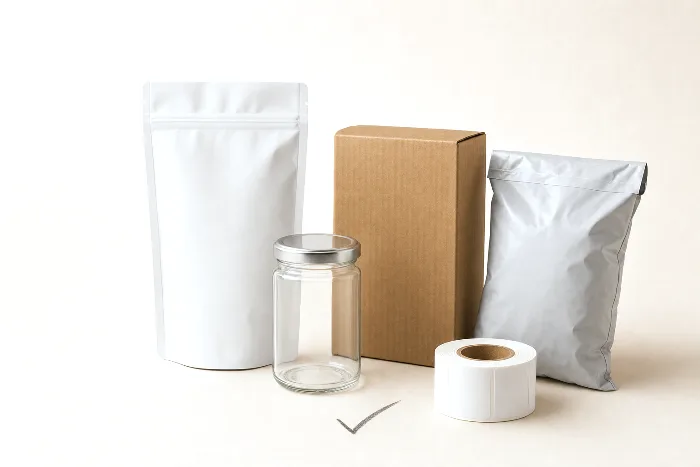
| Factor | Stand-up pouch (flexible) | Rigid bottle or jar |
|---|---|---|
| Product protection | Strong barrier in the right laminate; less resistance to crushing and puncture | Rigid walls resist crushing and protect the contents physically |
| Material & shipping | Uses less material, ships flat and light before filling | Encloses air and adds weight; heavier to move |
| Shelf presence | Modern, flexible shape with a large uninterrupted print area | Premium heft and a classic feel in established categories |
| Refill & reuse | Rarely re-closed or reused across a long life | Refillable and re-closeable, well suited to dip-in use |
| Recyclability | Achievable with a mono-material structure; infrastructure still maturing | Single-resin plastic or glass recycles in many existing streams |
| Barrier ceiling | High with the right film stack, tunable to the product | High and inherent to the material |
Read it by scanning down the factor column and asking which rows your product cares about. A dry snack that ships in parcels and wants a big graphic pushes hard on material and shipping and shelf presence — the pouch column lights up. A serum that customers dip into daily and expect to refill pushes on protection and refill and reuse — the rigid column lights up. Same table, opposite answers, and both are correct for their product. That's the whole method: let the product tell you which rows are load-bearing, and don't let a row your product ignores drag the decision.
The same discipline applies to the smaller calls. Shrink sleeves win when a container's shape is complex and you want full-height, wrap-around coverage or a tamper band; pressure-sensitive labels win when the shape is simple, the tooling should be light, and recyclability of the container matters — the deep-dive on shrink sleeve vs pressure-sensitive labels lays both sides out. Digital printing wins on short runs and many versions; flexo wins on long, stable runs and special inks — and the crossover is about plates and changeover, not a magic break-even price, which is exactly the honest version told in digital vs flexo.
Use the pickers and calculators, not a rule of thumb
Rules of thumb are where bad packaging decisions come from. "Pouches are always cheaper" and "boxes always protect better" are the kind of half-truths that survive because they're right often enough to feel safe — and wrong often enough to cost you a run. Instead of a rule, run the specific check your decision turns on.
- Choosing a label format? Feed your container and coverage needs into the label format picker and let it narrow the field before you commit to tooling.
- Deciding between a mailer and a box, or two box sizes? The economics usually hinge on dimensional weight, and that's product-specific. Run your own dimensions rather than trusting a generic claim about which ships cheaper.
- Weighing custom against off-the-shelf? A stock component skips tooling and lead time but limits shape and brand; a custom one does the opposite. The honest trade-off is walked through in custom vs stock packaging.
- Ready to lock a spec? Capture it once in the spec sheet builder so every supplier quotes the same thing — a tight spec is the difference between comparable quotes and apples-to-oranges guesses.
When you've made the format call and want real numbers, cost and lead time both follow from the same drivers — process fit, quantity, decoration, and freight — and the only reliable way to see them is a quote at your true volumes. Our guide to sourcing and buying packaging covers how to run that process so the quotes come back comparable, and a Quick Quote turns a decided spec into an actual price.
The full Decisions & Comparisons library
Each of these is a deep-dive on one decision, written to the same both-sides standard as this guide — name where each option wins, name the trade-off, send you to the tool or quote for the numbers.
- Label decoration methods compared — pressure-sensitive labels, shrink sleeves, direct print, and in-mold labeling, and where each fits.
- Shrink sleeve vs pressure-sensitive labels — 360° coverage and complex shapes versus simpler, lighter-tooling, more recyclable labels.
- Pouch vs rigid packaging — the flexible-versus-rigid trade-off, from a team that makes rigid and quotes flexible.
- Premade pouches vs rollstock — no filling line and many SKUs versus high-volume form-fill-seal.
- Poly mailer vs box — light and space-saving versus protective and premium, decided on fragility and dimensional weight.
- Digital vs flexo label printing — short runs and many versions versus long, stable runs and special inks — the real cost drivers, not fake break-even prices.
How PackOS helps you decide
PackOS is built to make these calls concrete instead of theoretical. Upload real artwork, a die file, a prior quote, or even a rough spec, and it detects the structure, dimensions it, and builds an editable, parametric model of the package — so you can see what a format actually means for your product rather than argue it in the abstract. From there it produces a photoreal 3D proof and an instant quote, which turns the last two questions — what it looks like and what it costs at your volumes — into something you can look at and compare. You can see the reconstruction run on the technology page, or put a real file through it with Quick Quote. The framework picks the format; the tools tell you what it becomes.
Frequently asked questions
Is there a single best type of packaging?
No. The right package depends on what your product needs to survive, how many units and versions you run, where it sells, and how the brand needs to look. A format that wins for one product loses for another, which is why this guide frames every choice as a trade-off rather than a winner.
What is the first thing to decide when choosing packaging?
Start with what the product needs to survive — moisture, oxygen, light, crushing, and shelf life. Protection and barrier requirements rule out whole categories before cost or looks matter, so they come first.
Does packaging cost depend more on the format or the quantity?
Both, and they interact. One-time costs like tooling and plates are spread over the run, so per-unit cost falls as quantity rises. The format sets the floor and the quantity decides how quickly setup is amortized. Get a real quote at your actual volumes rather than trusting a generic price.
Since Calyx makes rigid containers, is this guide biased toward rigid?
We manufacture rigid containers and also quote labels and flexible packaging, so we have reason to present both sides fairly. Where a comparison involves a format we make against one we do not, we say so and name where each genuinely wins.
How do quantity and number of versions change the decision?
Higher volumes reward processes with a cheaper per-unit run even when setup is higher, while many versions or frequent changes reward processes with low setup and fast changeover. That single tension decides several format and print calls, from digital versus flexo to premade versus rollstock.