
Shrink sleeve vs pressure-sensitive labels: which to choose
Two ways to decorate the same bottle can look nearly identical on the shelf and behave completely differently in tooling, on the line, and in the recycling stream. Here is how to choose between a shrink sleeve and a pressure-sensitive label without guessing.
THE SHORT ANSWER
There is no universal winner — the deciding factor is your container. If it has a complex or contoured shape you want to decorate top to bottom, or you need a built-in tamper band, a shrink sleeve earns its extra tooling. If the container has a clean flat or cylindrical labeling panel and you want simpler tooling, more finish options, and an easier recycling story, a pressure-sensitive label is usually the better call.
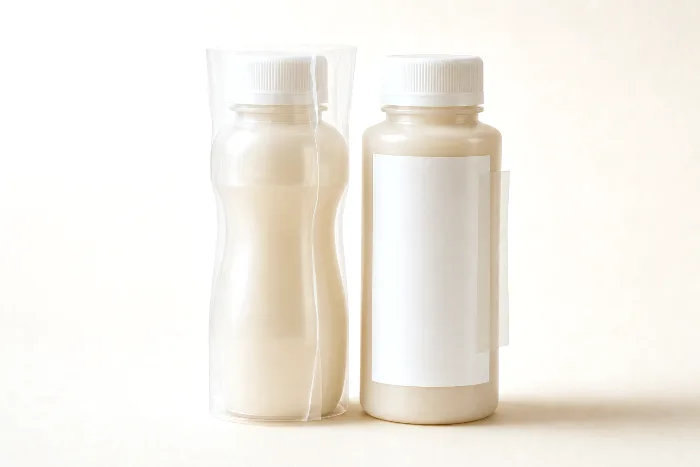
- Shrink sleeve — a printed plastic film tube shrunk with heat to hug a container 360°.
- Pressure-sensitive label — a printed face stock with adhesive applied to a defined panel.
- Sleeves win on contoured shapes, full-body coverage, and integrated tamper or multipack bands.
- Pressure-sensitive labels win on tooling simplicity, flat or cylindrical panels, and recyclability.
- Cost and lead time depend on run size, colors, and finishing — get a real quote, not a rule of thumb.
What each format actually is
The two formats solve the same problem — get your brand onto a container — in fundamentally different ways. Understanding the mechanics is most of the decision. This comparison is part of our guide to choosing the right packaging, and it sits alongside the broader menu of options in label decoration methods compared.
A shrink sleeve is a tube of printed plastic film — commonly PVC, PETG, or OPS — printed on the reverse, seamed into a loop, slipped over the container, and then passed through a heat tunnel. The heat shrinks the film so it conforms to the container's shape, wrapping it all the way around. Because the graphic distorts as the film shrinks, sleeve artwork is pre-distorted to land correctly once it hugs the body. Read the full walkthrough in our shrink sleeve labels guide.
A pressure-sensitive label (often abbreviated PS or PSL) is a three-layer sandwich: a printed face stock, an adhesive layer, and a release liner. It is die-cut on a web, then applied — by hand, by a semi-automatic dispenser, or by an inline applicator — to a defined panel on the container. It sticks where you place it and leaves the rest of the container bare.
Shrink sleeve vs pressure-sensitive: the honest trade-off
Neither format is better across the board — each wins in different places. The table below lays out the factors that actually drive the choice, with an honest read on both sides. A note on where we sit: PackOS quotes both shrink sleeves and pressure-sensitive labels, so neither format pays our bills more than the other. This is a genuine trade-off, not a sales pitch.
| Factor | Shrink sleeve | Pressure-sensitive |
|---|---|---|
| Coverage | 360° full-body wrap; graphics run top to bottom, including the neck and base | A defined panel — front, back, wrap, or spot — with the rest of the container left bare |
| Container shape | Excels on contoured, tapered, and compound-curve shapes | Best on flat panels or straight-walled cylinders; struggles on complex curves |
| Tamper evidence | Built-in perforated neck band tears visibly on opening | Optional, via destructible face stock or a separate tamper seal |
| Tooling & minimum run | Adds a seaming step and a shrink step; sleeve format tooling on top of print | Simpler die tooling; digital print suits short runs and many SKUs |
| Decoration & finishes | Seamless billboard look; finish range limited by the shrink film | Wide face-stock, texture, and finish menu — foils, textured papers, specialty coatings |
| Recyclability | Can complicate container recycling unless the sleeve washes off, floats, or matches the container resin | Smaller footprint, but face stock and adhesive still affect the container's recyclability |
| Application | Placed over the container, then heat-shrunk in a tunnel | Applied by hand, semi-auto, or inline applicator to the panel |
Read the table as a set of dials, not a scoreboard. The right answer is the format that matches the most rows that matter to your product.
Where shrink sleeves genuinely win
Sleeves shine when the container itself is the reason you can't use a flat label. Their strengths cluster around shape and coverage:
- Contoured and compound-curve containers. Waisted bottles, tapered tubs, and odd silhouettes that a flat label would wrinkle or flag on are exactly where a sleeve conforms cleanly.
- Full-body billboards. When you want an unbroken, edge-to-edge graphic that reads as one continuous surface — no visible label boundary — a sleeve delivers a look a panel label can't.
- Integrated tamper evidence. A perforated neck band that tears on first open gives obvious, built-in tamper evidence without a second component.
- Multipack and promotional banding. Sleeves can gang multiple units together or add a temporary promotional wrap over an existing decoration.
- Decorating over seams and features. Because the film shrinks to the surface, it can carry graphics across handles, indents, and steps that would defeat a flat label.
The cost of those wins is complexity: a sleeve adds a seaming operation and a heat-shrink application step, the artwork has to be distorted to survive the shrink, and — as the next section covers — the material choice has real recyclability consequences.
Where pressure-sensitive labels genuinely win
Pressure-sensitive labels win on simplicity, flexibility, and material choice. If your container has a clean labeling panel, a PS label is usually the lower-friction path:
- Simpler tooling and setup. A PS label needs a cut die and print — no seaming, no shrink tunnel — which keeps the front of the job simpler and makes short runs and frequent artwork changes far easier.
- A deeper finish menu. Face-stock choice is enormous: coated and uncoated papers, films, textured and specialty stocks, foils, and tactile coatings that a shrink film can't match.
- Variable data and versioning. Digital PS printing makes many SKUs, seasonal versions, and serialized or variable data straightforward, without new format tooling for every change.
- Front-and-back or spot decoration. When you only need a defined area labeled — leaving clear windows to show product, or a bare base — a panel label is the natural fit.
- Easier recovery in recycling. A smaller label that peels or floats away tends to interfere less with container recycling than a full-body sleeve, though the details still matter.
Where PS labels give ground is coverage and shape. They can't wrap a compound curve seamlessly, and getting a true 360° look means a wrap label with a visible seam or overlap rather than the continuous body of a sleeve.
The recyclability caveat
This is the factor most comparisons gloss over, so it's worth stating plainly. A full-body shrink sleeve can interfere with how a container is recycled. Material recovery facilities lean on optical sorters that read the surface they see — and on a fully sleeved container, that surface is the sleeve, not the bottle. If the sleeve resin differs from the container resin and covers most of the body, the container can be mis-sorted or downgraded unless the sleeve is designed to separate.
The mitigations are real but have to be chosen deliberately: wash-off sleeves that release from the container in the recycling wash, float-separable films whose density lets them part from the container in a sink-float step, or matching the sleeve resin to the container so the whole item stays in one stream. Which approach applies depends on the container, the sleeve film, and the recycling system it lands in — so treat this as a design decision, not an afterthought.
Pressure-sensitive labels are not automatically clean, either. A small label usually has a smaller footprint, but the face stock, the adhesive, and whether the label releases in the wash all affect the outcome. In both cases the honest move is to design for recyclability up front and check the current guidance rather than assume. Our sustainable packaging guide covers the broader picture, and the Association of Plastic Recyclers publishes design guidance for exactly these decisions.
How to decide
You can usually settle the question by walking the same short sequence in order — the first factor that clearly points one way is often the answer:
- Look at the container. Complex curve or full-body graphic ambition → lean sleeve. Clean flat or cylindrical panel → lean pressure-sensitive.
- Decide the coverage. Do you need true 360°, edge-to-edge decoration, or is a defined panel enough?
- Check tamper needs. If you want obvious, built-in tamper evidence, a sleeve neck band is the simplest route — but a destructible PS label or a separate seal can also do the job.
- Weigh run size and SKU count. Many versions, short runs, and frequent changes favor the simpler tooling of pressure-sensitive; long, stable runs soften the added setup of a sleeve.
- Factor in recyclability goals. If a clean single-material recycling story matters, weigh the sleeve's separation strategy against a smaller label footprint.
- Then quote both. Once the shape and coverage narrow it down, the cost and lead-time comparison depends on your real quantity, colors, and finishing — so compare actual quotes rather than guessing at a break-even.
If you want a fast first pass, the label format picker walks you through these same questions and points to the format that fits your container and coverage.
How PackOS quotes both formats
Because PackOS quotes both shrink sleeves and pressure-sensitive labels, you can put the two side by side on your own container instead of relying on a made-up rule. Upload artwork or a spec and PackOS detects the structure, dimensions it, and can price a sleeve and a PS label against the same product, quantity, and finishing — so the comparison is grounded in your job, not a generic table. You can see how the detection and dieline reconstruction work on the technology page, or run your real file through Quick Quote. When cost is the deciding factor, that real number — for both formats — beats any rule of thumb.
Frequently asked questions
What's the difference between a shrink sleeve and a pressure-sensitive label?
A shrink sleeve is a printed plastic film tube that is placed over a container and shrunk with heat so it hugs the full shape, wrapping the container all the way around. A pressure-sensitive label is a printed face stock with an adhesive backing that is applied to a flat or cylindrical panel. The sleeve decorates the whole body and follows contours; the label sticks to a defined area.
Are shrink sleeves harder to recycle than pressure-sensitive labels?
Often, yes, though it depends on the materials. A full-body sleeve made from a different plastic than the container can confuse optical sorters and interfere with recycling unless it is designed to wash off or float away. A pressure-sensitive label usually covers less area, but its face stock and adhesive still matter. Check current recyclability design guidance from the Association of Plastic Recyclers for your specific structure.
When is a shrink sleeve worth the extra tooling?
A shrink sleeve earns its extra setup when the container has a complex or contoured shape you want to decorate from top to bottom, when you want a seamless full-body look, or when you need an integrated tamper-evident neck band or a multipack band. If the container has a clean flat or cylindrical labeling panel and you do not need full coverage, a pressure-sensitive label is usually simpler.
Can you get tamper evidence without a shrink sleeve?
Yes. Shrink sleeves make tamper evidence easy because a perforated neck band tears when opened, but pressure-sensitive labels can also provide tamper evidence through breakaway or destructible face stocks and tamper-evident seals. The right choice depends on your container, your regulatory needs, and how obvious you want the tamper feature to be.
Do shrink sleeves cost more than pressure-sensitive labels?
It depends on run size, number of colors, coverage, and finishing, so there is no fixed answer. Sleeves add a seaming step and a heat-shrink application step, and full-body coverage uses more printed material, which can raise cost. Pressure-sensitive tooling is usually simpler. The only reliable way to compare is to quote both against your real container, quantity, and artwork.