
Label decoration methods compared: PS labels, shrink sleeves, direct print & IML
Pressure-sensitive labels, shrink sleeves, direct print, and in-mold labels all put your brand on a container — but they win in very different places. Here is how to pick the one that fits your product, not the one a single vendor happens to sell.
THE SHORT ANSWER
There is no single best way to decorate a container. The right method is the one that fits your container's shape, how much of it you need to cover, how many units and versions you are running, and how the finished package needs to recycle. The deciding factor is almost always the container itself — its shape and material — followed by your run size.
- Pressure-sensitive labels — best for almost any clean surface, short-to-mid runs, and many versions
- Shrink sleeves — best for full 360° coverage, complex or contoured shapes, and built-in tamper bands
- Direct print (screen, pad, digital-on-object) — best for high volumes of one stable design with no applied label
- In-mold labels (IML) — best for very high-volume rigid containers decorated as they are formed
What drives the decision
Choosing a decoration method feels like a branding question, but it is mostly an engineering one. The look you want has to survive the container you actually ship, the equipment that applies it, and the volumes you run. Four things decide it, roughly in this order:
- Container shape and material. A straight-walled bottle or jar takes a wrapped label easily. A tapered, ribbed, or compound-curved container may need a film that conforms, or a printing method that lays ink onto the surface itself.
- Coverage. How much of the container the design has to cover. A small front-and-back label is a very different problem from a full 360° wrap that runs top to bottom over every seam.
- Run size and versions. How many units, and how many different designs. Light setup favors short runs and many SKUs; heavy tooling only pays back over long, stable runs.
- Recyclability. How the finished package needs to be recovered, and whether the decoration helps or hinders that at the sorting facility.
Nail those four and the method usually chooses itself. Start from the brand look alone and you can back yourself into a method your container cannot actually take — a full wrap on a shape a flat label will flag off, or a direct-print program on a run too short to justify the setup.
The four methods in plain terms
Before the trade-offs, here is what each method actually is, without the jargon.
Pressure-sensitive labels
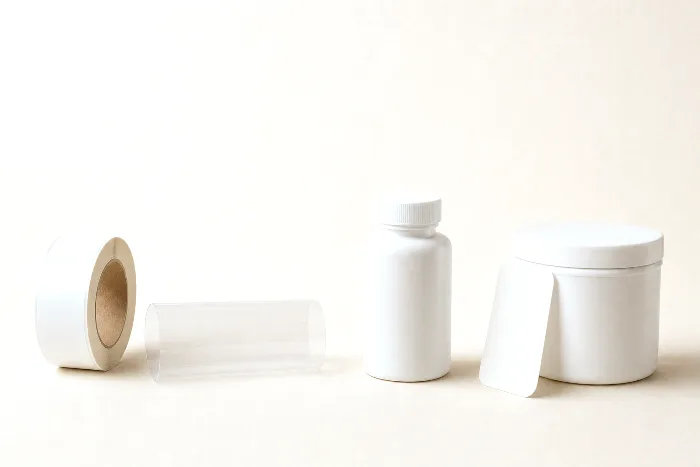
A pressure-sensitive label — the everyday self-adhesive label — is a printed face stock coated with adhesive and carried on a release liner. The label is die-cut, wound onto a roll, and applied to the container by hand or by an applicator. It is the most flexible method: it prints on paper or film, applies to almost any clean surface, and lets you swap artwork between runs without rebuilding tooling.
Face stock — the printed top layer of a pressure-sensitive label (paper, film, or foil) that carries the artwork, sitting above the adhesive and the release liner. See more terms in the packaging glossary.
What the face is made of drives how the label prints, how it survives moisture and handling, and how the whole package recycles — our label materials guide walks through paper, film, and specialty options.
Shrink sleeves
A shrink sleeve is a printed plastic film tube slipped over the container and shrunk to its shape with heat. Because the film conforms, a sleeve can decorate contoured, tapered, and irregular containers a flat label cannot wrap, and it can cover the full 360° of the surface — top to bottom, seams and all. Sleeves also double as tamper-evident bands over caps and closures. See our overview of shrink sleeve labels, and if you are weighing this exact pairing, we put the two side by side in shrink sleeve vs pressure-sensitive.
Direct print
Direct printing puts ink straight onto the container with no applied label at all — screen printing, pad printing, or newer digital-on-object systems. There is nothing to peel, nothing to lift, and the graphic becomes part of the object. It rewards high volumes of a single, stable design, because the setup is per-design and, for screen work, per-color.
In-mold labels
In-mold labeling (IML) places a pre-printed label into the mold before the container is formed, so the label fuses to the wall as the plastic is molded or thermoformed. The label becomes structurally part of the container and is often the same base plastic, which can simplify recycling. IML makes sense at very high volume, where the mold and the label tooling pay back across a long run.
Which method wins where
None of these is the winner. Each earns its place under different conditions, and each carries a real cost for the thing it does well. Here is the honest version, method by method.
| Method | Best when | Trade-off |
|---|---|---|
| Pressure-sensitive label | Most containers; short-to-mid runs; many versions or frequent artwork changes; partial coverage | Adhesive and liner add a separate material to the package; can lift or flag on tight curves; not a full 360° wrap |
| Shrink sleeve | Complex or contoured shapes; full 360° coverage; tamper bands; maximum shelf impact | Extra film can complicate container recycling; needs a shrink tunnel; slower and costlier to change once tooled |
| Direct print | Very high volume; a single stable design; a printable surface; a clean, no-label look | Setup is per-design and often per-color; poor fit for short runs or many versions; limited on some shapes and materials |
| In-mold label | Very high-volume rigid containers; durable, integrated graphics; single-material recyclability | Highest upfront tooling; only economical over long runs; design changes are slow to turn around |
Read the table as a set of conditions, not a ranking. A pressure-sensitive label that would be an expensive mistake at hundreds of millions of identical units is exactly right for a brand running dozens of SKUs. An in-mold label that no short run could justify is the low-cost-per-unit answer once volume is enormous. The cost comparison only becomes real against your own container, coverage, and quantity — which is why the honest move is to quote it rather than trust a break-even number you read online.
An honest word on where we sit
A quick disclosure, because it matters here. Calyx — the manufacturer behind PackOS — makes rigid containers, which are exactly what direct print and in-mold labeling decorate. PackOS also quotes labels and shrink sleeves. In other words, we sit on both sides of this comparison, so the trade-offs above are meant as an honest read of where each method genuinely wins, not a nudge toward whatever we happen to sell. If the right answer for your product is a pressure-sensitive label on someone else's bottle, that is the answer we want you to reach.
The recyclability question, honestly
Decoration is easy to treat as a surface detail, but it can decide whether a package recycles cleanly. The tension is sharpest with shrink sleeves: a full-coverage sleeve is often a different plastic than the container it wraps, and at the recovery facility that can cause two problems. Optical sorters may read the sleeve instead of the bottle underneath and send the container to the wrong stream, and a sleeve that does not separate can contaminate the material it is sorted with. Some sleeve films are engineered to be compatible with the container resin or to release during recycling, and the Association of Plastic Recyclers publishes design guidance for exactly these cases.
Pressure-sensitive labels have their own version of this. The face material and the adhesive both affect whether a container recycles, and a wash-off adhesive behaves very differently from an aggressive permanent one. In-mold labels, because they can be the same base plastic as the container, often sidestep the issue entirely. None of this makes one method universally "green" — it makes recyclability one more factor to weigh against shape, coverage, and run, rather than an afterthought bolted on at the end.
How to pick for your container
Put the four levers together and the shortlist is usually short:
- Clean-walled bottle or jar, a range of SKUs, artwork that changes → a pressure-sensitive label is the default starting point.
- Complex or contoured shape, full coverage, or a tamper band → look hard at a shrink sleeve.
- Enormous volume of a single, settled design on a printable surface → direct print or in-mold labeling start to pay back.
To narrow it quickly for a specific container, the label format picker walks you through shape, coverage, and run size and points to a method — a faster first pass than reasoning it out from scratch.
How PackOS helps: once you have a container and a decoration method in mind, PackOS reconstructs the label or sleeve geometry, checks it against the container, and prices it, so the structural decision and the quote happen together instead of in separate silos. You can see the structural side of this on our technology page.
This piece is part of our guide to choosing the right packaging — if you are weighing bigger format calls too, like pouch versus rigid or mailer versus box, that guide maps every decision to the article that goes deep on it.
Frequently asked questions
What is the most common way to decorate a container?
Pressure-sensitive labels are the most widely used method because they apply to almost any clean, dry surface, need very little tooling, and let you print many versions on one run. They are the default starting point for most brands, but they are not automatically the cheapest or best for every container — coverage, shape, and run size can point you toward a sleeve, direct print, or in-mold label instead.
Are shrink sleeves recyclable?
It depends on the sleeve material and the container it covers. A full-coverage sleeve is often a different plastic than the bottle underneath, and it can confuse automated sortation or interfere with recycling if it is not removed. Some sleeves are designed to be compatible with the container resin or to release cleanly, and recyclers publish design guidance for this. Check the current guidance from the Association of Plastic Recyclers and your local recycler before assuming a sleeve is accepted.
What is in-mold labeling?
In-mold labeling places a pre-printed label into the mold cavity before the container is formed, so the label fuses to the container wall as the plastic is molded or thermoformed. The result looks like part of the container with no separate applied label. It suits very high-volume rigid containers because the label tooling and mold setup are worth it only across large runs.
Which label decoration method is cheapest?
There is no universal cheapest method. Pressure-sensitive labels usually win at lower volumes and when you run many versions because their setup is light. Direct print and in-mold labeling can win at very high volume because there is no applied label to buy per unit, but they carry higher upfront tooling. The only reliable way to compare is to quote your real container, coverage, and quantity.
When should I use direct print instead of a label?
Direct print makes sense for high-volume containers with a single stable design, where the surface suits printing and you want a clean look with no applied label edge. It trades flexibility for that look — changing the artwork means changing the setup — so it fits established products more than short runs or frequent version changes.