
Premade pouches vs rollstock: which is right for your brand?
You picked a stand-up pouch. There's a second decision most brands don't see coming: how that pouch is supplied. Premade or rollstock changes your equipment, your minimums, and who actually fills the bag — so it's worth getting right before you tool up.
THE SHORT ANSWER
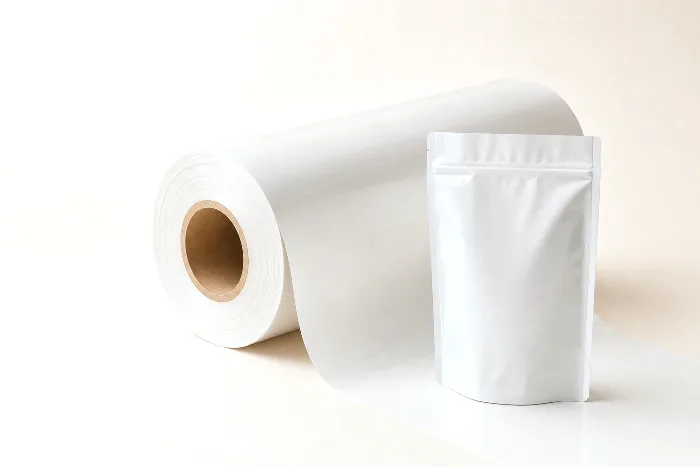
There's no universal winner — the deciding factor is how you fill, and how much. Premade (preformed) pouches arrive ready to fill and suit lower or variable volume, many SKUs, and brands that fill by hand or through a co-packer. Rollstock — a printed roll of film run on a form-fill-seal (FFS) machine — pays off once your volume is high and steady enough to justify the line. The choice comes down to whether your real, ongoing volume earns the equipment, not to a magic number.
- Premade pouch — made by your supplier, shipped fully formed, filled on your side (hand, tabletop, or co-packer). Low equipment, flexible SKUs.
- Rollstock — a roll of laminate the FFS machine forms, fills, and seals in one pass. Lower material cost per pouch at scale, but you need a line to run it.
- Deciding factor — volume vs equipment: does your steady volume justify owning or renting an FFS line?
- Cost — qualitative here on purpose. Have both quoted against your real quantities rather than trusting a rule of thumb.
What premade pouches and rollstock actually are
Both formats start as the same thing: a printed, laminated film. The difference is when that film becomes a pouch, and who turns it into one.
A premade pouch — also called a preformed or pre-made pouch — is manufactured to completion by your flexible-packaging supplier. They print the laminate, die-cut the shape, and seal it on three sides, leaving the top open. What lands on your dock is a carton of finished, empty pouches, with the bottom or side gusset and any press-to-close zipper or tear notch already built in. You add product and seal the top. None of the pouch-making happens on your line. For the anatomy of the pouch itself — materials, seals, and closures — see our stand-up pouch spec guide, and where pouches sit within the wider flexible packaging family.
Rollstock is the same laminate, printed and delivered as a roll rather than as finished pouches. The pouch doesn't exist yet. It's formed at the moment of filling by a form-fill-seal (FFS) machine, which pulls film off the roll, folds and seals it into a pouch, drops in the product, and seals the top — all in one continuous motion. Vertical machines (VFFS) are common for free-flowing product like snacks, coffee, and powders; horizontal machines (HFFS) can produce premade-style stand-up shapes straight from the web. In short, the roll is the raw material and the machine is the pouch factory.
Who fills the pouch: the real dividing line
Strip away the jargon and the choice is about who owns the filling step.
- With premade pouches, pouch-making is your supplier's job and filling is yours — but filling a preformed pouch is comparatively simple. You can do it by hand for samples and short runs, move to an inexpensive tabletop filler and heat sealer as you grow, or hand filling entirely to a co-packer.
- With rollstock, you can't fill anything until a form-fill-seal machine turns the film into a pouch. That means you either buy or lease an FFS line and run it in-house, or work with a co-packer who already owns one. There is no hand-filling a roll of film.
That single fact drives almost everything else: your minimums, your changeover time, your cost per pouch, and how quickly you can get to a first production run. If you don't have a line and aren't ready to invest in one, the premade path — in-house or co-packed — is often the only realistic starting point.
Premade pouches vs rollstock: when each wins
Neither format is better in the abstract; each genuinely wins in a different situation. Here's the honest split, factor by factor.
| Factor | Premade pouch | Rollstock (FFS) |
|---|---|---|
| Best volume | Lower to moderate, or variable | High and steady |
| SKU count / versions | Many SKUs and short runs are easy | Best on a few long, stable runs |
| Filling equipment | Hand, tabletop filler, or co-packer | Requires a form-fill-seal line |
| Changeover | Fast — swap which pouch you fill | Slower — re-set the machine and web |
| Minimum order | Generally lower to start | Generally higher (film + line time) |
| Material cost per pouch | Higher — you buy finished pouches | Lower at scale — you buy film |
| Throughput | Limited by your filling method | High once the line is running |
| Speed to launch | Fast — no equipment to install | Slower — line and validation needed |
| Capital outlay | Little to none | Significant if you buy the line |
A short way to hold it: premade buys you flexibility and a low starting line; rollstock buys you unit economics and speed once you're at scale. The crossover isn't a fixed quantity you can read off a chart — it shifts with your material, pouch size, number of colors, and how stable your demand is.
The co-packer question
Most emerging brands never own a filling line at all — they use a co-packer, and that quietly makes the premade-versus-rollstock choice for them. A co-packer built around premade pouches will ask you to supply finished pouches; one built around rollstock will run your printed film on their FFS lines. Which route is open to you often comes down to which co-packer you can actually partner with for your category, volume, and location.
That's why the packer decision and the format decision should happen together. Before you commit to rollstock tooling, confirm you have a filling path for it. Our guide to evaluating a co-packer walks through capability fit, capacity and minimums, quality systems, traceability, and the red flags to watch — the same criteria that tell you whether premade or rollstock is realistic for you right now.
Minimum order quantities and tooling
Both formats carry setup. There are plates or cylinders for the print, and either a die for the pouch shape (premade) or format tooling and change parts for the FFS machine (rollstock). Those one-time costs get spread across the run, which is why the per-pouch price falls as quantity rises for either format — the same mechanics as any packaging minimum order quantity.
The difference is where the floor sits. Premade generally lets you start at a lower minimum, because you're buying finished pouches without committing to a full FFS run. Rollstock tends to want more volume to be worth it: you're buying film by the roll and paying for line time, and the economics only tip in its favor once you're running enough to amortize both the material and the machine. We won't put numbers on that here on purpose — real minimums swing widely with your material structure, size, color count, and supplier. The honest move is to have both formats quoted against your actual annual volume and SKU list rather than trusting a figure from a blog.
How to decide for your brand
Work through these questions in order:
- What's your real, steady volume? Not a hopeful projection — the volume you'll reliably move. High and stable points toward rollstock; lower or uncertain points toward premade.
- How many SKUs and versions? Many sizes, flavors, or limited editions favor premade, where switching is just changing which pouch you fill. A few high-volume SKUs favor rollstock's long, efficient runs.
- Who fills it? If you don't own a form-fill-seal line and aren't ready to buy one, you're choosing premade (in-house or co-packed) or a rollstock co-packer.
- How fast do you need to launch? Premade needs no equipment install or line validation, so it's usually the faster path to a first production run.
- How stable is the design and size? Rollstock rewards artwork and dimensions that rarely change; premade absorbs frequent change far more gracefully.
This is one decision inside a larger set — format, material, decoration, channel — so it's worth reading alongside our guide to choosing the right packaging, and the upstream question of pouch vs rigid packaging if you haven't locked the format itself.
A common and sensible arc: start premade, move to rollstock later. Validate the product and the pouch at lower volume without buying equipment, keep your structure and dimensions consistent, and switch to rollstock once volume is high and steady enough to justify a line. Getting the pouch spec right up front is what makes that transition painless instead of a full redesign.
How PackOS helps you spec and quote a pouch
Whichever supply format you land on, the pouch's spec is the same input a supplier needs to price it: dimensions, gusset, material structure, closures, and artwork. PackOS reads a pouch spec or artwork file, detects the structure, rebuilds an editable, parametric dieline, and prices it — so you can compare formats from one clean spec instead of re-briefing every supplier from scratch. You can see how the reconstruction works on our technology page, or run a real file through Quick Quote to get a price against your own quantities.
Frequently asked questions
What is the difference between premade pouches and rollstock?
Premade pouches arrive already formed and sealed on three sides, ready to fill and close. Rollstock is a printed roll of laminate film that a form-fill-seal machine forms into a pouch, fills, and seals in one continuous run. Premade shifts the pouch-making to your supplier; rollstock makes the pouch on your own line at the moment of filling.
Which is cheaper, premade pouches or rollstock?
It depends on volume. Rollstock generally has a lower material cost per pouch at high, steady volume because you are buying film rather than finished pouches, but it only pays off once you can justify a form-fill-seal line. Premade pouches avoid that equipment cost and win at lower or variable volume and when you run many SKUs. Ask both suppliers to quote your real quantities rather than trusting a rule of thumb.
Do I need a filling machine to use premade pouches?
No. Premade pouches can be filled by hand, on a simple tabletop filler, or by a co-packer, which is why they suit new and lower-volume brands. Rollstock requires a form-fill-seal machine, so you either invest in that equipment or work with a co-packer who already runs it.
Which format is better for many SKUs or frequent design changes?
Premade pouches usually fit better. Because the pouch is made before filling, you can hold different sizes and short print runs and switch between them with little changeover. Rollstock is most efficient on long, stable runs, so frequent size or artwork changes add setup and waste on a form-fill-seal line.
Can I start with premade pouches and switch to rollstock later?
Yes, and many brands do. Starting with premade pouches lets you validate a product and its packaging at lower volume without buying equipment, then move to rollstock once volume is high and stable enough to justify a form-fill-seal line. Keep your pouch structure and dimensions consistent so the switch does not force a full redesign.