
Confectionery packaging: chocolate & candy
A chocolate bar and a bag of gummies look like simple products to package, but they fight opposite physical enemies — one hates heat, the other hates moisture — and both have to look good enough to be an impulse buy or a gift.
THE SHORT ANSWER
Confectionery packaging protects sweets from their two biggest enemies — heat and moisture — while carrying the premium shelf appeal that sells them. Chocolate needs a barrier wrap that guards against heat, light, and odor and resists bloom; sugar candy needs a moisture barrier to stay crisp or supple; and both lean on cartons, foil, and finishes to look giftable.
- Chocolate — a flow-wrap or foil, usually inside a printed carton or sleeve; guard against heat, bloom, light, and odor pickup
- Candy — moisture barrier first: pouches, twist-wraps, jars, and tins keep hard candy crisp and gummies from clumping
- Boxed assortments — a rigid or folding carton with a fitted insert that seats each piece
- Presentation — foil, embossing, and specialty finishes do much of the selling in the confectionery aisle
What confectionery packaging has to solve
Confectionery is deceptively demanding to package. Under the fun graphics and impulse pricing, every sweet is a small, unstable food system that degrades if the package lets the wrong thing in. Three forces shape almost every decision:
- Heat and bloom — chocolate is a fat system that softens near body temperature and develops a dull, streaky "bloom" after temperature swings.
- Moisture — most sugar candy is hygroscopic, so it pulls water out of the air and turns tacky, while gummies clump or dry out as moisture moves in or out.
- Presentation — the confectionery aisle is won on looks, and much of the category is bought as a gift, which raises the bar on finish and structure.
Underneath those headline problems sit the same barrier concerns that run through the rest of flexible food packaging: oxygen, light, and aroma. Chocolate readily picks up nearby odors and stales when exposed to oxygen and light; candy's shelf life is dominated by water activity. This guide is one chapter in the complete guide to food & beverage packaging — the same barrier logic that decides a coffee bag's film structure decides a chocolate bar's wrap.
Formats by product type
There is no single "confectionery pack." The right format follows the product's physics and its price point. Here is how the common categories usually break down.
| Product | Common format | Why |
|---|---|---|
| Chocolate bar | Flow-wrap (fin-seal), often foil or metallized film, plus a printed carton or sleeve | Barrier against heat-softening, light, oxygen, and odor; the carton adds rigidity, a big shelf face, and a premium feel |
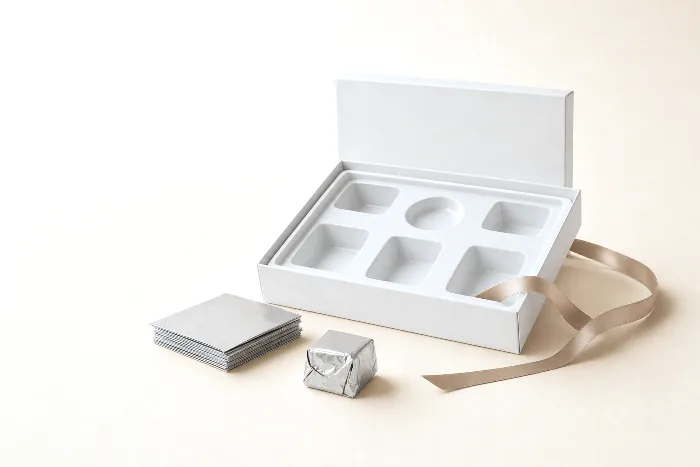
| Boxed chocolates / assortment | Rigid or folding carton with a molded or vacuum-formed insert | Seats each piece so they don't shift or scuff; the box is the gift |
| Individually wrapped pieces | Twist-wrap, foil, or single-piece flow-wrap | Portioning, a tamper cue, and per-piece barrier for truffles, caramels, and pralines |
| Hard candy / mints | Flow-wrap, rigid tin, or pouch | Moisture barrier keeps them from going tacky; tins and pouches reclose |
| Gummies / chewy candy | Resealable stand-up pouch or jar | Moisture barrier plus reseal so pieces don't dry out or fuse together |
| Bulk / pick-and-mix | Stand-up pouch or lidded jar | Volume, reseal, and shelf presence for share sizes |
Notice the pattern: chocolate almost always ends up with a barrier wrap and a structural carton, while sugar candy leans on a single moisture-barrier format that recloses. The rest of this article works through why.
Chocolate: heat, bloom, and barrier
Chocolate is mostly cocoa butter and sugar, and cocoa butter softens right around body temperature (roughly 34–37 °C / 93–99 °F). That single fact drives most chocolate packaging: the pack has to survive warm warehouses, delivery trucks, and a shopper's hand without the product deforming or the wrap sticking to it.
The more subtle enemy is bloom — the pale, marbled film that turns a glossy bar dull. There are two kinds, and it helps to know the difference:
- Fat bloom comes from cocoa butter migrating to the surface and recrystallizing after heat swings. It's the most common form, and it's cosmetic rather than a safety issue, but it reads as "old" to shoppers.
- Sugar bloom comes from moisture condensing on the surface, dissolving sugar, then evaporating and leaving a gritty crust — often after a cold-to-warm swing, like moving a bar out of a fridge.
Packaging can't stop bloom by itself, because the root cause is temperature and humidity swings in the supply chain. What a good wrap does is buy margin: a tight barrier film limits moisture exchange and slows the surface changes, so the product tolerates the swings it will inevitably see. That's why premium chocolate is typically flow-wrapped in a foil or metallized film — the metal layer is an excellent barrier to light, oxygen, and aroma, all of which stale a bar's flavor. Clear or paper-only wraps look great but concede barrier, so they're usually reserved for fast-turning products or paired with a light-blocking carton.
Candy: moisture is the enemy
Sugar confectionery flips the priority. Hard candy, mints, caramels, and gummies are all sensitive to water, just in different directions. Hard candy and many sugar shells are hygroscopic: they pull moisture out of the air, and once the surface picks up water it goes tacky, then cloudy, then sticky enough to weld pieces together. Gummies and chewy candy hold a specific moisture level to stay soft — lose it and they dry and harden; gain it and they clump and bleed color.
The answer in both cases is a moisture barrier, matched to how the product is sold:
- Single-serve and multipack — flow-wrap each piece or run a pillow bag in a moisture-barrier film so the product is protected right up to the moment it's eaten.
- Share and resealable — a high-barrier stand-up pouch with a press-to-close zipper keeps the barrier working after the first opening, which is where a lot of bagged candy quietly goes stale.
- Premium and gifting — a lidded jar or a rigid tin recloses cleanly and adds a keepsake feel, at the cost of weight and shelf space.
Twist-wraps deserve a note: the classic candy twist looks charming and signals "individually wrapped," but an open twist is a weak moisture and oxygen barrier on its own. Products that need real protection either use a sealed flow-wrap instead, or rely on the outer bag or jar to do the barrier work while the twist handles portioning and presentation.
Premium finishes and foil
Confectionery is one of the most visually competitive categories in the store, and a large share of it is bought as a gift, so finish carries real commercial weight. This is where embellishments earn their keep.
Foil is doing double duty in chocolate: a metallized or foil-laminated wrap is both a serious barrier and a premium visual cue, which is why so many bars use it inside the carton. On the printed carton or label itself, the toolkit is broader — foil stamping for metallic type and borders, embossing to raise a logo, spot gloss to make one element pop against a matte field, and soft-touch coatings for a velvety hand-feel that reads as expensive. Each of these is a separate pass in production and interacts with the print underneath, so the artwork has to be built for it. Our guide to label finishes and laminates covers how these effects are specified and where they add cost and lead time.
The discipline is restraint: a foil-stamped, embossed, spot-gloss carton can look luxurious or busy depending on how the layers land in registration. The finishes that flatter a design are the ones chosen to reinforce a single focal point, not to decorate every element.
Cartons, inserts, and gifting
Structure is the other half of confectionery packaging. A folding carton gives a chocolate bar the rigidity to stand on a shelf, the large printable faces a wrap can't offer, and a clean surface for those premium finishes. The carton style — straight-tuck, reverse-tuck, sleeve, or a window carton that shows the product — changes both the shelf look and the machine that fills it. Our overview of folding carton styles walks through the common structures and when each one fits.
Boxed assortments add a component most other food packaging skips: the insert. A vacuum-formed plastic tray or a molded-pulp insert seats each chocolate in its own cavity so pieces don't slide, collide, or scuff against each other in transit — bloom and surface damage both increase when pieces rub. The insert also spaces the pieces for presentation, which is a big part of why an assortment feels like a gift rather than a bag of loose candy. Choosing the insert material is a small sustainability decision in itself: molded pulp is more widely recyclable, while formed plastic holds tighter tolerances and a glossier look.
Seasonality is the confectionery reality that packaging has to plan around. Holidays drive a large share of the category's volume, and each one brings limited-edition graphics, gift formats, and window cartons on tight timelines. Practically, that means artwork and structure that can be re-skinned quickly for a new season without re-engineering the whole pack — the same carton and insert carrying fresh print — so a brand can turn a seasonal run around inside a short production window.
Food-contact safety, briefly
Every layer that touches the sweet — the foil against a bar, the film in a pouch, the coating on a tray — is a food-contact material, and it has to be suitable for direct contact with food. In the United States the FDA regulates food-contact substances, and the practical concern for confectionery is migration: whether anything from the packaging could transfer into the product. Chocolate's fat content matters here, because fats can act as a solvent and pull certain substances more readily than a dry product would, so the film or coating spec is chosen with that in mind.
The rules and the way they're applied change over time and by market, so treat this as orientation rather than a checklist — confirm the specific requirements for your product and region with the relevant authority. Our food packaging regulations primer covers the food-contact basics in more depth, and the official source is the U.S. FDA.
How PackOS helps with confectionery packaging
Whether it's a flow-wrapped bar, a resealable gummy pouch, or a boxed assortment with a fitted insert, confectionery packaging couples a barrier decision to a structural one and a finish. PackOS is built to move that whole bundle quickly. Upload artwork or a die file for food & beverage packaging and it detects the structure, classifies the cut and crease lines, reads the embellishments and finishes, and rebuilds an editable, parametric model — then produces a photoreal 3D proof and an instant quote. You can see the detection and quality checks run on the technology page, or try it on a real file with Quick Quote.
Frequently asked questions
What's the best packaging for chocolate?
Most chocolate is flow-wrapped in a barrier film — often foil or metallized — and then placed in a printed folding carton or sleeve. The wrap guards against heat, light, oxygen, and odor pickup, while the carton adds rigidity, a large printable face, and a premium feel. Boxed assortments use a rigid or folding carton with a fitted insert that seats each piece.
How do you keep candy from getting sticky?
Sugar confectionery is hygroscopic, meaning it pulls in moisture from the air and turns tacky. The fix is a moisture-barrier package: a flow-wrap, a high-barrier stand-up pouch, or a resealable jar or tin. Reseal matters most for multi-serving bags of gummies or hard candy so the barrier still works after the first opening.
What is chocolate bloom, and can packaging prevent it?
Bloom is the pale, streaky film that appears on chocolate. Fat bloom comes from cocoa butter migrating and recrystallizing after heat swings; sugar bloom comes from moisture dissolving surface sugar. Packaging cannot stop bloom on its own, but a good barrier wrap plus stable, cool storage limits the temperature and humidity swings that cause it.
Do boxed chocolates need a plastic insert?
Usually yes. An insert — commonly vacuum-formed plastic or molded pulp — seats each piece in its own cavity so the chocolates do not shift, collide, or scuff during shipping and handling. The insert also spaces the pieces for presentation, which is a large part of why boxed assortments feel like a gift.
Is a flow-wrap or a carton better for a chocolate bar?
They usually work together rather than compete. The flow-wrap is the primary barrier that touches or immediately surrounds the bar and protects it from heat, light, and odor. The carton or sleeve is secondary packaging that adds rigidity, shelf presence, and a premium printed surface. Some bars use only a foil-and-paper wrap, while premium bars add the carton.