
Freeze dried candy packaging: keep the crunch, size the bag, label it right
Freeze dried candy is one of the fastest-moving corners of confectionery — and one of the easiest to ruin between the dryer and the shelf. Get the crunch to the customer and you have a repeat buyer; let moisture back in and you have a chewy bag of disappointment. The packaging is what stands between the two.
THE SHORT ANSWER
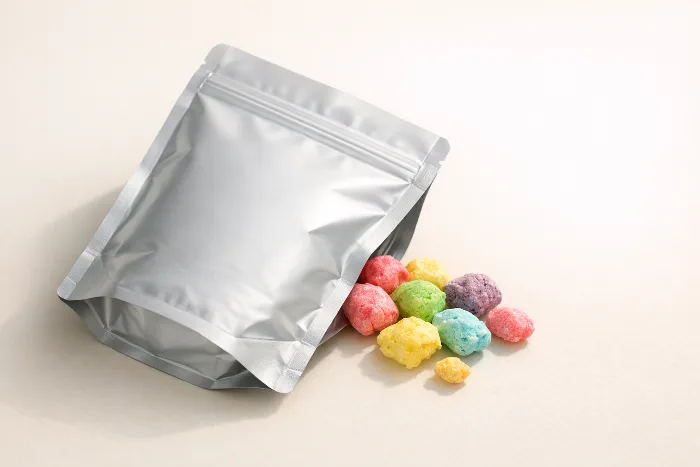
Freeze dried candy packaging needs a high-barrier mylar bag with a low moisture-vapor transmission rate, usually heat-sealed and often holding a desiccant. Freeze drying leaves the candy porous and hygroscopic — it pulls water vapor out of the air and goes chewy the moment it can — so the bag's job is to keep moisture out for the whole shelf life, and to be sized for candy that puffs up to a much larger volume than its weight suggests. The essentials:
- High barrier — metallized PET or foil mylar, not clear poly; it blocks moisture and light.
- Low MVTR — the film's moisture-vapor transmission rate is what actually protects the crunch.
- Right size — freeze dried candy has very low bulk density, so size the bag by volume, not weight.
- Sealed and protected — a full, continuous heat seal, often a food-grade desiccant, and a resealable zipper.
- Labeled right — net weight, ingredients, allergens; cottage-food rules vary by state, so verify locally.
Try the label size calculator →
Why freeze dried candy loses its crunch
Freeze drying (lyophilization) pulls almost all the water out of the candy by sublimation — turning ice directly to vapor under vacuum — and leaves behind a rigid, glassy, extremely porous structure. That porosity is exactly what makes the candy light and crunchy. It is also what makes it desperate to reabsorb water. The finished product is strongly hygroscopic: it pulls water vapor out of the surrounding air and, the moment it picks up moisture, it softens, turns chewy or sticky, and can collapse back toward its original texture.
So the whole design problem of freeze dried candy packaging is a moisture problem. No film is a perfect barrier; water vapor migrates through any plastic, and faster through any weak or channeled seal. What matters is the rate. A metallized or foil laminate can have a moisture-vapor transmission rate orders of magnitude lower than a clear polyethylene bag — the qualitative reason clear "candy bags" that look fine for gummies will let freeze dried candy go stale. Barrier is measured with standardized methods (for example, ASTM moisture-vapor transmission tests); ask your film supplier for the tested value of the structure you buy.
The bag: high-barrier mylar and low MVTR
"Mylar" is the everyday name for a metallized or foil-laminated film bag. A typical high-barrier structure is a laminate: a printable outer layer (often PET), a barrier core (aluminum foil, or metallized PET/aluminum vapor-deposited on film), and a heat-sealable inner layer (usually a polyethylene sealant). The barrier core is the point — it is what blocks moisture, light, and oxygen. Clear films skip that core, which is why they lose to mylar on every barrier axis that matters for freeze dried candy.
Mylar bags for freeze dried candy usually come down to a few honest trade-offs:
- Full foil vs. metallized — a true foil laminate is generally the strongest moisture and light barrier; metallized films are a lighter, often lower-cost barrier that still far outperforms clear poly. Which is "enough" depends on your shelf-life target and storage conditions.
- Window or no window — customers love seeing the candy, but a clear window is a weak spot in an otherwise high-barrier bag. Options are a small window on an otherwise foil bag, a fully printed opaque bag with photography, or a clear bag only for very fast-turn, air-conditioned retail where the product sells through quickly.
- Resealable zipper — a press-to-close zipper is real convenience once the bag is open, but it is not the primary barrier. The factory heat seal is what protects the crunch until the customer opens it; the zipper only slows moisture afterward.
- Stand-up vs. flat — a stand-up pouch merchandises well on a shelf; a flat "lay-flat" bag ships and stores densely. Both can be built to the same barrier. If you want the mechanics of a stand-up format, see our stand-up pouch spec guide.
To weigh film families more broadly — foil vs. metallized vs. clear, and their recyclability trade-offs — see our overview of flexible packaging types and the note on recyclable mono-material pouches. Today the highest-barrier structures for freeze dried candy packaging are typically multi-material laminates; mono-material recyclable options trade some barrier for recyclability.
Sizing the bag for very low bulk density
Here is the mistake almost everyone makes with freeze dried candy bags: they size the bag by weight, using the same rule of thumb they would for the original candy. Freeze dried candy has a very low bulk density — it puffs up to several times its original volume — so a bag sized to the weight of the pre-dried candy will be far too small, and the fragile pieces will be crushed at the seal.
Size by volume, not weight. The reliable method is to measure the puffed volume of your actual product after drying, then add headspace for the heat seal, a desiccant packet, and enough slack that the brittle candy is not crushed in transit. Only then does a bag footprint fall out.
The table below maps common flat mylar bag sizes to the way freeze dried candy makers typically use them. Treat it as a starting point, not a rule: there is no packaging standard for candy bag sizes, and capacity depends entirely on how puffed and dense your specific candy is.
| Common flat bag size | Typical use for freeze dried candy | Note |
|---|---|---|
| ~3.5 × 5 in | Single-serve, samples, impulse | Small portion; least crush headroom |
| ~4 × 6 in | Small grab-and-go retail bag | A light, airy portion looks fuller than it weighs |
| ~5 × 8 in | Standard single-SKU retail bag | The most common size we see for a solo candy |
| ~6 × 9 in | Larger retail or mixed assortment | More puffed volume; watch fill-line and crush |
| ~7 × 10 in and up | Value / bulk / multi-serve | High volume; plan crush protection for shipping |
These are common stock sizes, not a standard. Confirm the real fit with your finished candy before you commit tooling or a print run. Once the bag is chosen, use the label size calculator to fit a front or wrap label to the printable panel — and if you are packing into a jar or tube variant instead of a bag, the same calculator sizes a wrap label to the container's circumference for you.
Desiccants, headspace, and the heat seal
A high-barrier bag only works if it is actually sealed and left room to do its job. Three details decide whether the crunch survives:
- The heat seal is the primary barrier. A continuous, full-width seal with the right temperature, dwell, and pressure is what keeps moisture out until the customer opens the bag. A weak or channeled seal — a tiny unbonded lane across the seal — is a slow leak that will stale the product no matter how good the film is. This is worth verifying on press with seal-strength and leak checks.
- A desiccant is insurance, not a cure. A small food-grade desiccant — silica gel or a molecular sieve packet, clearly marked "do not eat" — mops up residual moisture in the product and any that sneaks in over time. Size it to the headspace and product, but never treat it as a substitute for a proper barrier and seal. If the bag leaks, a desiccant only delays the inevitable.
- Headspace protects a brittle product. Freeze dried candy is fragile. Leave room for the seal and the desiccant, and enough slack that pieces are not crushed when bags are stacked and shipped. Because most freeze dried candy is high-sugar and low-fat, moisture is the main enemy; a foil structure also handles light and oxygen, which mostly matters for color.
Freeze dried candy labels and cottage-food rules
Freeze dried candy labels carry the same core information as any packaged food, generally including:
- Statement of identity — what the product is (e.g., "freeze dried candy" plus the variety).
- Net quantity of contents — the net weight; remember the light, airy product weighs little for its volume, so the number can surprise customers used to dense candy.
- Ingredient list — in descending order by weight.
- Allergen declaration — the major allergens, per FDA labeling requirements.
- Name and address — of the responsible firm (manufacturer, packer, or distributor).
- Nutrition information — a Nutrition Facts panel where required; small-business and low-volume exemptions exist under FDA rules, so verify whether yours applies rather than assuming.
Many home-based makers sell freeze dried candy under a state cottage food law. Whether freeze dried candy qualifies, what statements your label must carry (several states require a "made in a home kitchen" style disclosure, with wording that varies), and where you are allowed to sell all depend on your state's program.
Cottage food rules vary by state. Verify the current requirements with your state's cottage food program and the FDA before you print — and confirm your process with a co-packer or food-safety professional if you scale beyond a home kitchen. This article is general information, not legal or food-safety advice.
For the broader picture of what federal food-label rules require, see our guide to food packaging regulations; for candy-specific format choices beyond freeze dried, see confectionery packaging.
Shelf life and what to promise
Shelf life for freeze dried candy is set by the combination of barrier, seal integrity, desiccant, and storage — not by a number you can copy from a competitor's bag. The honest move is to validate it: run storage tests (real-time and, if you can, accelerated) on your actual product in your actual bag, and print only a date you can stand behind. Then help it keep that promise by storing and shipping cool, dry, and out of direct light. Freeze dried candy is not a cold-chain product, but if a variant includes moisture-sensitive inclusions, our notes on frozen and refrigerated packaging are a useful companion. Do not print a shelf-life you have not tested — a stale bag does more brand damage than a conservative date.
How PackOS helps
PackOS quotes flexible packaging — including the metallized and foil mylar bags freeze dried candy needs — so you can go from a rough idea to a real, structured spec quickly. Upload artwork or a specification and it detects the structure, sizes the material, and returns an instant quote; you can watch the detection run on the technology page. When you are ready to price a real bag of freeze dried candy packaging, start a Quick Quote for a per-bag number instead of a guess. This piece is part of our food & beverage packaging guide, which links every format and compliance deep-dive in the cluster.
Frequently asked questions
Do freeze dried candy bags need a desiccant?
Often, yes. Freeze dried candy is hygroscopic, so a small food-grade desiccant such as silica gel or a molecular sieve packet helps absorb residual and in-package moisture and protect the crunch. A desiccant is insurance, not a substitute for a high-barrier bag and a full heat seal. Use food-grade packets clearly marked do not eat.
What kind of bag is best for freeze dried candy?
A high-barrier, heat-sealed mylar bag — metallized PET or a foil laminate — with a low moisture-vapor transmission rate. Foil and metallized films block moisture and light far better than clear polyethylene, which is why most freeze dried candy ships in opaque mylar. A resealable zipper adds convenience, but the heat seal is the primary barrier.
Why does my freeze dried candy get chewy or stale?
Moisture. Freeze dried candy is hygroscopic, so it pulls water vapor out of the air, and even a slow leak through a low-barrier film or a weak seal lets in enough moisture to soften the crunch. The fixes are a high-barrier bag, a fully sealed heat seal, and often a desiccant.
What has to go on a freeze dried candy label?
Generally the same core food-label elements: the product name, net weight, ingredient list, allergen declaration, and the name and address of the maker. If you sell under a state cottage food law, your state may also require a specific home-kitchen statement and may limit where you can sell. Cottage food rules vary by state, so verify the current requirements with your state and the FDA. This is general information, not legal advice.
How big a bag do I need for freeze dried candy?
Size by volume, not weight. Freeze dried candy has a very low bulk density because it puffs up, so a given weight fills a much larger bag than the same weight of the original candy would. Start from the puffed volume of your actual product, add headspace for the seal and any desiccant, and confirm the fit before you order.