
Food & beverage packaging: the complete guide
From a bag of coffee to a bottle of cold brew, food and beverage packaging does more work than almost any other category: it has to keep the product safe to eat, slow it going stale, survive the supply chain, and still sell itself on a crowded shelf. This guide maps the whole landscape.
THE SHORT ANSWER
Food and beverage packaging is the discipline of containing an edible product, protecting it from the things that spoil it, and doing both with materials that are safe for food contact — while still presenting on shelf and meeting labeling rules. Four ideas run through every decision:
- Barrier first — oxygen, moisture, light, and aroma are what stale food; the structure is chosen to block them
- Food-contact safe — every material that touches the product must be suitable for food contact, and in the US that means cleared under FDA rules
- Format follows the product — flexible pouches and films for dry goods, rigid bottles, cans, and jars for liquids and premium
- Shelf life is engineered — barrier, headspace gas, and closures together set how long it stays fresh
What food and beverage packaging has to do
Every package earns its keep by doing a handful of jobs at once, but food and drink raise the stakes. The product is perishable, it is going to be eaten, and it is regulated. Strip the category down and the same five jobs show up on almost every brief:
- Contain. Hold the product without leaking, crushing, or letting it spill — from free-flowing powder to carbonated liquid under pressure.
- Protect. Shield it from physical damage in transit and on shelf, and from the environmental factors that degrade it: air, water vapor, light, and heat.
- Preserve. Extend usable shelf life. This is the job that separates food packaging from most other categories — the pack is actively fighting spoilage the whole time it sits.
- Sell. Communicate the brand and win the shelf. Food is an impulse and habit category, and the pack is the last piece of marketing before the buy.
- Comply. Carry the required labeling and be made from materials that are safe for food contact.
The art of the category is that these jobs pull against each other. A structure heavy enough to protect a jar of sauce is expensive to ship. A film with a perfect barrier can be nearly impossible to recycle. A window that shows off the product lets in the light that fades it. Good food packaging is a set of deliberate trade-offs, not a single right answer — which is exactly the work we do for teams across the food & beverage industry.
Barrier science: oxygen, moisture, light, and aroma
Most of what makes food go bad can be traced to four culprits, and the packaging structure is chosen to control them:
- Oxygen drives oxidation — rancid fats, faded color, lost vitamins, and the growth of aerobic organisms. Fatty and roasted products (nuts, coffee, chips) are the most oxygen-sensitive.
- Moisture works both ways: dry products like crackers go soft when water vapor gets in, while moist products dry out when it escapes. The film has to hold the product's water activity roughly where it started.
- Light, especially UV, breaks down fats, pigments, and light-sensitive nutrients. Opaque or metallized structures protect against it; a clear window trades some of that protection for shelf appeal.
- Aroma moves in two directions too — flavors and volatiles can leak out, and outside odors can taint the product. Barrier films keep the good smells in and the bad ones out.
No single material blocks all four well while staying cheap, printable, and machinable. So food packaging is usually built as a laminate: several thin layers, each doing one job, bonded into one web. A print layer carries the graphics, a barrier layer (foil, a metallized film, or a specialty resin like EVOH) stops oxygen and light, and a sealant layer melts to close the pack. Understanding how those layers stack is the key to the whole category — our guide to flexible packaging types breaks the common structures down, and the stand-up pouch spec guide shows how one popular format is built from them.
Food-contact safety
Anything that touches the product is a food-contact material, and it has to be suitable for that use. In the United States food-contact materials fall under the U.S. Food and Drug Administration, which governs the substances a package may be made from and the conditions they are cleared for. The practical point for a brand is that the inside sealant of a pouch, the coating on a paperboard carton, the liner in a cap, and any inks or adhesives near the product all sit inside that framework — not just the obvious container.
What "safe" means in detail depends on the product (dry, aqueous, fatty, acidic), the temperature it will see (ambient, chilled, frozen, or heated in the pack), and how long it stays in contact. A structure that is fine for a dry snack may not be appropriate for a hot-fill sauce. Your converter should be able to confirm that the exact structure it prints is suitable for your food and its conditions. For a plain-language walk through the labeling and food-contact basics, see food packaging regulations: FDA & food-contact basics.
Not legal or regulatory advice. This article is a general introduction. Food-contact and labeling requirements depend on the product and the market, are enforced by authorities such as the FDA, and change over time. Confirm what applies to your product with the relevant authority and your own qualified advisors before you go to print, and review it periodically.
Formats by product category
Once you know a product's barrier needs and how it is filled and used, the format usually narrows quickly. The table below is a starting map of the food and beverage categories we build most often, the formats that dominate each, and where the barrier priority sits. Each row links to the deep-dive.
| Category | Common formats | Barrier priority |
|---|---|---|
| Coffee | Stand-up, flat-bottom, and side-gusset bags with a one-way degassing valve | Very high — oxygen, aroma, moisture, and light all matter |
| Snacks | Pillow (fin-seal) bags, stand-up pouches, flow-wrap | High — oxygen and moisture to keep product crisp; often nitrogen-flushed |
| Confectionery | Flow-wraps, cartons, and boxes; pouches and jars for candy | Moderate — moisture and heat for chocolate; premium presentation leads |
| Frozen & refrigerated | Freezer-grade bags and films, coated cartons, lidded trays | Cold-chain first — films must stay flexible cold; condensation and wet strength |
| Beverages | PET and glass bottles, aluminum cans, cartons, spouted pouches | Depends on drink — carbonation, light, and oxygen for sensitive liquids |
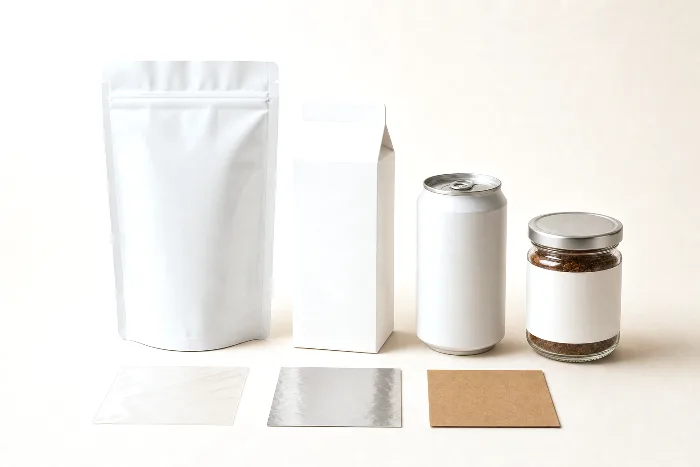
Two patterns are worth calling out. First, dry and shelf-stable products lean flexible — pouches and films give a strong barrier at low weight and low cost. Second, liquids and carbonated products lean rigid, because a bottle, can, or carton handles pressure and pouring in ways a flat film cannot. Most brands end up somewhere on that spectrum, and plenty use both a flexible primary pack and a rigid one across a range.
Shelf life and the freshness levers
Shelf life is not a property of the food alone; it is engineered by the pack. A handful of levers do most of the work, and they combine:
- Barrier level. The single biggest lever. A higher-barrier structure slows oxygen and moisture ingress, which directly extends the freshness window.
- Headspace gas. Flushing the pack with an inert gas — typically nitrogen — displaces oxygen before sealing, so there is less of it inside to attack the product. This is why a bag of chips is partly gas.
- Closures and reseal. A press-to-close zipper, tin-tie, or resealable lid protects the product after the first open, which matters most for multi-serving formats the buyer opens and closes over days or weeks.
- Active components. Degassing valves let freshly roasted coffee release carbon dioxide without letting oxygen back in; desiccants and oxygen absorbers manage moisture and residual air in some dry products.
- Light control. Opacity or a metallized layer keeps UV off light-sensitive products; a clear window is a deliberate trade of some shelf life for shelf appeal.
The right mix depends entirely on the product. Coffee needs a valve and a strong barrier; a shelf-stable cracker needs modest moisture protection and little else. Over-specifying wastes material and money; under-specifying costs shelf life and returns. Getting that balance right is the whole game.
The sustainability tension in food packaging
Food packaging sits on the sharp edge of the sustainability conversation, because the two goals genuinely conflict. The multi-layer laminates that give food its long shelf life mix materials — plastic, foil, sometimes paper — that are hard to separate and therefore hard to recycle. Yet a package that fails and lets food spoil creates far more waste than the packaging itself. Preventing food waste is a real environmental benefit that a naive "less packaging" instinct can undercut.
The industry is working the problem from several directions: mono-material structures that keep a strong barrier while using a single polymer family so they can be recycled in existing streams; source reduction that takes weight out of the pack; and format shifts, such as moving a rigid product into a lighter pouch. None of these is a free win — a mono-material film may need a thicker gauge or a specialty barrier to match a laminate, and recyclability depends on what local systems actually collect. Our sustainable packaging guide and the deep-dive on recyclable mono-material pouches walk through the honest trade-offs without the greenwashing.
How PackOS handles food & beverage packaging
Food and beverage brands run wide ranges — many SKUs, several formats, frequent flavor and seasonal variants — and each one still has to be structurally correct, print-ready, and priced. PackOS is built for that. Upload artwork or a die file for a pouch, carton, label, or bottle wrap and it detects the structure, rebuilds an editable, parametric model, checks it for print-readiness, and returns a photoreal 3D proof and an instant quote. Because the model is parametric, a size or flavor change reflows the die instead of restarting the job, which is how a growing food line keeps its packaging consistent across dozens of variants. You can watch the reconstruction and quality checks run on the technology page, or try it on a real file with Quick Quote.
The full Food & Beverage library
This guide is the overview. Each format below has its own deep-dive with the structures, barrier choices, and freshness details that matter for that product:
- Coffee packaging: bags, valves & freshness — why coffee needs a degassing valve and a high-barrier bag, and the stand-up, flat-bottom, and side-gusset formats.
- Snack packaging: pouches, films & resealability — pillow bags, stand-up pouches, and the barrier and reseal choices that keep snacks crisp.
- Confectionery packaging: chocolate & candy — flow-wraps, cartons, and boxes, and the heat, moisture, and premium-presentation factors.
- Frozen & refrigerated packaging: cold-chain basics — films that stay flexible when cold, condensation, and coatings for wet strength.
- Beverage packaging: bottles, cans & labels — PET and glass bottles, aluminum cans, cartons, and the labels and sleeves that finish them.
Frequently asked questions
What makes food and beverage packaging different from other packaging?
Food and beverage packaging has to keep the product safe to eat and slow the way it goes stale, not just protect and present it. That means controlling oxygen, moisture, light, and aroma with the right barrier, using materials that are cleared for food contact, and choosing a format that fits how the product is filled, stored, and opened. Most other packaging never touches the thing people put in their mouths, so it carries none of those constraints.
What is a food-contact material?
A food-contact material is any material intended to touch food or drink, from the sealant film on the inside of a pouch to the coating on a paperboard carton. In the United States these materials fall under the FDA, and your converter should be able to confirm that the structure it prints is suitable for the specific food and the conditions it will see. Requirements depend on the product and can change, so treat this as a question to verify rather than assume.
What does barrier mean in food packaging?
Barrier is how well a package resists the things that spoil food, mainly oxygen, moisture, light, and the loss of aroma. High-barrier structures add layers such as foil, metallized film, or specialty resins to block those elements and extend shelf life. The barrier a product needs varies widely: coffee and chips need a great deal of it, while a dry cracker needs relatively little.
Is flexible or rigid packaging better for food?
Neither is better in the abstract; it depends on the product. Flexible pouches and films are light, cheaper to ship, and easy to give a strong barrier, which suits coffee, snacks, and many dry goods. Rigid bottles, jars, cans, and cartons suit liquids, carbonated drinks, and products that need a hard shell or a premium feel on shelf.
Is food packaging recyclable?
It depends on the material. Single-material rigid formats such as glass, aluminum, and many PET bottles are widely recycled, while high-barrier flexible laminates often combine several materials that are hard to separate and are not widely recycled today. Mono-material films are closing that gap, but there is a genuine trade-off between barrier performance and recyclability, and local acceptance varies, so verify what is actually collected in your market.