
Snack packaging: pouches, films & resealability
Almost every snack you buy is sold in flexible packaging — a printed film bag or pouch engineered to keep the product crisp and fresh, cushion it in transit, and grab a shopper on a crowded shelf. This guide walks through the formats, the films, and the reseal choices behind them.
THE SHORT ANSWER
Snack packaging is mostly flexible film — pillow bags, stand-up pouches, and flow-wraps — engineered to block oxygen and moisture, cushion fragile product, and increasingly to reseal between servings. The format follows the product; the film is a laminate tuned to the shelf life you need. The core choices:
- Format follows the product — pillow bags for chips, resealable stand-up pouches for shareable portions, flow-wraps for bars and single items
- Barrier is the job — oxygen and moisture staling is held off with laminated, often metallized, film
- The "air" is nitrogen — a flush displaces oxygen and cushions the contents
- Reseal for portions — zippers, sliders, and peel-reseal labels turn a one-sitting bag into a multi-serving one
What snack packaging has to do
Snacks are an impulse category. A bag has to survive a bumpy trip through distribution, sit on a shelf looking appetizing, catch a shopper's eye in a fraction of a second, and then keep the product fresh once it's home and half-eaten. That's a lot of jobs for a few grams of film, which is why snack packaging is one of the most refined corners of flexible packaging.
Four demands drive almost every decision:
- Protection. Chips, crackers, and puffs are fragile. The pack has to cushion them so they arrive whole, not as a bag of crumbs.
- Barrier. Oxygen turns fats rancid and moisture turns crisp snacks stale. The film has to hold both out for the product's intended shelf life.
- Shelf appeal. Bold, printable film has to stand out in a sea of competitors — snacks live and die on the grab.
- Reseal. More snacks are sold as shareable or multi-serving portions, so the pack increasingly has to open and close again without spilling.
Almost all of this is delivered by flexible packaging — printed film rather than a rigid container. Snack packaging is one branch of the complete guide to food & beverage packaging, and it leans on the same material families used across the category.
The main snack formats
Most snacks land in one of a handful of flexible formats. The right one depends on the product's fragility, the serving model, and how the bag needs to present on shelf.
| Format | Reseal | Best for |
|---|---|---|
| Pillow / fin-seal bag | Not typically | Chips, crackers, puffs — runs fast on vertical form-fill-seal lines and uses very little film |
| Stand-up pouch | Yes — press-to-close or slider zipper | Shareable and multi-serving snacks: jerky, trail mix, granola, dried fruit |
| Flow-wrap (horizontal) | Not typically | Bars, cookies, and other rigid single portions wrapped on a horizontal line |
| Quad-seal / box pouch | Optional zipper | Larger fills and premium shelf presence — pretzels, popcorn, snack mixes |
The pillow bag — a simple back-seam tube closed with a top and bottom seal — is the workhorse of the chip aisle because it's fast to fill and film-efficient. When a snack is meant to be eaten over several sittings, a stand-up pouch with a zipper is the usual upgrade; our stand-up pouch spec guide covers how those are dimensioned, gusseted, and sealed. Flow-wraps suit anything rigid and single-serve, like a bar or a sandwich cookie, and quad-seal bags stand squarely on shelf for larger or more premium products.
Format is not purely a shelf decision — it also sets the filling method, the line speed, and how much film goes into each unit. A pillow bag on a vertical form-fill-seal line trades reseal and shelf presence for throughput and low material cost, while a pre-made stand-up pouch costs more per unit but arrives ready to fill and reads as a more premium product. Snacks with a strong aroma or high oil content push toward higher-barrier structures, the same way coffee does; if that's your product, the trade-offs in coffee packaging map closely onto snacks.
Barrier films and metallization
The quiet engineering in a snack bag is the film itself. Very few snack packs are a single sheet of plastic. Most are a laminate — two or more thin webs bonded together, each contributing a property the others can't.
A typical snack laminate stacks three roles:
| Layer | Common materials | Job |
|---|---|---|
| Outer / print | PET, BOPP | Carries the print, adds stiffness and gloss, protects the graphics |
| Barrier (middle) | Metallized film, aluminum foil, EVOH, metal-oxide coatings | Blocks oxygen, moisture, and light |
| Sealant (inner) | PE, PP | Melts to form the seals; this is the food-contact surface |
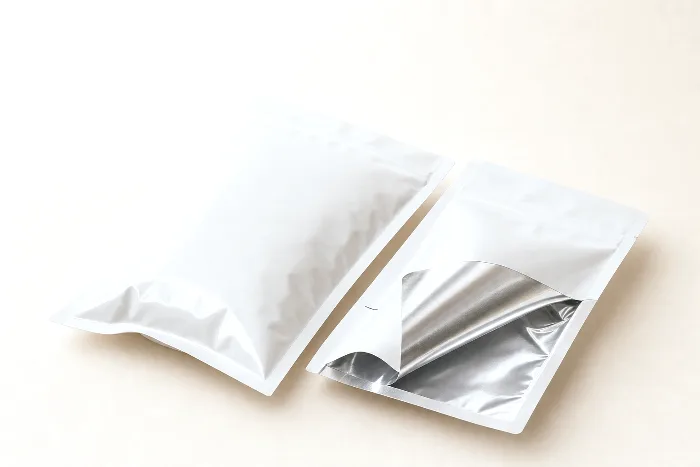
Metallization is why so many chip bags look silver on the inside. A microscopically thin layer of aluminum is vacuum-deposited onto a film web, blocking light and sharply improving the oxygen and moisture barrier at a fraction of the weight and cost of true foil. When a brand wants the product visible through the pack, clear high-barrier alternatives — metal-oxide coatings or an EVOH layer — can deliver much of the same protection while staying transparent.
Barrier is a spectrum, not a switch. A clear polypropylene bag can be fine for a fast-selling cracker, while an oil-rich, long-shelf-life snack may need a metallized or foil-grade laminate. Matching the structure to the real shelf-life target is where cost and quality get balanced — more barrier than you need is wasted money, less than you need is a stale product. The substrate families and their trade-offs are laid out in our guide to flexible packaging types. The catch is recyclability: a metallized, multi-material laminate is hard to recycle through standard curbside programs, which is the tension that mono-material pouches try to resolve.
Nitrogen flush and slack fill
Open a bag of chips and it seems half empty. That space is deliberate, and the gas inside usually isn't ordinary air.
During filling, many snack lines flush the headspace with nitrogen — an inert gas — to push out oxygen before the bag is sealed. Less oxygen means slower staling and rancidity, so the product lasts longer. The gas cushion does a second job: it protects fragile chips from being crushed in transit, acting like a pillow around the contents. The empty-looking volume is the headspace, and the portion beyond what the product occupies is often called slack fill.
Slack fill has a fair-packaging dimension too — a pack shouldn't be misleadingly empty relative to its contents — which is one reason fill level, bag size, and net weight are dialed in together rather than guessed. Get the headspace right and you protect the product without shipping a lot of air.
Resealability options
For anything sold as more than a single serving, reseal is now close to table stakes. The common mechanisms:
- Press-to-close zipper — the familiar interlocking rib-and-groove strip; simple and inexpensive.
- Slider zipper — a plastic slider rides along the zipper for easy one-handed open and close; a premium feel at a higher cost.
- Peel-and-reseal label — a pressure-sensitive adhesive flap over a cut opening, common on flatter or single-web packs.
- Tin-tie or fold-over — a bendable strip folded to hold the pack shut; more common on coffee and bakery than on snacks, but occasionally used.
The reseal choice interacts with the format and the film. A zipper adds a strip that has to be welded into the seal, which affects the bag's dimensions and the fill line, so it's decided alongside the structure — not bolted on at the end.
Food-contact and safety
Because snacks are food, everything that touches the product has to be a suitable food-contact material. In the US, food-contact substances fall under the U.S. Food and Drug Administration framework, and converters typically supply films and inks that are compliant for the intended contact and use. The practical implication for a brand is to confirm food-contact suitability with your supplier and to keep non-food-safe inks and coatings off the sealant side of the film. For a fuller picture of the rules that apply here, see our overview of food packaging regulations.
Requirements and their interpretation change over time and can vary by product and market, so treat this as orientation rather than legal guidance and verify the specifics with your supplier and the relevant authority.
How PackOS helps with snack packaging
Snack packaging looks simple and is quietly full of decisions: format, film structure, barrier level, reseal, bag size, and the printed artwork that ties them together. PackOS is built to move from an idea or an existing file to a manufacturable spec and a price quickly. Upload artwork, a sample, or a rough spec and it detects the structure, dimensions the pack, and produces a photoreal 3D proof plus an instant quote — the same workflow behind the food and beverage brands we build for. You can watch the reconstruction run on the technology page, or run a real file through Quick Quote.
Frequently asked questions
What kind of packaging are snacks usually sold in?
Most snacks are sold in flexible packaging — pillow bags (fin-seal bags) for chips and crackers, stand-up pouches with a resealable zipper for portions meant to be eaten over several sittings, and flow-wraps for bars and single items. The film is usually a laminate of two or more layers chosen for barrier, strength, and sealability.
Why are chip bags filled with air?
The gas inside a chip bag is mostly nitrogen, not ordinary air. Nitrogen is flushed in to displace oxygen, which would otherwise make the chips go stale and rancid, and the cushion of gas protects fragile chips from crushing during shipping and handling. The extra space is called headspace or slack fill.
What makes a snack bag keep food fresh?
Freshness comes from the barrier film. A snack bag blocks oxygen, moisture, and light, and often uses a metallized or foil layer to do it. Combined with a nitrogen flush and a good seal, a high-barrier laminate keeps chips crisp and fats from going rancid for the product's intended shelf life.
Can snack pouches be resealable?
Yes. Stand-up pouches and larger bags can be built with a press-to-close zipper, a slider, or a peel-and-reseal adhesive label so the pack can be opened and closed repeatedly. Single-serve pillow bags and flow-wraps are usually meant to be eaten in one sitting and are not resealable.
Are snack packaging films recyclable?
Most traditional snack films are multi-material laminates that are hard to recycle through standard curbside programs. Mono-material structures, built from a single polymer family, are designed to be more recyclable while keeping enough barrier, but they involve trade-offs. Recyclability depends on the structure and the collection programs available in your market.