
Caps & closures: CRC, dispensing & sealing
A container is only as good as the part that closes it. This guide covers the closures that finish bottles, jars, and tubes — screw caps, disc-tops, flip-tops, pumps, triggers, droppers, and child-resistant caps — and how they seal, dispense, and match the neck they sit on.
THE SHORT ANSWER
A closure is the part that seals and often dispenses a container — a screw cap, snap cap, disc-top, flip-top, pump, trigger sprayer, dropper, or child-resistant cap. Its job is to seal the container reliably, control how the product comes out, and — for regulated products — resist opening by children. One rule governs all of them: the closure's thread finish must match the container's neck finish exactly.
- Match first — the cap and neck must share the same thread finish (e.g. 24-410) or it won't seal
- Seal — liners and induction seals close the gap; tamper bands and foil show first opening
- Dispense — disc-tops, flip-tops, pumps, triggers, and droppers each meter product differently
- Child-resistant — CRCs trade easy access for a push- or squeeze-and-turn action where required
- Recyclability — multi-part pumps and droppers are harder to recycle than a simple screw cap
What a closure has to do
A closure is the finishing part of a rigid container — the cap, lid, pump, or dropper that turns an open bottle or jar into a sealed, shippable, usable package. It's easy to treat the closure as an afterthought once the bottle is chosen, but it does several jobs at once, and getting any of them wrong shows up fast: on the filling line, in transit, or in the customer's hand.
- Seal — keep the product in, and keep air, moisture, and contaminants out.
- Dispense — control how the product leaves: pour, squeeze, pump, spray, or drip.
- Protect — survive shipping and handling, resist back-off and leaks, and for many products resist opening by children.
- Communicate — carry branding, an open/closed cue, and often a visible sign of tampering.
Because the closure sits at the interface between the container and the user, it's where most in-use complaints originate — a cap that cross-threads, a pump that stops priming, a liner that leaks. This article walks the main closure families, how they mate to a container, how they seal, and where child-resistance and recyclability come in. It's part of our complete guide to rigid packaging, which covers the bottles, jars, and tubes these closures finish.
Thread finishes: why the cap must match the neck
The single most important compatibility fact about closures is this: a cap only fits a container whose neck it was specified for. That match is described by a thread finish (also called a neck finish) — a standardized pairing of a neck's diameter and its thread profile. If the two don't share the same finish, the cap either won't thread on or won't seal, no matter how close it looks.
Finishes are usually written as two numbers, such as 24-410. The first number is the nominal outside diameter of the neck in millimeters; the second is a thread-style code that defines the thread's height, its turns, and its profile. A 24-400 and a 24-410 share the same 24 mm diameter but have different thread heights, so their caps are not interchangeable — a common and costly mix-up. Continuous-thread (CT) finishes are the everyday screw-on standard; other systems exist for specialty and industrial containers.
The finish also decides what sealing method is available and whether a given liner or induction seal will register on the land. Because the finish is a shared spec, the practical rule is to specify the closure and the container together and confirm the exact finish code before anyone cuts tooling. For the container side of that spec — materials, shapes, and how neck finishes are called out — see our guide to bottle types and neck finishes.
Closure types at a glance
Most closures fall into a handful of families. They differ mainly in how — or whether — they dispense, and in how they seal against the neck. Here's the working vocabulary.
| Type | Dispensing | Notes |
|---|---|---|
| Screw / continuous-thread | Remove to pour | The workhorse. Simple, cheap, reliable; takes a liner or induction seal. Can be made child-resistant. |
| Disc-top | Press the disc, squeeze | One-hand open/close for lotions, shampoos, and sauces. Meters a controlled stream. |
| Flip-top / hinged | Flip the lid, squeeze | Fast open/close; small orifice for precise dosing. Common on personal care and condiments. |
| Snap / press-on | Remove or peel | No threads — presses onto a bead. Used for lightweight lids, spice caps, and over-caps. |
| Pump | Depress the actuator | Meters a fixed dose of lotion, serum, or soap. Multi-part with a spring and dip tube. |
| Trigger sprayer | Pull the trigger | Atomized or stream spray for cleaners and mists. The most complex common closure. |
| Dropper | Squeeze the bulb | Drop-by-drop dosing for serums, tinctures, and essential oils. Glass or plastic pipette. |
| Child-resistant (CRC) | Push- or squeeze-and-turn | A screw or snap cap engineered so a second motion is needed to open. Required for many categories. |
Within each family there are dozens of variants — orifice sizes, actuator styles, spray outputs. The families above are the ones you'll pick between when you spec a package.
How closures seal: liners, induction seals & tamper bands
Threading a cap on is not, by itself, a seal. The seal is what closes the gap between the closure and the top of the neck (the "land"). There are a few common ways to make it, and they're often combined.
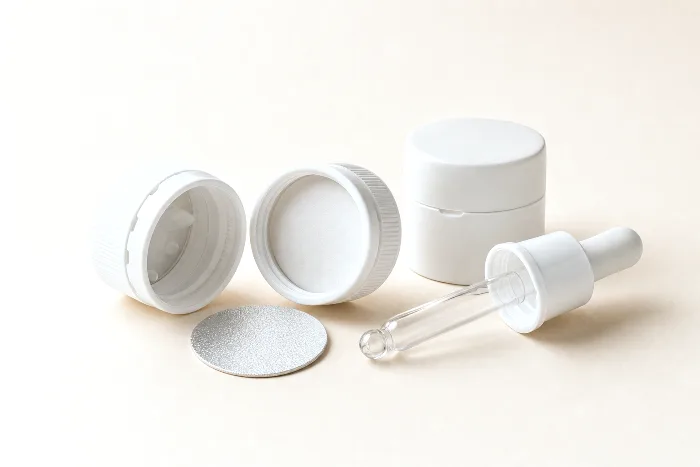
- Liner seals. A disc inside the cap — foam-backed, pulp-and-foil, or a specialty laminate — that compresses against the land when the cap is tightened. Linerless caps replace the disc with a molded sealing ring or plug that grips the inside or top of the neck.
- Induction seals. A foil membrane placed in the cap and bonded to the neck by heat after capping. It gives a hermetic barrier and, because it must be broken to open, doubles as tamper-evidence.
- Tamper bands. A ring below the cap skirt that stays on the neck when the cap is first unscrewed, or a shrink band over the whole closure. Both make a first opening visible.
Induction seals and tamper bands are the everyday mechanisms of tamper-evidence — the visible proof that a package hasn't been opened. It's a distinct idea from child-resistance (which is about difficulty of opening, not evidence of it), and the two are frequently paired on the same package. For the mechanisms in depth, see our guide to tamper-evident packaging.
Child-resistant closures
A child-resistant closure (CRC) is a cap engineered so that opening it takes a coordinated action most young children can't perform — most commonly a push-and-turn or squeeze-and-turn motion — while remaining openable by adults, including seniors. It is not a lock; the goal is to slow and deter, not to make a package impossible to open.
In the United States, child-resistant packaging is governed by the U.S. Consumer Product Safety Commission (CPSC) under the Poison Prevention Packaging Act (PPPA), and closures are commonly tested and classified against the ASTM D3475 standard. Which specific products require CR packaging, and how a design is tested and certified, are set by regulation and can change — and additional rules apply to categories such as cannabis that vary widely by state or market. Treat CRC selection as a compliance decision, not just a hardware choice. Our overview of child-resistant packaging requirements covers the concept in more depth.
Matching a closure to the product
The right closure follows from the product's viscosity, dose, and use context — how thin it is, how much comes out per use, and whether it needs one hand or precise metering. The pairings below are typical starting points, not rules; your fill, neck finish, and compliance needs decide the final choice.
| Product | Typical closure | Why |
|---|---|---|
| Thin liquids (toners, oils) | Disc-top or flip-top | Controlled pour or squeeze without spills; one-hand open/close. |
| Lotions & creams | Pump or disc-top | Meters a consistent dose; keeps fingers out of the product. |
| Cleaners & sprays | Trigger sprayer | Atomized or stream output over a surface; adjustable nozzle. |
| Serums & tinctures | Dropper | Drop-by-drop dosing for small, high-value volumes. |
| Pills & supplements | CR screw cap + induction seal | Child-resistance plus a tamper-evident, moisture-limiting barrier. |
| Powders & dry goods | Wide-mouth screw cap | Big opening for scooping or pouring; liner keeps it fresh. |
Where a product spans categories — a cannabis tincture that is both high-value and regulated, say — the closure has to satisfy two masters at once: a dropper for dosing and a child-resistant, tamper-evident construction. Spec those constraints together rather than bolting one on later.
The recyclability of multi-part closures
Closures are where a nicely recyclable container can quietly lose its recyclability. A plain polypropylene screw cap is about as good as it gets: single-material, and — following current guidance from groups like The Association of Plastic Recyclers — best left screwed onto the container so it isn't lost as a loose small item in sorting. The complications start when a closure combines materials.
- Pumps and trigger sprayers pack a plastic body, a metal spring, a dip tube, and sometimes a glass or metal ball into one part. Mixed materials that are hard to separate are frequently not accepted in curbside streams.
- Droppers pair a plastic or aluminum collar with a rubber bulb and a glass or plastic pipette — again, several materials in a small assembly.
- Metal-shelled and decorated caps can carry coatings or liners that complicate recovery.
The levers that help are the familiar ones: choose mono-material where the function allows, prefer spring-free or all-plastic pump designs as they mature, and keep sorting-hostile decoration to a minimum. Recyclability also depends on what your local system actually accepts, which varies — so verify against local guidance. None of this is a reason to skip a pump a product needs; it's a reason to weigh the closure's end-of-life alongside its function.
How PackOS handles closures
Because the closure and the container are a single spec — the finish has to match, the seal method has to suit the fill, and the compliance layer has to be right — PackOS treats them together. It captures the neck finish, the closure type, and the sealing and tamper-evidence approach as part of one package definition, so the pieces are checked for fit before anything is priced or tooled. From there it produces a proof and an instant quote against a package it knows will actually close. You can see how the structure model works on the technology page, or put a real spec in front of it with Quick Quote.
Frequently asked questions
What is the difference between a cap and a closure?
Closure is the umbrella term for anything that seals the opening of a container — screw caps, snap caps, pumps, droppers, and dispensing tops all count. A cap usually means a simple threaded or snap-on lid. Every cap is a closure, but not every closure is a cap.
What does a closure thread finish like 24-410 mean?
A thread finish is the standardized spec shared by a container neck and its matching cap. In a code like 24-410, the first number is the neck outside diameter in millimeters and the second describes the thread style — its height, number of turns, and profile. The cap must share the same finish as the neck or it will not seal.
What is a child-resistant closure?
A child-resistant closure is a cap designed to be difficult for young children to open while still usable by adults, usually through a push-and-turn or squeeze-and-turn motion. In the United States these fall under the Consumer Product Safety Commission and the Poison Prevention Packaging Act, with specific categories and testing set by regulation. This is general information, not legal advice — verify current requirements with the CPSC.
How does an induction seal work?
An induction seal is a thin foil membrane placed inside the cap and bonded to the container rim. After the cap is applied, the container passes under an induction coil that heats the foil and melts a polymer layer, welding the seal to the lip. Removing the cap reveals an intact foil seal, which provides visible tamper-evidence and a barrier against leaks and moisture.
Are dispensing closures recyclable?
It depends on the closure. A simple polypropylene screw cap is widely accepted where the container itself is recyclable, but pumps, triggers, and droppers combine several materials — plastic, metal springs, glass, and rubber — that are hard to separate, so they are often not accepted curbside. Mono-material and spring-free designs improve the odds. Check local guidance, since acceptance varies.