
Jar packaging: glass & plastic jars
The jar is one of packaging's oldest shapes and still one of the most versatile — a wide-mouth container that holds everything from face cream to salsa to gummy vitamins. This guide covers what jars are for, the common styles and materials, and how they get sealed and labeled.
THE SHORT ANSWER
A jar is a wide-mouth rigid container — usually shorter and broader than a bottle — made from glass or plastic and closed with a threaded lid. The wide opening is the whole point: it lets you fill, scoop, or dip into thick and chunky product that a narrow bottle neck can't handle.
- Wide mouth — for creams, balms, spreads, spices, and supplements
- Glass vs plastic — premium and inert vs light and shatterproof
- Styles — straight-sided, tapered, French square, hexagonal, low-profile
- Sealed by a lid plus a liner or induction seal
- Wide, flat walls give jars generous label real estate
What a jar is for
A jar is a rigid container defined by one feature above all others: a wide mouth. Where a bottle narrows to a small neck for pouring or dispensing, a jar keeps its opening nearly as wide as its body, so you can reach in with a finger, a scoop, or a spoon. That single difference decides almost everything else about the format — how it's filled, what it holds, and how it presents.
Jars suit product that a narrow neck can't handle:
- Thick or semi-solid — creams, balms, salves, ointments, hair masks, body butter
- Chunky or granular — spices, dry rubs, loose tea, bath salts, granola
- Wet and spoonable — sauces, salsa, jam, honey, nut butter, pickles
- Countable solids — gummies, capsules, candies, cotton rounds
Because you access the product directly, jars also read as generous and premium. You see the full contents through a clear jar, and a wide lid feels substantial in the hand. That's why cosmetics, candles, and specialty food reach for jars even when a pouch or tube would use less material. The trade-off is efficiency: a jar's wide opening and rigid walls make it heavier and bulkier to ship than a flexible pack holding the same volume, so the format is a deliberate choice for presentation and access rather than the cheapest way to move product.
Jars are one branch of the wider family of rigid containers — bottles, jars, tubes, cans, and their closures. If you're weighing a jar against a bottle or a tube for the same product, start with the complete guide to rigid packaging and come back here for the jar detail.
Jar styles: straight-sided, tapered and more
"Jar" covers a surprising range of profiles, and the shape you pick affects filling, shelf presence, stacking, and how a label wraps. The common families:
| Style | Profile | Best for |
|---|---|---|
| Straight-sided | Vertical walls, cylindrical, flat shoulder | Cosmetics, candles, food; large flat label area |
| Tapered (jelly) | Slightly wider at the mouth than the base | Spoonable food; easy fill and clean scrape-out |
| Low-profile / ointment | Short and very wide | Balms, salves, samples, solid perfume |
| French square | Square body with rounded corners | Spices and dry goods; packs tightly on shelf |
| Hexagonal | Six flat faceted sides | Jam, honey, artisan food; decorative look |
| Bail / clamp | Straight-sided with a wire bail lid | Preserves, specialty and gift food |
The profile is not just cosmetic. A tapered jar releases the last of a thick product more easily and de-molds cleanly on a filling line; a straight-sided jar stacks and cases efficiently and gives the flattest label panel; a French square makes the most of shelf depth. Wide, low jars are stable but tip-prone when tall stacks are shipped, so the packout and the closure torque matter as much as the silhouette.
Some jars add a second wall. A double-wall jar has an outer shell around an inner cup, which creates a thick, luxe look and a small insulating air gap — common in prestige skincare. It uses more material for the same fill, a trade-off worth naming up front when weight, cost, or recyclability are on the table.
Jar materials: glass vs plastic
The biggest jar decision is glass or plastic. Each has a distinct feel, weight, barrier, and recycling story.
| Material | Feel | Typical use |
|---|---|---|
| Glass | Premium, weighty, inert, high clarity | Cosmetics, candles, specialty food, prestige supplements |
| PET | Clear and glass-like, light, shatterproof | Food, supplements, personal care that needs clarity |
| PP | Opaque or frosted, soft-touch, heat-tolerant | Creams, thicker cosmetics, hot-fill food |
| PS | Rigid and glassy but brittle | Dry cosmetics, some spice and craft jars |
| Acrylic (PMMA) | Thick, glass-like, luxe | Prestige skincare double-wall jars |
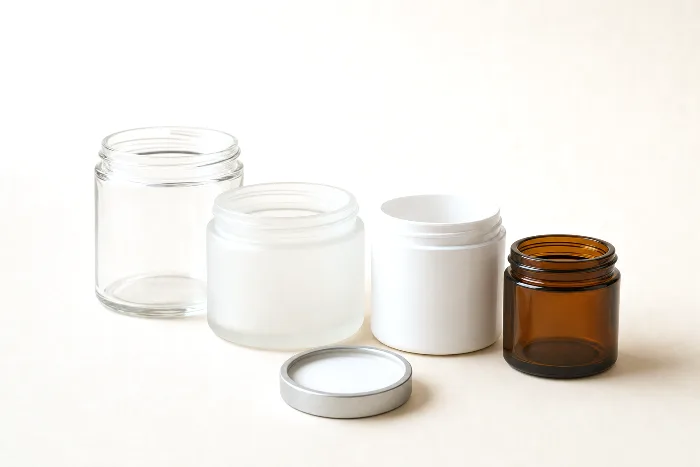
Glass is inert — it won't interact with acids, oils, essential oils, or fragrances — and it's an excellent oxygen and moisture barrier, so it protects sensitive formulas and preserves flavor. It also recycles readily and can be reprocessed repeatedly without losing quality. The costs are weight and fragility: glass is heavy to ship and can break, which raises freight and adds secondary-packaging demands. Amber, green, and frosted glass add light protection for formulas that degrade in UV.
Plastic jars flip those trade-offs. PET and PP are light, shatterproof, and cheaper to ship, and PP tolerates the heat of hot-fill food and repeated washing. Their barrier is lower than glass and their feel is less premium, though a well-made PET jar reads close to glass on shelf. Where recycled content matters, rPET jars carry post-consumer material with the clarity of virgin PET, and both PET and HDPE have established recycling streams — while PP and PS acceptance varies more by region.
Deciding between the two is rarely a slam dunk — it's a genuine set of trade-offs across feel, weight, breakage, freight, and recyclability. We work through them in detail in glass vs plastic packaging: an honest comparison.
Liners, induction seals and lids
A jar isn't finished until it's closed, and the closure does more than sit on top. It seals the product in, sometimes dispenses, and often carries the tamper-evidence and freshness protection the product needs.
Most jars use a threaded lid — a continuous-thread cap that screws onto the jar's neck finish. The finish (the diameter and thread style at the jar mouth) and the lid have to be specified as a matched pair: a lid built for one finish won't seal on another, so the jar and the closure are always chosen together, never in isolation. Beyond the lid, jars commonly add an inner seal:
- A liner — a disc inside the cap that compresses against the jar rim to seal as the lid is tightened.
- A pressure-sensitive (PS) seal — a peel-off disc that sticks to the rim with no heat, giving a visible seal on opening.
- An induction seal — a foil membrane heat-bonded to the rim under the cap, giving a hermetic seal and clear tamper-evidence when the buyer breaks it.
Wide-mouth jars can also take flip-top, disc-top, or pump closures for lotions and serums, and child-resistant lids where the contents call for them. The full menu of caps, liners, and seals — and how the thread finish has to match the container — is covered in our guide to caps and closures.
The wide-label real estate
The jar's wide, often straight walls are a gift to a brand: they give a broad, flat panel for a label or print, front and center at eye level. Most jars are decorated with a wrap label, though shrink sleeves and direct print (screen or digital) are options at higher volumes or where full coverage is wanted.
A wrap label on a jar is sized to the circumference and the straight wall height, not the volume — a common source of error. Two details decide whether it looks clean: the overlap seam (where the label's leading and trailing edges meet, usually a few millimeters of overlap so there's no visible gap) and any curve at the shoulder or base that a flat label can't follow. Straight-sided jars are the easiest to label because the wall is a true cylinder; tapered and shouldered jars need a label shaped to the taper or kept to the straight zone so it doesn't wrinkle.
For cosmetic jars specifically — where the label, the lid, and the jar together carry a premium unboxing experience — the shape, wall construction, and decoration choices get their own treatment in cosmetic jar packaging: creams, PCR and airless.
Getting the wrap right starts with the real container dimensions. Measure the actual circumference and wall height, not the nominal fill size, or the label gaps, floats, or wrinkles once it's applied to a jar that isn't quite the shape the artwork assumed.
How PackOS handles jars
PackOS treats a jar the way it treats any container: as a set of real dimensions and a decoration surface. Upload a label artwork, a jar spec, or a previous file, and it reads the wrap size, checks that the artwork fits the circumference and wall with proper bleed and safety, and renders a photoreal 3D proof of the jar with the label in place — so you can see the seam, the coverage, and the fit before anything is printed. From the same understood dimensions it can price the label run. You can see the reconstruction on the technology page, or try it on a real file with Quick Quote.
Frequently asked questions
What is a jar in packaging?
A jar is a wide-mouth rigid container, usually shorter and broader than a bottle, made from glass or plastic. The wide opening is the defining feature — it lets you fill, scoop, or dip into thick or chunky product like creams, balms, spices, sauces, and supplements that a narrow bottle neck can't handle.
Glass or plastic for jars — which is better?
Neither is universally better. Glass feels premium, is inert, is an excellent barrier, and recycles readily, but it is heavy and can break. Plastic jars in PET or PP are light, shatterproof, and cheaper to ship, but they offer a less premium feel and a lower barrier. The right choice depends on the product, the brand position, and your shipping and sustainability priorities.
What is a straight-sided jar?
A straight-sided jar has vertical walls that run straight from the base to the shoulder, giving a clean cylindrical shape and a large, flat label area. It is one of the most common jar styles for cosmetics, candles, and food because it stacks well, looks modern, and takes a wrap label cleanly.
How are jars sealed?
Jars are sealed by the closure and, often, an inner seal. A threaded lid screws onto the neck finish, and a liner, a pressure-sensitive seal, or a heat-applied induction seal sits between the lid and the jar mouth to keep product fresh and show evidence of tampering. The lid and the jar's neck finish have to be specified together so the threads match.
What size label does a jar need?
A jar's label is sized to its circumference and straight wall height, not its volume. Because jars are wide and short, they offer a broad, flat panel, but a full wrap has to account for the overlap seam and any curve at the shoulder or base. Measuring the actual container, rather than guessing from the fill size, is what keeps the wrap label from gapping or wrinkling.