
Cosmetic jar packaging: creams, PCR & airless
The jar is the face of premium skincare — a wide-mouth vessel you dip into for a cream, a balm, or a mask. Choosing one means balancing feel in the hand, compatibility with the formula, hygiene, and how easily the whole thing can be recycled.
THE SHORT ANSWER
A cosmetic jar is a wide-mouth rigid container for thick, scoopable products — face and body creams, balms, masks, and scrubs. The decisions that define one are the material (glass, PP, acrylic, or PCR-based resin), single-wall vs double-wall construction, whether the formula needs an airless jar to stay stable, and how the jar is sealed and decorated. The core trade-off is always the same: the more premium and multi-part the jar, the harder it is to recycle.
- Material sets feel and recyclability — glass is premium and inert; PP and acrylic are lighter; PCR cuts virgin plastic
- Double-wall jars look more substantial but combine materials, making them harder to recycle
- Airless jars protect oxidation-prone actives and keep fingers out of the product
- Liners, discs, and induction seals keep product fresh and leak-free in transit
- Every added part or material lowers the odds the jar is recycled at end of life
Why creams and balms go in jars
Jars exist for products you scoop rather than pour or pump. A rich moisturizer, a body butter, a cleansing balm, a clay mask, a sugar scrub — these are high-viscosity textures that don't move well through a narrow neck or a pump dip tube. The wide mouth of a jar gives full, easy access to the product, right down to the last of it, and that generous opening is part of the ritual buyers associate with a treat-yourself cream.
The flip side is exposure. An open jar puts the whole surface of the formula in contact with air and, usually, with fingers. For a stable balm that's fine. For a thin serum or an active-heavy treatment, a jar is often the wrong call — those dispense better and stay more stable in a squeeze tube or a pump or dropper bottle. Match the vessel to the viscosity first, then worry about the look. Jars are one format in a much larger toolkit; this article is part of the complete guide to beauty & cosmetic packaging, and the mechanics shared across every wide-mouth container are covered in our jar packaging guide.
Jar materials: glass, PP, acrylic and PCR
Material is the first real decision, because it sets three things at once: how the jar feels in the hand, how it interacts with your formula, and what happens to it after use. Here's how the common choices compare.
| Material | Feel | Notes |
|---|---|---|
| Glass | Premium, weighty, cool to the touch | Inert and compatible with nearly any formula; widely recycled; heavy and breakable, which raises freight and drives protective secondary packaging |
| PP (polypropylene) | Light, utilitarian | Strong chemical resistance; shatter-resistant; recycles in many curbside programs; reads less luxe than glass or acrylic |
| Acrylic (PMMA) | Glass-like, luxe, thick-walled | High clarity and heft without the weight of glass; can craze or fog when it contacts certain solvents and actives; rarely accepted for recycling |
| PCR | Depends on the base resin | Post-consumer recycled content (typically in PP or PET) cuts virgin plastic; expect slight color and shade variation batch to batch |
A few practical notes. Glass wins on prestige and on compatibility — if a formula is aggressive or fragrance- heavy, glass rarely reacts with it. Acrylic gives you that thick, jewel-like wall that many prestige brands want, but it is one of the trickier plastics for both chemical compatibility and end-of-life, so test your formula against it before committing. PP is the workhorse: safe, light, and recyclable, if less glamorous. PCR isn't a separate material so much as a sourcing choice layered onto PP or PET — it lowers the virgin-plastic footprint but, as we'll see, doesn't automatically make the finished jar recyclable.
Single-wall vs double-wall jars
Beyond the material, jars come in two construction styles, and the difference is mostly about presence on shelf.
- Single-wall — one continuous wall holds the product. It's the most material-efficient option, the lightest to ship, and by far the easiest to recycle because there's only one part to deal with.
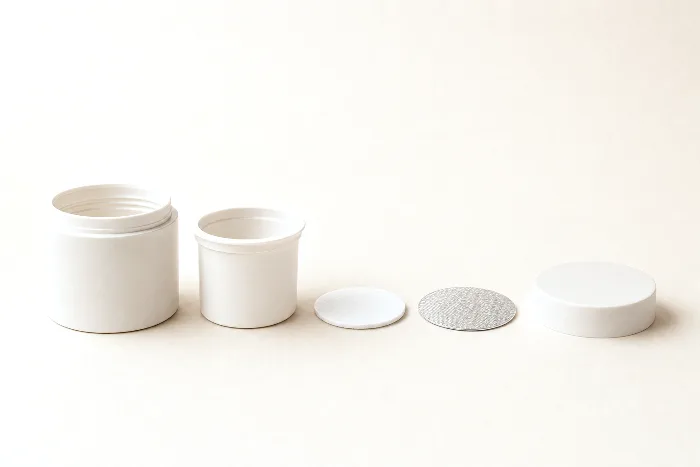
- Double-wall — an inner jar that actually holds the product nests inside an outer shell, with an air gap between them. The gap makes the jar look and feel larger and more substantial than its fill volume, adds a premium heft, hides the product line, and gives a little insulation for temperature-sensitive formulas.
Double-wall jars are a staple of prestige skincare for exactly those reasons — they let a modest fill feel like a serious purchase. The cost is real, though: you're using more material, often two different plastics or a plastic-and-glass pairing, and that combination is much harder to separate and recycle than a plain single-wall jar. If sustainability is central to your brand story, that tension is worth confronting up front rather than at the recycling bin.
Airless jars: protecting the formula
An airless jar solves the open-jar hygiene and stability problem with mechanics. Instead of an open reservoir, the product sits above a piston (or inside a collapsing pouch). As the user pumps or presses, the piston rises to push product up through a small opening, and air never backfills the space behind it. Fingers never touch the reservoir, and the formula stays sealed from oxygen until the moment it's dispensed.
That matters most for formulas built around oxidation-prone actives — vitamin C, retinol, many peptides — that degrade on contact with air. Airless construction also improves everyday hygiene, delivers a consistent metered dose, and evacuates the container more completely than a scoop-and-dip jar. The trade-offs are cost and parts: an airless jar is a small mechanism with a spring, a piston, and a base, so it's pricier per unit and adds to the recyclability challenge. For a simple balm or a shelf-stable cream, a standard jar is usually plenty; save airless for the formulas that genuinely need the protection.
Liners, discs and inner seals
The jar and its lid are only part of a working closure. Several small components sit between them to keep product fresh and leak-free from the fill line to the customer's shelf:
- Cap liner — a foam or PE disc inside the lid that compresses against the jar rim to form the primary seal against leaks and moisture loss.
- Sealing disc (shive) — a pressure-sensitive disc that presses down onto the product surface, reducing the air gap and keeping a cream from smearing onto the lid in transit.
- Induction seal — a foil membrane bonded to the jar rim by an induction pass after filling. It gives a hermetic barrier and visible tamper-evidence: the customer peels it to open for the first time.
- Inner lid — a snap-in secondary lid, common on double-wall and airless jars, that adds a barrier and a cleaner reveal on first use.
Which of these you need depends on the formula and how far it travels. A shelf-stable balm might only need a liner; a water-based cream shipping cross-country benefits from a sealing disc or an induction seal. The closure itself — threads, snap fit, child-resistance where it applies — is a decision of its own; our caps & closures guide covers how those parts match the jar's neck and do their sealing and dispensing work.
Decorating a cosmetic jar
A jar is a small canvas with two printable surfaces — the body wall and the lid top — plus the option to color the substrate itself. The common approaches are pressure-sensitive labels wrapped on the body and/or struck on the lid, direct screen or pad printing onto the jar, hot stamping for metallic type and borders, and substrate treatments like frosting, spray-coating, or metallization that change the whole look of the vessel. Because a jar wall is curved and often small, brand color fidelity and tight registration matter; getting a signature brand color to read the same across glass, plastic, and PCR takes deliberate color management.
Embellishments — finishing techniques applied on top of the base print to add tactile or visual richness: foil stamping, embossing and debossing, spot gloss or soft-touch matte, and metallic or textured coatings. On jars they carry much of the premium feel. See more terms in the packaging glossary.
Embellishments are where a jar earns its shelf presence, but they come with a recyclability cost you should weigh: metallized coatings and foil can complicate sorting, and a permanently bonded label can make an otherwise-recyclable jar harder to process. Keep decoration in proportion to the sustainability promise you're making elsewhere on the pack.
The recyclability of a multi-part jar
A jar looks like one object, but at the recycling facility it's a collection of parts: the jar body, the lid, a liner or sealing disc, sometimes an inner jar, sometimes a whole airless mechanism with a spring. Recycling systems reward simplicity — a single-material jar with a matching-material cap has the best chance of actually being recycled. Every additional material, every metallized coating, and every attached component that has to be separated first lowers the odds.
This is where a couple of common assumptions get people. Post-consumer recycled content is a genuine win for virgin-plastic reduction, but a jar made from PCR is not automatically recyclable at end of life — those are two different things. And a double-wall or acrylic jar can look and feel like the sustainable choice while being harder to recycle than a plain PP single-wall. The honest levers — mono-material construction, refill systems, source reduction, and clear recycling guidance for the customer — are laid out in our guide to sustainable beauty packaging. There's no free lunch here, only trade-offs made on purpose.
How PackOS helps you spec a jar
Speccing a jar means pinning down a stack of decisions — fill volume and headspace, material, wall construction, neck finish and closure, seal, and decoration — and each one moves the cost and the timeline. PackOS is built to make that concrete fast: it reads your artwork or component drawings, dimensions the parts, and turns them into a parametric model with a photoreal proof and an instant quote, so you can compare a glass single-wall against a PCR double-wall without waiting on a back-and-forth. You can watch the reconstruction run on the technology page, see how we support the category on our beauty & personal care page, or price a real jar now with Quick Quote.
Frequently asked questions
What kind of product goes in a cosmetic jar?
Jars suit thick, high-viscosity products you scoop rather than pour or pump — face and body creams, balms, masks, and scrubs. The wide mouth gives easy access to the last of the product, which is hard to reach in a bottle or tube. Thin lotions and serums usually dispense better and stay more stable in a tube, pump, or dropper.
Are airless jars worth it?
Airless jars use a piston or pouch that pushes product up as the jar empties, so air and fingers never touch the reservoir. They cost more and add parts, but they protect oxidation-prone actives like vitamin C and retinol, improve hygiene, and dispense a consistent dose. For a simple balm or a shelf-stable formula, a standard jar is usually enough.
What is a double-wall cosmetic jar?
A double-wall jar is an inner jar that holds the product nested inside an outer shell, with an air gap between them. The gap makes the jar look larger and more substantial on shelf, adds a premium feel, and gives some insulation. The trade-off is that combining two materials makes the jar harder to recycle.
Are cosmetic jars recyclable?
It depends on the materials and your local program. A single-material glass or PP jar with a matching cap has the best chance. Double-wall jars, acrylic jars, and jars with mixed materials, metallized coatings, or attached liners are harder to recycle because the parts must be separated first. Post-consumer recycled content reduces virgin plastic but does not by itself make a jar recyclable.
Glass or plastic for a cosmetic jar?
Glass feels premium, is inert and compatible with almost any formula, and is widely recycled, but it is heavy and can break. Plastics like PP and acrylic are lighter, shatter-resistant, and cheaper to ship. Acrylic looks glass-like but is rarely recycled, while PP recycles more easily but reads less premium. The right choice depends on the formula, the brand position, and shipping.