
Beauty & cosmetic packaging: the complete guide
Beauty and personal care packaging does more work than almost any other category. It has to protect a sensitive formula, dispense it cleanly, survive a bathroom shelf, and still look worth the price in a crowded aisle. This guide walks through the formats, the compatibility rules, the finishes, and the labeling that go into a beauty pack.
THE SHORT ANSWER
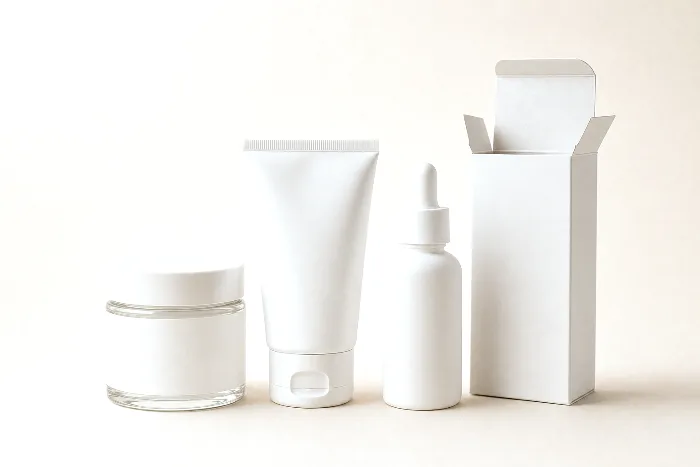
Beauty and cosmetic packaging is the system of primary containers, closures, decoration, and secondary cartons that holds and presents a personal care product — chosen for formula compatibility, dispensing, premium presentation, and labeling compliance. The main primary formats are jars, tubes, and bottles, usually finished with a printed folding carton. The right choice balances four things:
- Compatibility — the material must not react with or degrade the formula it holds
- Dispensing — pump, dropper, flip-top, or airless, matched to the viscosity and the dose
- Presentation — finish, color fidelity, and an unboxing that justify the price
- Compliance — an accurate ingredient declaration (INCI) and evolving rules such as MoCRA
What beauty packaging actually has to do
Beauty and personal care is one of the most demanding packaging categories in retail. A single skincare launch might ask its packaging to protect a light-sensitive active, dispense a precise dose, feel expensive in the hand, reproduce a brand color exactly across four different substrates, and pass an ingredient-declaration review — all at once. Most other categories optimize for one or two of those. Beauty has to hit all of them.
It helps to think of a beauty pack as four jobs stacked on top of each other:
- Protect and preserve the formula. Serums oxidize, emulsions separate, fragrances flash off. The container and closure are the first line of shelf-life defense.
- Dispense cleanly. A pump, dropper, flip-top, or airless piston has to deliver the right amount without mess, clogging, or contamination.
- Present at a premium. The category lives on shelf appeal and the unboxing moment. Finish, weight, and color fidelity carry the price.
- Comply. The label has to carry an accurate ingredient declaration and meet the rules of every market the product sells into.
Every decision in this guide is really a trade-off between those four jobs. A heavy double-wall glass jar wins on presentation but loses on freight and sustainability. A mono-material tube wins on recyclability but may give up some barrier. The craft is in balancing them for a specific product, which is exactly what the rest of this guide — and the deeper articles it links to — is about.
Primary containers by product type
Beauty packaging is usually described in three layers: a primary container (the part that touches the product), a closure (how it opens and dispenses), and secondary packaging (the printed carton, and sometimes a sleeve or gift box). The table below maps the most common product types to the formats that typically fit them.
| Product | Primary pack | Secondary |
|---|---|---|
| Face / eye cream, balm | Wide-mouth jar (glass, PP, acrylic) or airless jar | Folding carton |
| Lotion, cleanser, mask | Squeeze tube (laminate or extruded) | Carton or none |
| Serum, facial oil | Glass dropper bottle or airless bottle | Carton, often with an insert |
| Foundation, liquid makeup | Bottle with pump or airless | Carton |
| Lip balm / stick, deodorant | Twist-up stick or small jar | Carton or blister |
| Loose or pressed powder | Compact, sifter jar, or jar | Carton |
| Shampoo, conditioner, body wash | Bottle (HDPE, PET, PCR) with disc-top or pump | Usually none |
| Fragrance | Glass bottle with crimp pump | Rigid box |
Each of these behaves very differently, which is why the cluster below breaks jars, tubes, and bottles out into their own deep-dives. What matters at the pillar level is that the primary/secondary split lets you decorate and protect independently: a plain airless bottle can sit inside a heavily embellished carton, or a beautifully decorated tube can ship with no carton at all. That flexibility is a big part of why the same product can be launched at a mass price point and a prestige price point without changing the formula.
Formula and material compatibility
The least visible but most consequential decision in beauty packaging is compatibility: whether the container material and the formula can live together for the product's whole shelf life without either one changing. Get this wrong and the symptoms are ugly — a cream that discolors, a fragrance that attacks a liner, a serum that loses potency, a tube that panels or swells on the shelf.
A few of the usual culprits:
- Actives and antioxidants. Ingredients like vitamin C, retinol, and many botanicals oxidize on contact with air and degrade in light. These formulas often move to airless packaging and opaque or UV-filtering materials.
- Essential oils and high-oil formulas. Oils can permeate or stress-crack some plastics and attack certain adhesives and inks, which pushes brands toward glass or more resistant resins such as PP.
- pH extremes. Very acidic or alkaline formulas can corrode metal components or react with a liner, so the closure and any induction seal have to be chosen to match.
- Anhydrous vs. water-based. Water content changes the barrier and preservative demands, and can make a formula more prone to microbial issues if the pack does not seal well.
Because you cannot eyeball this, brands run stability and compatibility testing — filling the actual pack with the actual formula and holding it at elevated temperatures for weeks or months to see what happens. This is also where airless systems earn their place: by keeping the formula off both air and fingers, they protect sensitive actives and improve hygiene, which is why so many treatment serums and moisturizers ship in airless bottles and jars. The material and the dispenser are not a styling choice here; they are part of the formula's shelf life.
Decoration and premium finishes
If compatibility is the hidden decision, decoration is the visible one — and in beauty it is where a lot of the budget goes. The category competes on shelf presence and on the unboxing moment, so the finishing techniques matter as much as the structure.
The common levers are hot-foil and cold-foil for metallic accents, embossing and debossing for tactile logos, spot UV or raised varnish for contrast, and soft-touch or matte laminates for the "expensive" hand-feel. These can be applied to a carton, a label, a shrink sleeve, or directly to a tube. Our guide to label finishes and laminates goes deeper on how each one is produced and what it adds in complexity.
The other half of premium decoration is color. A brand's signature shade has to look identical whether it is printed on a coated carton, a clear pressure-sensitive label, a metallized film, and a molded cap — four substrates that all take ink differently. Holding a color across them is a color-management problem, not a design one, and it is worth working with a converter who manages it with real measurement rather than by eyeballing proofs. Beyond the printed graphics, the substrate and closure are themselves decoration: frosted glass, colored resin, weighted double-wall jars, and metal collars all read as premium before a single graphic is applied.
Cosmetic labeling: INCI, FDA and MoCRA
Beauty packaging is also a compliance surface. In the United States, cosmetics are regulated by the FDA, primarily under the Federal Food, Drug, and Cosmetic Act (FD&C Act) and the Fair Packaging and Labeling Act (FPLA), with the Modernization of Cosmetics Regulation Act (MoCRA) adding a newer layer of requirements that is still being implemented.
This is general information, not legal or regulatory advice. Cosmetic rules differ by market and change over time — MoCRA, for instance, is still rolling out — so confirm current requirements with the FDA and qualified counsel before you finalize any label. Nothing here states a definitive rule for a specific jurisdiction; treat it as orientation, not a compliance checklist, and re-verify periodically because the rules move.
At a high level, a cosmetic label generally carries a statement of identity (what the product is), the net quantity of contents, the name and place of business of the responsible party, any required warnings, and an ingredient declaration. That ingredient list is written in INCI — the International Nomenclature of Cosmetic Ingredients — a standardized naming system so the same ingredient reads consistently across brands and markets. There is also a line between a "cosmetic" claim and a "drug" claim: once a product claims to affect the structure or function of the body, it can cross into drug territory with a very different rulebook.
Two labeling realities shape the packaging itself. First, small primary containers rarely have room for a full ingredient list, so brands lean on the carton or a peel/booklet label. Second, every market has its own rules, so a product sold internationally may need multiple language panels or market-specific symbols such as the period-after-opening (PAO) mark. The cosmetic label requirements deep-dive covers the elements in more detail — but, again, treat all of it as general orientation and verify with the authority.
Sustainability leadership in beauty
Beauty gets more sustainability scrutiny than almost any other category, and for a fair reason: the packs are often small, heavy relative to their contents, and built from several materials bonded together — exactly the combination that is hard to recycle. A weighted double-wall jar, a pump with a metal spring, a foiled carton, and a shrink band can be four different waste streams in one product.
The levers brands pull, each with an honest trade-off:
| Lever | Benefit | Caveat |
|---|---|---|
| Refill / refillable systems | A durable outer with a replaceable inner pod cuts material over time | Only pays off if customers actually refill |
| Post-consumer recycled (PCR) content | Reduces virgin plastic in the pack | Can limit clarity and sometimes compatibility with sensitive formulas |
| Mono-material design | A single-polymer pack is far easier to recycle | Harder to match the barrier of a multi-layer laminate |
| Source reduction | Thinner walls, single-wall, no carton where it is not needed | Less shelf presence and protection to work with |
| Reusable / take-back glass | Premium, inert, and reusable | Heavy, which raises freight impact |
The recurring problem is the multi-part pack: a pump or dropper mixes plastics, metal, and small parts that most curbside systems cannot handle, which is why "recyclable" so often carries an asterisk. Designing for real recyclability usually means simplifying the pack, and it interacts with a growing body of extended producer responsibility law. The sustainable beauty packaging deep-dive and our broader sustainable packaging guide walk through the levers and the trade-offs, and the mono-material discussion in our recyclable pouch guide explains why single-polymer construction matters. One caution that spans all of it: green claims are themselves regulated, so "recyclable" and "compostable" have to be accurate for the market where the product actually sells.
The full Beauty & Personal Care library
This guide is the map; the articles below are the territory. Each one goes deep on a format or a decision that this pillar only introduces.
- Cosmetic jar packaging: creams, PCR & airless — glass vs PP vs acrylic, single- vs double-wall, airless jars, and the liners that seal them.
- Cosmetic tube packaging: squeeze & laminate — extruded vs laminate tubes, diameters and closures, and how tubes are printed.
- Skincare bottle packaging: droppers, pumps & airless — matching the dispenser to serums, lotions, and oxidation-prone actives.
- Cosmetic label requirements: FDA, INCI & MoCRA — the panels, ingredient naming, and the evolving MoCRA framework.
- Sustainable beauty packaging: refill, PCR & mono-material — the levers to cut impact, and the honest trade-offs of each.
How PackOS handles beauty packaging
The hard part of a beauty program is that the primary pack, the closure, the decoration, and the carton are all separate decisions that have to end up as one coherent, quotable spec. PackOS is built to hold that whole picture. Upload artwork, a die file, or an existing spec for a jar, tube, bottle, or carton, and it detects the structure, rebuilds an editable parametric dieline, renders a photoreal 3D proof, and prices it — so you can see how a finish change or a size change moves the whole job before you commit. You can watch the reconstruction and proofing run on the technology page, see how we support the category on our beauty and personal care page, or try it on a real file with a Quick Quote.
Frequently asked questions
What is the most common type of cosmetic packaging?
There is no single most common format. Beauty spans jars, tubes, bottles, and cartons, and the right one depends on the product. Creams and balms usually go in wide-mouth jars, lotions and cleansers in squeeze tubes, serums in dropper or pump bottles, and most of these ship inside a printed folding carton for shelf presentation and protection.
What does product compatibility mean in cosmetic packaging?
Compatibility means the packaging material will not react with, absorb, or degrade the formula it holds. Active ingredients, essential oils, and high or low pH formulas can interact with certain plastics or corrode metal, so brands run stability and compatibility testing before committing to a material. Formulas that oxidize easily are often paired with airless packaging that limits contact with air.
What is an airless jar or bottle, and when do you need one?
An airless container dispenses product through a pump and piston system that keeps air away from the formula. It is useful for actives such as vitamin C and retinol that oxidize or lose potency when exposed to air. Airless packaging also improves dosing and hygiene because the user does not dip fingers into the product.
What is INCI on a cosmetic label?
INCI stands for International Nomenclature of Cosmetic Ingredients, a standardized naming system used to list ingredients on cosmetic labels. It gives every ingredient a consistent name so the ingredient declaration reads the same way across brands and markets. Specific labeling requirements vary by market and change over time, so verify the current rules with the relevant authority.
Is beauty packaging recyclable?
It depends on the pack. Single-material glass and many plastic bottles and jars are widely recyclable, but multi-part items such as pumps, droppers, and mixed-material tubes are harder to recycle because they combine materials and small components. Brands reduce impact through mono-material designs, post-consumer recycled content, refill systems, and source reduction, though each lever has trade-offs.