
Cosmetic tube packaging: squeeze & laminate
The squeeze tube is the quiet workhorse of the bathroom shelf — lotions, cleansers, serums, and creams all live in one. This guide covers how a cosmetic tube is built, the extruded-versus-laminate decision that drives its barrier and recyclability, and the closures and print that make it look premium.
THE SHORT ANSWER
A cosmetic tube is a flexible, squeezable container built from three parts: a printed body, a moulded shoulder, and a threaded neck that takes a cap or applicator. Product is filled through the open tail, which is then sealed. Tubes come in two main constructions, and the choice sets almost everything else:
- Extruded tubes — seamless, made in one piece from polyethylene (or PP); effectively mono-material and easier to recycle, but a lower barrier
- Laminate tubes — rolled and side-seamed from a printed multi-layer web; higher barrier and sharper print, but harder to recycle when they include a foil layer
- Diameter sets shelf presence and fill volume; length is set to hold that fill
- Closures — flip-top, screw, or an applicator tip — must match the tube's shoulder and neck
What a cosmetic tube is
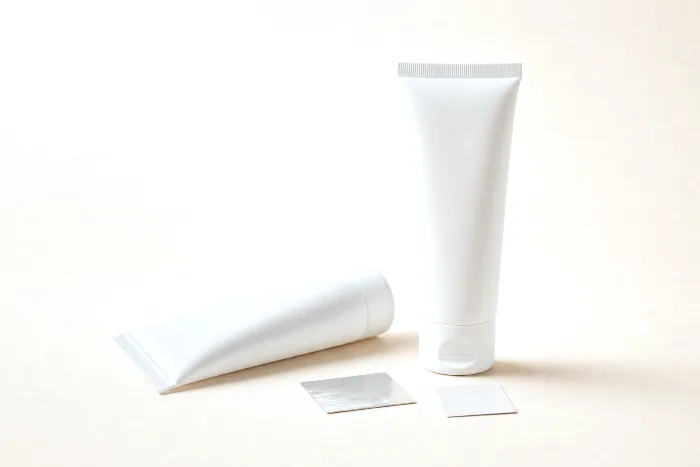
A cosmetic tube is a collapsible container designed to be squeezed. Anatomically it has three pieces. The body is the printed, flexible barrel that holds the product and carries the graphics. The shoulder is the moulded cone at the top that funnels product toward the opening. The neck (or orifice) is the threaded spout the cap screws or snaps onto. Product is filled from the bottom through the still-open tail, which is then closed — welded on plastic and laminate tubes, or crimped and coded on metal — to seal the tube.
Brands reach for tubes because they solve several problems at once. The tube dispenses hygienically: you never dip fingers into the product, and the opening reseals with the cap. It collapses as it empties, so very little product is stranded. It is light and largely unbreakable, which travels and ships well. And the body is a continuous, full-height printable surface that shows off a design without the seams and label edges of a bottle. That combination is why tubes dominate skincare and personal care, and it is a core format in beauty and personal care packaging. Tubes are one chapter of the complete guide to beauty & cosmetic packaging; jars, bottles, and cartons each earn their own.
Extruded vs laminate tubes
The single biggest decision in a tube spec is construction, because it sets the barrier, the wall feel, the print method, and the recyclability all at once. There are two families.
Extruded tubes are formed as a single seamless piece — the body is extruded as a continuous plastic sleeve, cut to length, and the shoulder and neck are moulded on. They are typically polyethylene (PE), sometimes polypropylene (PP), which makes them essentially one material. Extruded tubes have a characteristically thicker, softer wall and no visible side seam. Their trade-off is barrier: plain PE lets oxygen and some aromas through over time, so extruded tubes suit water-based lotions, cleansers, and shorter-shelf-life formulas rather than products that oxidise quickly.
Laminate tubes are built the other way around: a flat web of laminated film layers is printed, then rolled and welded down its length into a side seam, with the shoulder moulded on afterward. The laminate is what supplies the barrier, and there are two common versions. An ABL (aluminium barrier laminate) tube carries a thin aluminium foil layer, giving a very high barrier and the "dead-fold" look where the tube stays squeezed rather than springing back. A PBL (plastic barrier laminate) tube replaces the foil with a plastic barrier such as EVOH or metallised film, trading a little barrier for a construction that can be made all-plastic and, in the right build, recyclable. Laminate tubes tend to have thinner, crisper walls and a smoother printing surface.
| Tube type | Barrier | Recyclability |
|---|---|---|
| Extruded PE | Low–moderate | Good — mono-material, if the cap is also PE |
| Extruded PP | Moderate | Good — mono-material, if the cap matches |
| Laminate — PBL (all-plastic) | High | Moderate — recyclable when built mono-PE with a matching cap |
| Laminate — ABL (aluminium barrier) | Very high | Poor — the foil layer mixes materials |
Read the table as a spectrum, not a ranking: a high barrier and easy recyclability pull in opposite directions, and the right tube is the one that protects your specific formula for its shelf life with the least material. The barrier and recyclability values here are typical generalisations — the exact behaviour depends on the film build and the local recycling stream.
Sizing a tube: diameter, length and fill
A tube is specified by its diameter and its length. Diameter is the more strategic of the two: it sets how the tube reads on shelf and how much product a given length holds. Length is then chosen to hold the fill volume plus a little headspace so the tube can be filled and sealed cleanly and still be squeezed. Tube diameters cluster around a set of common sizes, so it pays to design toward a standard rather than an odd dimension.
| Diameter feel | Typical products | Note |
|---|---|---|
| Slim | Serums, eye creams, lip products, samples | Reads precious; small fills |
| Medium | Facial cleansers, hand creams, treatments | The everyday cosmetic tube |
| Wide | Body lotions, masks, shave creams, scrubs | Big print face; larger fills |
Because the usable volume depends on the shoulder height and the closure that sits on top, tube capacity is approximate — always confirm the exact fill with your converter before locking a size. If your formula is thin and needs precise, drop-by-drop dosing rather than a squeeze, a tube may be the wrong format and a dropper or pump bottle the right one; see skincare bottle packaging for those dispensers.
Closures: flip-top, screw and applicator
The cap does more than seal — it defines how the product is used every day, so it is chosen alongside the formula. Three families cover most cosmetic tubes.
- Flip-top (hinged) caps snap open and shut one-handed and meter a controlled amount. They are the default for lotions, cleansers, and everyday creams.
- Screw caps give a simple, secure seal and a clean, minimal silhouette; they suit thicker products and premium designs where the cap is part of the look.
- Applicator tips — nozzles, precision spouts, roller-balls, or brush applicators — deliver product to a target area for eye creams, spot treatments, and gels.
Whatever the style, the closure has to match the tube's shoulder profile and neck thread, so the tube and cap are specified as a pair. The mechanics of thread finishes, dispensing types, and sealing carry over from rigid containers — our caps & closures guide covers how those match up in detail.
| Closure | Dispensing | Best for |
|---|---|---|
| Flip-top | Controlled, one-handed | Lotions, cleansers, daily creams |
| Screw cap | Open pour / squeeze | Thick creams, minimalist premium looks |
| Nozzle / precision tip | Fine, targeted line | Gels, ointments, hair and styling |
| Roller-ball / brush | Applied to skin directly | Eye creams, spot treatments |
Printing and finishing a tube
How a tube is decorated depends on how it is made, and this is where laminate and extruded diverge again.
Laminate tubes are printed flat, before the tube is seamed. The graphics are laid onto the web by flexographic, gravure, or offset printing while it is still a flat sheet, which allows high-resolution artwork, full-coverage backgrounds, and precise colour — the same web-printing advantages as flexible packaging. The printed web is then formed into the tube, so the design wraps the full body with only the side seam to plan around.
Extruded tubes are decorated after forming, directly onto the finished tube, most often by dry offset (letterpress) or silkscreen. That is excellent for crisp line art, type, and solid brand colours, though very heavy full-coverage or photographic images are harder than on a flat-printed laminate. Either construction can then carry the finishes that make a tube feel premium: matte or gloss varnish, soft-touch coatings, hot-foil stamping, and embossing. Those embellishments behave much like they do on labels — our guide to label finishes and laminates explains how matte, gloss, foil, and soft-touch change the look and feel. Consistent brand colour across a print run is its own discipline, and it is one of the things a good preflight and proofing workflow is meant to protect.
Mono-material and recyclable tubes
Tubes have historically been a recycling problem for one reason: mixed materials. An ABL laminate mixes plastic and aluminium, and even an all-plastic tube fails recycling if its cap is a different resin than its body. The industry answer is the mono-material tube — body, shoulder, and cap all in one polymer family, usually polyethylene, so the whole package is a single material stream. Extruded PE tubes are naturally close to this, and PBL laminates can be engineered as all-PE builds that keep a useful barrier.
Two honest caveats keep this from being a silver bullet. First, "recyclable" depends on your local collection actually accepting tubes — a small, flexible, product-contaminated format that many curbside programs still do not take, so the claim is real only where the infrastructure exists. Second, a mono-material tube may accept a lower barrier than a foil laminate, so it has to be matched to a formula and shelf life it can genuinely protect. For the deeper engineering of tube walls, shoulders, and orifices across categories, see the general tube packaging guide. The right move is usually to reduce material and specify mono-material where the formula allows — and to say plainly what the tube can and can't do rather than overclaim.
How PackOS handles tube artwork
A tube is a wrap: a continuous printed surface that has to align around a seam and read correctly once it is formed and filled. When you bring tube artwork to PackOS, it treats that surface the way it treats any package — detecting the print area, planning the seam and safety margins, and producing a proof and an instant quote so you can see the decoration on the real geometry before committing to tooling. Because the same engine understands the construction, the barrier stack, and the finish, the material and print route can be costed together rather than guessed. You can watch that reconstruction and preflight run on the technology page, or try it on a real file with Quick Quote.
Frequently asked questions
What is the difference between an extruded and a laminate tube?
An extruded tube is made in one seamless piece, usually from polyethylene, so it is effectively mono-material and easier to recycle but offers a lower barrier. A laminate tube is rolled and side-seamed from a printed web of layered films — either aluminium-barrier laminate (ABL) or all-plastic laminate (PBL) — which gives a higher barrier and a smoother printing surface but is harder to recycle because it mixes materials.
Are cosmetic tubes recyclable?
It depends on the construction. A mono-material tube — an all-polyethylene extruded or PBL tube with a matching polyethylene cap — is designed to be recyclable where facilities accept it. A laminate tube that contains an aluminium barrier layer, or a tube with a cap in a different resin, mixes materials and is much harder to recycle. Recyclability also depends on local collection, so verify what your market actually accepts.
What diameter and fill should a cosmetic tube be?
Tube diameter is chosen to suit the fill volume and the shelf presence you want, and the length is then set to hold that volume with a little headspace for filling and squeezing. Smaller diameters suit serums and eye creams; larger diameters suit body lotions and cleansers. Because tube capacity is approximate and varies with shoulder and closure choice, confirm the exact fill with your converter.
What closures work on cosmetic tubes?
The common options are a flip-top (hinged) cap for controlled everyday dispensing, a screw cap for a simple secure seal, and an applicator tip — such as a nozzle, roller-ball, or brush — for targeted products. The closure has to match the tube's shoulder and neck, so the tube and cap are specified together.
How are cosmetic tubes printed?
Extruded tubes are usually decorated after forming, by dry offset (letterpress) or silkscreen printing directly onto the tube, with hot-foil and labels for accents. Laminate tubes are printed on the flat web before the tube is seamed, which allows high-resolution flexographic, gravure, or offset graphics and full-coverage designs. Both can carry finishes such as matte or gloss varnish, foil, and embossing to look premium.