
Skincare bottle packaging: droppers, pumps & airless
A serum, a facial oil, a treatment essence — the bottle it ships in is rarely an afterthought. In skincare, the dispenser you pick shapes the formula's shelf life, the ritual of using it, and how premium the product feels in the hand.
THE SHORT ANSWER
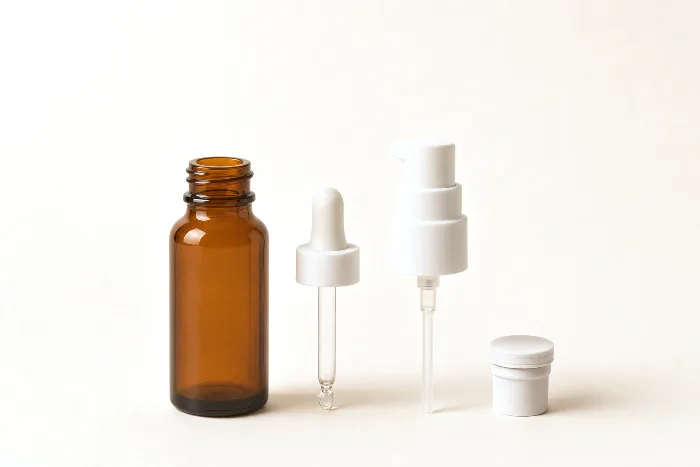
Skincare bottles are chosen dispenser-first. A glass dropper suits thin, potent serums; a treatment pump suits lotions, essences, and cleansers; and an airless bottle protects actives that oxidize, such as vitamin C and retinol. The bottle body — glass, PET, or PP — is then matched to the brand's feel, the formula's compatibility, and shipping weight.
- Dropper — controlled drops, best for serums and facial oils
- Treatment pump — a metered shot, best for lotions, essences, and cleansers
- Airless — no dip tube, protects oxygen-sensitive actives and evacuates nearly all the product
- Body material — glass feels premium but is heavy; PET and PP are light and shatter-resistant
Why the dispenser decides the bottle
Most rigid packaging decisions start with the container and treat the closure as a finishing detail. Skincare works the other way around. The dispenser controls the dose, protects the formula from air and contamination, and defines the moment the customer interacts with the product every day — so it is chosen first, and the bottle body is selected to fit it. A pipette needs a narrow neck and a small, tall bottle. A treatment pump needs a dip tube sized to the fill. An airless mechanism replaces the neck-and-dip-tube arrangement entirely.
Thick creams and balms rarely live in bottles at all — a wide-mouth cosmetic jar serves them better, and pourable lotions and cleansers often go in a squeeze tube. Bottles own the middle ground: fluids and light emulsions you meter out in small, precise amounts. This article is part of our complete guide to beauty & cosmetic packaging, focused on the bottle formats that carry serums, oils, toners, and treatment lotions.
Dispenser types: dropper, pump, and airless
Three dispensers cover the vast majority of skincare bottles. Each maps to a product type and a dosing behavior.
| Dispenser | Best for | Dose control |
|---|---|---|
| Glass dropper | Serums, facial oils, high-potency actives used sparingly | A few drops at a time — the most precise, fully user-controlled |
| Treatment pump | Lotions, essences, cleansers, thicker fluids | A metered shot per stroke — consistent, hands-free |
| Airless pump | Oxygen-sensitive actives (vitamin C, retinol, peptides) | A small metered dose with minimal air ingress |
| Disc / flip-top cap | Toners, mists, watery products | Poured or splashed — least controlled, lowest cost |
The dropper is the signature serum format: a glass pipette with a graduated or plain barrel and a rubber or silicone bulb. It gives the user complete control over a few drops and makes the ritual feel deliberate and clinical. The trade-off is exposure — every use pulls a little air into the headspace, so droppers suit stable formulas or oils more than fragile water-based actives. Bulb material matters, too: some essential oils and high-alcohol formulas can degrade a natural-rubber bulb, so a silicone or a compatible bulb is specified for those.
The treatment pump uses a spring, a piston, and a dip tube to deliver a repeatable shot — typically a fraction of a milliliter per stroke, with the exact output varying by pump engine. It suits products used in larger, less precious amounts: milky cleansers, lotions, essences. Lockable pumps that twist down for shipping keep them from priming in transit. The airless bottle solves the dropper's air problem: instead of a dip tube, a piston rises through the bottle (or a collapsible inner pouch contracts) as product is drawn out, so almost no air re-enters. That protects ingredients that brown or lose potency on contact with oxygen and lets the pack evacuate nearly all of its contents — less waste, and a cleaner claim on fill efficiency.
Glass, PET, or PP: choosing the bottle body
Once the dispenser is set, the body material balances three things: how the brand wants the product to feel, how the formula behaves against the material, and what the pack costs to ship. The neck finish and bottle shape are their own decision — covered in our bottle types guide — but material is where most skincare briefs start.
| Material | Feel | Barrier & compatibility | Best for |
|---|---|---|---|
| Glass | Premium, weighty, cool to the touch | Inert, excellent barrier; amber or cobalt shields light-sensitive actives | Serums, oils, prestige lines |
| PET | Clear, light, glass-like | Good barrier for water-based formulas; less resistant to some solvents and oils | Toners, mists, value and travel sizes |
| PP | Softer, often opaque or frosted | Broad chemical resistance; common for airless components and pump parts | Airless systems, active-heavy formulas |
Glass reads as premium and is chemically inert, so it is the default for serums and facial oils where feel and formula purity matter. Amber, cobalt, and opaque glass add light protection for actives that degrade in UV; clear glass shows the product but offers none. The cost is weight and breakage — heavier freight and a real risk of loss in the parcel network, which pushes many brands toward secondary cartons and protective inserts. PET mimics the look of glass at a fraction of the weight and shatters far less, making it the workhorse for toners, mists, and travel sizes; it handles water-based formulas well but is less forgiving with some oils and solvents. PP is the quiet specialist: chemically robust and the usual choice for airless pistons and pump internals, though it is rarely crystal-clear. Recycled content — rPET and PCR resins — is increasingly specified across all three; the trade-offs are covered in our guide to sustainable beauty packaging.
Closures, pumps, and how they seal
On a skincare bottle the dispenser is the closure, and it only works if it matches the bottle. Pumps, droppers, and caps are specified by neck finish — the diameter and thread style at the mouth of the bottle, such as a 20-410 or 18-415 designation. Order a pump for the wrong finish and it will not thread down or seal. Our caps & closures guide walks through how those finishes are read and matched, but the short version for bottles is: lock the neck finish early, because it constrains every closure option and the label real estate below it.
- Droppers seal with a bulb-and-collar assembly that screws to the neck; the pipette length is cut to the bottle so it reaches the bottom of the fill.
- Treatment pumps seal with a gasketed closure and a dip tube trimmed to the fill height; lockable and non-lock versions trade shipping security against one-handed convenience.
- Airless pumps integrate the seal into the mechanism — there is no dip tube, and the piston or inner pouch is what keeps air out.
- Overcaps and shipping caps protect the actuator and prevent accidental priming or leaks during transit, which is why samples and e-commerce units often ship with an extra cap the retail unit does not need.
Labels and decoration on small, curved bottles
Skincare bottles are some of the hardest labels to apply well: small diameters, tight radii, and narrow front panels leave little room for both the required copy and the brand. A pressure-sensitive wrap label on a thin, conformable film is the most common answer — the film has to bend around the curve without wrinkling or lifting at the seam. Clear "no-label-look" films make the graphics appear printed straight onto glass; a shrink sleeve gives full 360-degree coverage and doubles as a tamper band when the shape has compound curves a flat label cannot follow. The film choice — paper, BOPP, PE, or a specialty stock — is driven by the bottle, the fill, and whether the product will get wet in a bathroom; see our label materials guide for how those stack up.
Decoration on the bottle itself can go beyond a label: screen printing and hot-foil stamping put durable, washable graphics directly on the glass or plastic, and frosting or coating changes the whole surface feel. Because skincare so often sells on shelf color and finish, matching a brand's exact hue across a label, a printed bottle, and a secondary carton is a real production challenge — one reason many prestige lines rely on a printed folding carton to carry the heavy decoration and let the bottle stay clean. Whatever the mix, the label and any print have to be built to the bottle's true dimensions, not an idealized flat, or the artwork will crawl as it wraps.
How PackOS handles skincare bottles
PackOS treats a skincare bottle the same way it treats any package: it reads the real geometry and works forward from there. Upload a label file, a bottle spec, or a previous print-ready artwork and it detects the container, dimensions the wrap label and its dieline to the true circumference and panel, and produces a photoreal 3D proof plus an instant quote — so a curved label that would otherwise reveal its wrap error only on press is caught while it is still a file. You can see the reconstruction run on the technology page, and it is the same engine behind the packaging we produce for the brands we work with in beauty and personal care. To try it on a real bottle label, start a Quick Quote.
Frequently asked questions
What is the difference between a dropper and a pump bottle?
A dropper delivers a few controlled drops at a time and suits thin, potent serums where dose precision matters. A pump delivers a metered shot of product and suits lotions and cleansers used in larger amounts. The choice follows the product's viscosity and how much you dispense per use.
When should skincare use an airless bottle?
Airless bottles are worth it when the formula contains actives that degrade on contact with air, such as vitamin C, retinol, or peptides. A piston or collapsible pouch pushes product up without letting air back in, which protects the formula and dispenses nearly all of it.
Is glass or plastic better for a serum bottle?
Neither is universally better. Glass feels premium, is inert, and gives a strong barrier, but it is heavy and can break. PET and PP are light, shatter-resistant, and cheaper to ship, and PP tolerates a wider range of formulas. The right choice balances brand feel, the formula's compatibility, and freight.
Why do serum bottles use amber or opaque glass?
Light can degrade sensitive ingredients, so amber, cobalt, and opaque bottles shield light-sensitive actives. Clear glass shows the product but offers no light protection, so it is used mainly when the formula is stable or shelf appeal outweighs the risk.
How are labels applied to small, curved skincare bottles?
Small curved bottles use pressure-sensitive labels on a thin, conformable film that wraps the curve without wrinkling, or a shrink sleeve for full coverage. Tight radii and narrow panels leave little room, so the label material and dieline must be matched to the bottle before printing.