
Mono-material packaging: designing for recyclability
A multi-material laminate protects a product brilliantly — and then sits in landfill, because a recycler can't pull its fused layers apart. Mono-material packaging keeps every layer in one polymer family so the whole thing recycles. Here's the trade-off, and how to make the switch without losing shelf life.
THE SHORT ANSWER
Mono-material packaging is built from a single polymer family — an all-PE pouch, an all-PP tub, an all-paper carton — so the whole package can go into one recycling stream instead of being pulled apart. Multi-material laminates protect beautifully but fuse incompatible layers a recycler can't separate, so they're usually rejected. The catch with going mono-material is engineering: rebuilding the barrier and the heat-seal window inside one material family — a trade-off that is increasingly solvable.
- Mono-material — one polymer family (all-PE, all-PP, or paper-based), so it recycles cleanly
- Multi-material laminate — bonded layers of different materials; superb barrier, poor recyclability
- The trade-off — barrier and seal performance have to be rebuilt within a single family
- The payoff — a genuinely recyclable structure, lower eco-modulated fees, and a truthful recyclable claim
What mono-material packaging actually is
Most flexible packaging you pick up — a coffee bag, a snack pouch, a refill pack — is a laminate: two, three, or more thin layers of different materials bonded into one web, each doing a job. One layer prints and carries gloss, another blocks oxygen and moisture, another seals under heat, another adds stiffness. The result protects the product beautifully. It also can't be recycled, because those layers are permanently fused and made of materials that belong in different recycling streams.
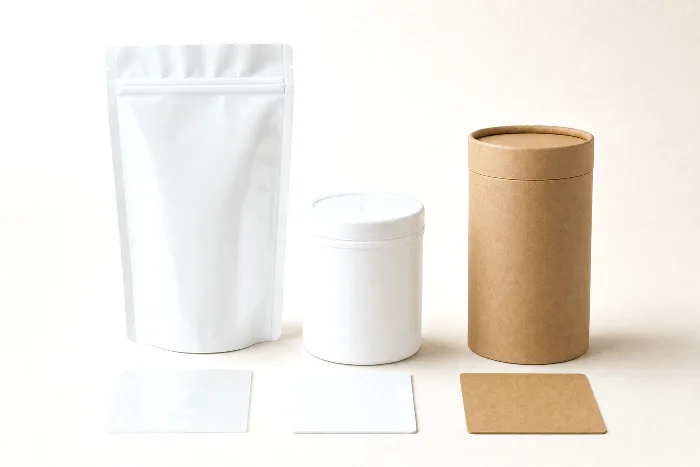
Mono-material packaging takes the opposite approach: build the whole structure from one polymer family so that, at end of life, it's a single, sortable material. An all-polyethylene (all-PE) stand-up pouch, an all-polypropylene (all-PP) tub and lid, an all-paper carton — each is designed so a recycler sees one material, not a sandwich of incompatible ones. This is what "design for recycling" means in practice, and it's one of the most consequential structural decisions a brand makes. It's also part of our complete guide to packaging design.
The word "family" is doing real work here. All-PE doesn't mean one identical film top to bottom; it means every layer is a polyethylene — you can combine different PE grades and orientations and still stay inside the PE recycling stream. The same is true for all-PP. The goal isn't chemical purity; it's stream compatibility: if a materials recovery facility can identify the package as one thing and route it to one place, it's recyclable in principle — otherwise it's residue no matter how "green" the marketing.
Why multi-material laminates don't recycle
Recycling infrastructure sorts by material type. A materials recovery facility identifies each item — often optically — and routes polyester one way, polyethylene another, paper another, and sends anything it can't cleanly identify to residue. A conventional high-barrier laminate is engineered to be inseparable: the layers are bonded micron-thin by adhesive or co-extrusion, and there is no practical, economical way to peel a metallized polyester layer off a polyethylene sealant layer and recover each cleanly. Faced with a structure that is part polyester, part aluminum, part polyolefin, the system does the only thing it can — it rejects it.
That's not a failure of will; it's physics and economics. Even a structure that is "mostly plastic" fails if it mixes polymer families, because polyester, polypropylene, and polyethylene melt and reprocess at different temperatures and don't blend into a usable recyclate. A thin aluminum foil or an oxygen-barrier layer — often a small fraction of the total weight, and invisible — is enough to disqualify the whole package. If you want the mechanics of the different formats those laminates show up in, see our guide to flexible packaging types.
The uncomfortable truth is that the very layering that makes a laminate such a good barrier is exactly what makes it unrecyclable. Mono-material design keeps the performance while removing the layer conflict — harder than swapping one film for another, because the barrier has to come from somewhere.
The mono-material families: all-PE, all-PP, and paper
Three families cover most mono-material packaging today. Each recycles through a different established stream, and each has a natural home. Choosing between them is the first real design decision, because it constrains everything downstream — barrier, seal, stiffness, and the recycling story you can honestly tell.
| Family | What it's good at | Recycles with |
|---|---|---|
| All-PE (polyethylene) | Pouches, films, shrink, liners — soft, forgiving, easy to seal; the most common flexible mono-material | The polyethylene film stream (store drop-off in many areas) |
| All-PP (polypropylene) | Tubs, cups, caps, and stiffer pouches — higher heat resistance and rigidity, good clarity | The polypropylene recycling stream |
| Paper-based | Cartons, wraps, and paper pouches — premium feel and broad curbside acceptance | The paper/fiber stream (if any coating stays compatible) |
All-PE is the workhorse of recyclable flexible packaging. Polyethylene is soft, seals over a wide range, and is collected through film drop-off programs in many markets, so an all-PE pouch has a real recovery route. The engineering challenge is barrier and stiffness, both of which polyethylene lacks on its own. Our companion piece on the recyclable mono-material pouch walks through how an all-PE stand-up pouch is actually built.
All-PP trades some of PE's sealing forgiveness for stiffness and heat resistance, which makes it the natural family for rigid tubs, cups, and closures — and for pouches that need more body. Paper-based structures win on consumer perception and curbside acceptance, but the catch is the coating: paper needs a moisture or grease barrier to hold most products, and a heavy plastic lamination or the wrong coating can push a "paper" package back out of the fiber stream. Repulpability is the test, not the look.
The engineering trade-offs — and how they're solved
Going mono-material means giving up the easy barrier of a foil or a mixed-polymer laminate and rebuilding that performance inside one family. Three trade-offs dominate, and each has a real toolkit behind it:
- Barrier. A foil layer used to do the oxygen-and-moisture work. Inside a single family you rebuild it with transparent barrier coatings (silicon-oxide or aluminum-oxide, the "SiOx / AlOx" coatings), thin barrier layers kept compatible with the base family, or metallized films that stay within the polymer stream. For many products this closes most of the gap; for the most oxygen-sensitive goods it's still the hardest part.
- Seal window. Multi-material laminates separate the "print" layer from the "seal" layer, so the sealant melts long before the outer film distorts. In a mono-material structure both are the same polymer, which narrows the temperature range between "sealed" and "melted." The fix is oriented films — machine-direction oriented (MDO) polyethylene, or an oriented-PP skin — that raise the outer layer's melt point so the inner layer can still seal without the whole web collapsing.
- Stiffness and machinability. A single soft film can be floppy on a fast filling line. Orientation, film thickness, and structure design restore enough body to run cleanly — usually a modest line-settings change rather than a redesign.
None of these is a reason not to switch; they're the checklist you work through with a converter. A pragmatic conversion looks like this:
- Define the real barrier requirement. Oxygen and moisture sensitivity, target shelf life, and light protection — measured, not assumed. Over-specifying barrier is what makes a switch look impossible.
- Match the family to the format. All-PE for most flexible pouches, all-PP where you need stiffness or heat, paper-based where the product tolerates it and the coating stays repulpable.
- Rebuild the barrier inside the family. Coatings, oriented films, or a compatible barrier layer sized to the requirement from step one — no more.
- Re-validate the seal and the line. Confirm seal integrity across the narrower window and re-tune fill and sealing settings before a full run.
- Confirm the recyclability claim. Check the finished structure against recognized design-for-recycling guidance so the claim on the pack is true, not aspirational.
When mono-material works today — and when it's still hard
Mono-material isn't all-or-nothing across a catalog. It's a spectrum, and honesty about where a product sits saves a lot of failed trials. In broad terms:
- Converts easily today: dry goods and low-oxygen-sensitivity products — many powders, granola and snacks, pet treats, hardware, apparel, and non-food consumer goods — where a coated all-PE or all-PP structure carries the shelf life comfortably.
- Converts with engineering: products that need moderate barrier — coffee, some confectionery, personal care — where oriented films plus a transparent barrier coating usually get there, given proper validation.
- Still genuinely hard: very high-barrier, long-shelf-life, or highly aroma-sensitive products that have historically depended on foil. These are the frontier; test rigorously and treat any claim cautiously rather than forcing a switch that shortens shelf life.
A second reality check: "recyclable in principle" and "recycled in practice" aren't the same. A mono-material pouch is recyclable only where a collection route exists for that stream, which is why the honest on-pack instruction often points to store drop-off rather than curbside — cover it in your labeling rather than overclaiming.
The EPR and recyclable-claim payoff
There are two reasons the switch increasingly pays for itself, beyond the sustainability story. The first is Extended Producer Responsibility (EPR). A growing number of US states are enacting packaging EPR laws that make the producer pay for packaging's end of life, and most build in eco-modulation — recyclable, well-designed packaging is charged less than hard-to-recycle packaging. A genuinely recyclable mono-material structure is exactly what those programs reward. The specifics (who counts as a producer, how fees are set, what exemptions apply) vary by state and change over time, so treat this as a direction, not a rulebook — our guide to packaging EPR laws in the US covers the landscape, and you should confirm the current rules with each state's program.
The second is the recyclable claim itself. "Recyclable" is a regulated marketing claim, and putting a chasing-arrows symbol or a recyclability label on a package you can't actually recycle is exactly the kind of claim that draws scrutiny. Mono-material design is what lets you make the claim honestly — the structure really does recycle where the collection exists. Getting the on-pack symbol and wording right is its own topic; see recycling labels on packaging for how the symbols, resin codes, and substantiation rules fit together, and our broader sustainable packaging guide for how mono-material sits alongside the other levers (right-sizing, recycled content, reuse).
How PackOS helps you make the switch
Switching to mono-material is a structural change — new material, new barrier math, a new seal window, a new dieline, and a new price — and that's where quotes and proofs usually stall. PackOS keeps it fast: it reads your existing artwork or spec, rebuilds an editable, parametric model of the structure, and lets you compare material routes and their manufacturing and cost implications side by side. You can see how it models materials and structures on the technology page. When you're ready to price a mono-material version of a pack, upload the current one and run a Quick Quote — the switch is far less daunting when you can see the trade-off before you commit.
Frequently asked questions
What is mono-material packaging?
Mono-material packaging is made from a single polymer family — for example an all-polyethylene pouch or an all-polypropylene tub — so the whole package can be recycled in one stream instead of being separated. It replaces multi-material laminates that combine incompatible layers a recycler cannot pull apart.
Why can't multi-material laminates be recycled?
A typical laminate bonds several different materials — say polyester, aluminum, and polyethylene — into one thin web. Recyclers sort by polymer type, and there is no practical way to separate those fused micron-thin layers back into clean streams, so the whole structure is usually rejected. Mono-material keeps every layer in the same family so it stays recyclable.
Does mono-material packaging protect the product as well as a laminate?
It can, but it takes engineering. Barrier that used to come from a foil or a mixed-polymer layer is rebuilt with coatings, oriented films, or a compatible barrier layer inside the same polymer family. Many dry, low-oxygen-sensitivity products convert easily today; very high-barrier or long-shelf-life products are harder and should be tested before switching.
What are the main mono-material families?
The three common families are all-polyethylene, all-polypropylene, and paper-based structures. Polyethylene and polypropylene recycle through established plastic streams, while paper-based packaging recycles with fiber, though any non-compatible coating on paper can complicate it. The right family depends on your barrier, sealing, and stiffness needs.
Will switching to mono-material lower my packaging compliance costs?
It can help. Extended Producer Responsibility programs increasingly charge producers based on how recyclable their packaging is, so a genuinely recyclable mono-material structure can reduce eco-modulated fees and support a truthful recyclable claim. The exact effect depends on the program and your markets, so confirm the rules with each authority.