
Retail-ready packaging requirements: SRP, PDQ & shelf-ready
Ship it, open it in seconds, make it look good on the shelf, then recycle the empty tray — retail-ready packaging has to do all four. Here's how the SRP and PDQ formats work, and why the binding numbers always live in the retailer's supplier portal, not in a guide like this one.
THE SHORT ANSWER
Retail-ready packaging (RRP), also called shelf-ready packaging (SRP), is a secondary pack — usually a corrugated tray — engineered to go straight from the pallet to the shelf without being unpacked. It has to survive transit, open in seconds without a knife, hold the product neatly on the shelf, and then break down for recycling. There is no single universal spec — the binding rules live in each retailer's supplier portal.
- The "five easies" — a good pack is easy to identify, open, shelve, shop, and dispose of
- SRP vs PDQ — SRP is the utilitarian tray family; PDQ is the more display-forward, printed version
- An engineering trade-off — the board and tray geometry must survive stacking and then tear open clean
- No universal standard — exact dimensions, perforations, and print rules vary by retailer and program; always pull the current supplier-portal spec
Requirements and fees change. This page was last verified against the major retailers' supplier portals (for example, Walmart's Retail Link and Target's Partners Online) on 18 July 2026. Always confirm the current version in your retailer's supplier portal before you rely on it. This is general guidance, not legal or compliance advice.
What retail-ready packaging actually means
Retail-ready packaging (RRP) — a term used interchangeably with shelf-ready packaging (SRP) — is a secondary pack, usually a corrugated tray, built so a store associate can move it from the pallet to the shelf in one motion. Instead of unpacking loose units from a plain brown master carton and hand-stacking them, the associate opens the tray, lifts it onto the shelf as a unit, and the pack itself presents the product until it sells through.
Retailers care about this because shelf-stocking labor is expensive and shelf appearance drives sales. The industry usually sums up what a good retail-ready pack has to do as the "five easies":
- Easy to identify — a stocker can tell what's inside and where it goes at a glance.
- Easy to open — a tear strip or perforation opens it in seconds, with no box cutter and no damaged product.
- Easy to shelve — it drops onto the shelf as a unit and faces the product forward.
- Easy to shop — the shopper can see and grab the product without a mess of loose cartons.
- Easy to dispose — the empty tray breaks down flat and recycles cleanly.
That is a taller order than a plain shipper, which only has to survive transit and then get thrown away. A retail-ready pack has to survive transit and merchandise and open clean and recycle — often all in the same corrugated tray. Retail-ready is just one channel in the bigger picture; it's part of our guide to packaging requirements by sales channel, where the same SKU ends up needing very different packaging for a marketplace, big-box retail, and a direct parcel.
SRP, PDQ, and full display: what's the difference?
"Retail-ready" is an umbrella. Under it sit a few formats that solve slightly different merchandising jobs, and retailers don't always use the names the same way. Here's the practical distinction.
| Format | Where it's used | Trade-off |
|---|---|---|
| Shelf-ready tray (SRP) | Grocery, mass, and club aisles — replenishing an existing shelf | Cheapest and most efficient to ship and stock; least "display" impact |
| PDQ tray / counter unit | Promotions, checkout, and secondary placements | More printed branding and shopper pull; costs more and usually holds fewer units |
| Full display (FSDU) | Floor-standing seasonal or launch displays | High visibility; bulky, more expensive, and shipped or assembled as its own project |
| Die-cut branded tray | Branded presence on the main aisle shelf | Better looks than a plain tray; more tooling and a more complex dieline |
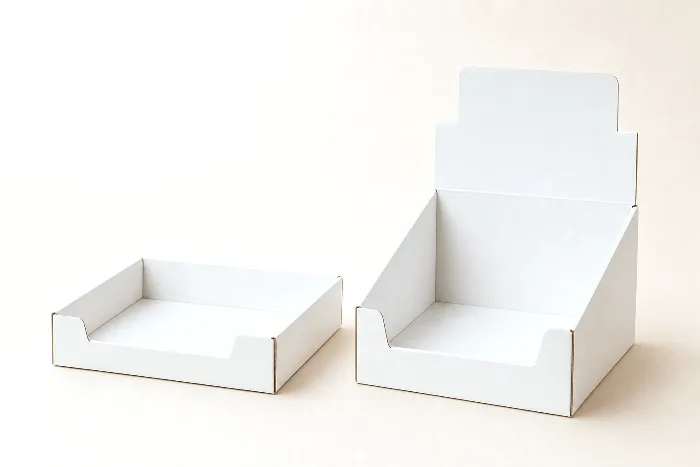
PDQ is usually read as "pretty darn quick" or "point-of-purchase display" — a more display-forward, often fully printed tray meant to catch a shopper's eye in a promotional spot, not just refill a shelf. SRP leans utilitarian; PDQ leans promotional. In practice the two overlap heavily, and the only definition that binds you is the one written into your retailer's program.
The engineering rules a shelf-ready pack has to hit
The hard part of retail-ready packaging is that two of its jobs fight each other. To survive a palletized, stacked, humid supply chain, the tray wants to be strong and sealed. To open in seconds on the sales floor without a knife, it wants to be weak and perforated. Good RRP resolves that tension deliberately. The levers:
- Perforation and tear features. A tear tab or zipper perforation defines exactly how the pack opens. Tuned well, it stays intact through transit and then removes the top or front in one pull. Placed badly, it either pops open in the truck or won't tear without a blade.
- Board strength for the real load. The tray still has to carry the stack above it, and a tray with a large open top or a die-cut front is weaker than a closed box of the same board. Corrugated also loses a large share of its stacking strength to humidity and time, so spec the board to the derated, real-world load — see corrugated box strength for the McKee/BCT reasoning and the derating factors.
- Tray geometry. Wall height, corner posts, and how the top removes all trade strength against shopability. A shallow tray shows product well but protects less; a taller tray protects more but hides the product. The corrugated tray style page shows the common geometries.
- Case-pack and pallet alignment. The tray footprint has to tile cleanly onto the pallet with no overhang, because overhang is where crush starts. Get the case pack, the tray footprint, the Ti-Hi and freight class, and the boxes-per-pallet pattern to agree, and the pack ships tight and stacks square.
Because a shelf-ready tray is a weaker structure than a sealed box but travels the same distance, many retailers require it to pass a transit-testing protocol — commonly an ISTA series test — before approving it. Treat testing as a design input, not an afterthought.
Where the binding specs actually live
Here's the honest part, and the reason this article names no exact dimensions, perforation dashes, or print percentages: there is no single universal retail-ready standard. Each retailer publishes its own binding requirements — tray dimensions, opening style, branding and print rules, case counts, pallet patterns, barcode placement — inside its supplier portal, and those requirements vary by retailer, by category, and often by individual program.
Those portals are the source of truth: Walmart's Retail Link, Target's Partners Online, and the equivalent supplier or vendor portals other chains run. A general guide can tell you what levers exist and how the physics works; it cannot tell you the current mandated tray height for a specific category at a specific retailer. When someone quotes you an exact retail-ready spec from memory or from a blog, treat it as a starting hypothesis and confirm it against the live portal spec before you cut tooling. What to pull from the portal for your program:
- Approved tray formats and opening styles for your category
- Case-pack counts and pallet (Ti-Hi) patterns
- Print, branding, and color requirements on the tray
- Barcode and labeling placement
- The transit-testing protocol you must pass
Designing one pack to ship, sell, and open clean
Once you have the portal spec, the design work becomes a right-sizing and structural problem you can actually engineer. A few principles carry across almost every program:
- Right-size to the product and the shelf. The tray should hold the intended case pack with minimal void, tile onto the pallet without overhang, and match the shelf depth. Excess size wastes board, weakens the stack, and costs freight.
- Put the tear line where strength allows. Route the perforation through the least structurally critical path so the pack survives transit but still opens in one motion — and keep it clear of the panels doing the load-bearing work.
- Design the printed face for the shelf, not the desk. Branding on an SRP or PDQ is read from a few feet away on a lit shelf, so facing and legibility matter more than fine detail.
- Decide which channel leads. If the same SKU also ships direct-to-consumer or through a marketplace, the demands diverge — retail-ready optimizes for shelf and replenishment, while a fulfillment channel like Walmart WFS optimizes for single-parcel protection and right-sized dimensional weight. Pick the lead channel before you finalize the structure.
How PackOS builds retail-ready packaging
PackOS treats a retail-ready tray the way it treats any structure — as a parametric dieline tied to real dimensions. Give it the product and the case pack and it models the tray, checks that the footprint tiles onto a pallet without overhang, flags where the board strength lands against the derated stacked load, and prices it — so you can iterate the geometry against transit reality before you commit to tooling. You can see the logistics reasoning on the technology page, or run your own tray through Quick Quote and get a dimensioned, priced pack back in about a minute. Bring the retailer's portal spec; PackOS handles the geometry.
Frequently asked questions
What is retail-ready packaging?
Retail-ready packaging, also called shelf-ready packaging or SRP, is a secondary pack — usually a corrugated tray — designed to move straight from the pallet to the shelf without being unpacked. A store associate opens it, places it as a unit, and the pack merchandises the product until it sells through. The industry often sums up the goal as the five easies: easy to identify, open, shelve, shop, and dispose.
What is the difference between SRP and PDQ?
SRP (shelf-ready packaging) is a broad term for any secondary pack that goes straight to the shelf, usually a tray with a tear-away top. PDQ usually refers to a more display-forward unit — a printed tray or small floor or counter display meant to catch a shopper's eye, not just replenish a shelf. In practice the terms overlap, and different retailers use them differently.
Who sets retail-ready packaging requirements?
Each retailer sets its own binding requirements and publishes them in its supplier portal — for example, Walmart's Retail Link or Target's Partners Online. The specifics, such as tray dimensions, perforation style, print rules, case-pack counts, and pallet patterns, vary by retailer and often by category or program, so the current spec always comes from the portal, not from a general guide like this one.
Does retail-ready packaging have to pass transit testing?
Usually, yes. A shelf-ready tray still has to survive distribution — palletized, stacked, and shipped — and then open cleanly on the sales floor, which is a harder engineering problem than a plain shipper. Many retailers reference transit-testing protocols such as ISTA series tests, and board strength has to be specified for the real stacked, humid, derated load. Confirm the exact protocol in the retailer's supplier portal.
Can one pack work for both retail and e-commerce?
Sometimes, but the demands differ. Retail-ready packaging optimizes for shelf appearance and easy replenishment, while e-commerce packaging optimizes for single-parcel protection and right-sized dimensional weight. A pack can be designed to serve both, but it usually means compromises, so it is worth deciding up front which channel leads.