
Vape cartridge packaging: carts, boxes & inserts
A vape cartridge is a small piece of fragile glass holding valuable oil — and in most markets it also has to be child-resistant. Its packaging has to protect the cart, keep it from moving, and satisfy compliance, all while looking premium on a dispensary shelf.
THE SHORT ANSWER
Vape cartridge packaging does two jobs at once: it immobilizes a fragile cart with a fitted insert, and it wraps that insert in a child-resistant — often tamper-evident, often opaque — outer that can be labeled and merchandised. Most cartridges ship in one of a few rigid formats:
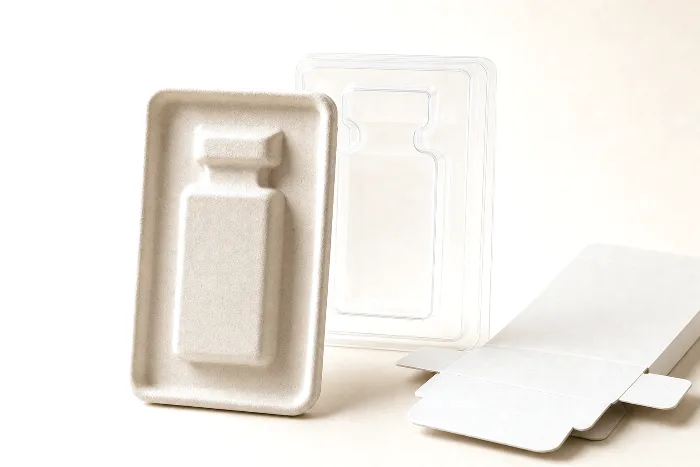
- Fitted insert (molded pulp, thermoform, or foam) — cradles the cart and mouthpiece so the glass can't rattle, chip, or leak
- Child-resistant slider box — an inner tray that only releases when you press a catch; the box itself is the CR mechanism
- Blister-in-carton — a sealed child-resistant blister carried inside a printed folding carton
- Compliance layer — tamper-evidence, opacity, and market-specific warning labels ride on top of all of the above
What a vape cartridge needs from its packaging
A vape cartridge — a "cart" — is a small tank of concentrated oil with a heating element and a mouthpiece, usually built on a glass body and the near-universal 510 thread. Disposables (all-in-one pens) add an integrated battery, which makes them heavier and shifts the center of gravity. Either way, the package is protecting a fragile, valuable, leak-prone object that a customer will unbox and then carry around. Vape packaging is one of the trickier formats in our complete guide to cannabis packaging, because it has to reconcile physical protection with a heavy compliance burden on a very small footprint.
Four pressures drive every decision:
- Fragility. The glass body and the ceramic or quartz heating element crack if the cart is dropped or rattles inside an oversized box. A cracked cart leaks oil and is unsellable.
- Movement. Oil migrates and air pockets form if a cart tumbles or is stored upside down. The package has to hold the cart in a known, stable orientation from packout to shelf.
- Compliance. In regulated cannabis markets a vape almost always has to be child-resistant, and is frequently required to be tamper-evident and opaque as well.
- Presentation. Carts are a premium, high-margin category. The package is the shelf ad and the unboxing moment, so print quality and structure carry real weight.
A note on the rules: this article is general education, not legal or regulatory advice. Cannabis packaging rules are set market by market, differ widely between states, and change often. Treat every requirement mentioned here as "generally, as of publication," name-check the standards, and confirm the current rule with your state or market regulator (and your own counsel) before you commit to a format.
The main vape cartridge packaging formats
Almost all cartridge packaging is rigid — a soft pouch can't stop a cart from cracking. The table below shows the formats that come up most often, how well each protects the cart, and how child-resistance is usually achieved.
| Format | Protection | Child-resistance |
|---|---|---|
| CR slider box | High — an inner tray cradles the cart on all sides | The box is the mechanism: press-and-slide release keeps the tray locked |
| Blister-in-carton | High — a sealed blister immobilizes the cart | Certified CR blister (peel-then-push) inside a printed folding carton |
| Carton + fitted insert | High — pulp, thermoform, or foam insert holds cart and mouthpiece | Pairs with a CR closure or CR blister to earn the rating |
| CR tube | Moderate — round wall needs a spacer to stop end-to-end travel | Push-and-turn or pop-top child-resistant cap |
| Mylar pouch | Low — fine for odor and light, poor for crush | CR zipper, but the cart still needs a rigid inner |
The slider box and the blister-in-carton are the two workhorses. A slider box looks premium, opens with a satisfying push-and-slide, and hides the CR mechanism inside a clean printed sleeve. A blister-in-carton separates the two jobs cleanly: the blister does compliance and immobilization, the carton does graphics and shelf presence. Tubes and pouches show up for value lines and single disposables, but on their own they rarely give a glass cart enough crush protection — most brands drop a rigid insert or spacer inside.
The insert problem: holding a cart still
The hard engineering in cartridge packaging isn't the outer box — it's the insert. A cart that can move is a cart that can chip, leak, or snap at the mouthpiece, so the insert is doing most of the protective work. It has to grip the cartridge body, capture the mouthpiece, and resist the shock of a parcel being thrown into a bin. Because so many carts share the 510 form factor, an insert can be designed to a predictable footprint — one of the quiet advantages of a standardized thread.
There are three common insert materials, each with a trade-off:
- Molded pulp. Opaque, recyclable, and on-brand for sustainability-minded lines. Fiber tolerances are looser than plastic, so the pocket has to be tuned to hold the cart snugly without crushing it.
- Thermoformed plastic (PET/PVC/RPET). Tight tolerances and, if you want it, a clear window that shows the cart. It cradles precisely but adds a plastic component to the recyclability story.
- Foam. The most protective for a heavy disposable or a multi-cart tray, but the least premium and the hardest to recycle.
Whatever the material, the insert and the outer carton are engineered as one system — the pocket depth, the wall thickness, and the fold pattern all have to agree. The outer is almost always a folding carton, and the carton style you pick (straight-tuck, a tray-and-sleeve, a full slider) determines how the insert loads and how the whole thing survives compression.
Folding carton — a paperboard box, printed and die-cut flat, that folds and glues into shape; the standard outer for vape cartridge packaging. See more terms in the packaging glossary.
Child-resistant mechanisms for vape boxes
"Child-resistant" is not a label you can simply print on a box — it's a tested, certified property. Packaging is evaluated against recognized protocols so that it's significantly difficult for young children to open while remaining usable by adults, including seniors. In the cannabis context, converters generally point to the same classification framework used for other regulated products, and the underlying test methods are described by bodies such as ASTM and administered in the consumer-product space under long-standing child-protection rules. For a plain-language walk through what the term means and how it's verified, see our guide to child-resistant packaging requirements.
For rigid vape formats, the CR mechanism is usually one of these:
- Press-and-slide tray. The inner tray won't slide out until you squeeze or press a catch on the sleeve. Common on premium slider boxes.
- Push-button slider. A button on the side must be depressed to release the drawer — a variant of the slide mechanism.
- Tuck-and-lock CR carton. A folding carton whose closure requires a deliberate two-step motion to open.
- CR blister. A peel-then-push blister where the foil must be peeled back before the cart can be pushed through — the compliance layer inside a carton.
Two practical points. First, the rating belongs to the tested package, not to the idea — a change to the board, the insert, or the closure can invalidate a certification, so lock the structure before you certify. Second, child-resistance and reusability often have to coexist: multi-use packages are expected to keep working after repeated opening, which raises the bar on the mechanism.
Compliance and labeling in brief
Beyond child-resistance, a cannabis vape package typically carries a dense labeling load: a THC or universal symbol, health warnings, batch or unique identifier, cannabinoid content, and often a state-specific icon — and the exact set varies by market. On a package this small there's very little label real estate, so the printed carton usually has to carry the bulk of the required copy, sometimes with a fold-out panel or a leaflet to fit it all. Two more requirements show up in many markets: opacity, so the product isn't visible through the pack, and tamper-evidence, so a buyer has visible proof the package hasn't been opened.
Because the specifics differ so much by jurisdiction, treat the label as a variable layer. We don't state per-state rules here — for a general survey of what tends to be required and how programs differ, see cannabis packaging requirements, and the cannabis brands we work with are profiled on our cannabis industry page. The durable design move is to build the structure once and treat the artwork and symbols as a per-market variant — verify each market's current rules with its regulator before you print.
How PackOS builds vape cartridge packaging
PackOS treats the carton and its insert as a single parametric model. Upload artwork, a previous production file, or a spec, and it detects the structure, classifies the cut, crease, and bleed lines, and rebuilds an editable dieline dimensioned to your cartridge — so changing the cart's length or diameter reflows the pocket, the panels, and the glue tabs together. From that it produces a photoreal 3D proof and an instant quote, because once the structure is understood the board area, the print, and the production route can all be calculated. You can see the reconstruction run on the technology page, or try it on a real file with Quick Quote.
Frequently asked questions
Do cannabis vape cartridges have to be in child-resistant packaging?
In most regulated cannabis markets, yes. Vape cartridges and disposables are almost always required to ship in child-resistant packaging, and many programs also require the package to be opaque and tamper-evident. The exact rule depends on your state or market, so confirm the current requirement with the relevant regulator before you commit to a format.
What is a 510 cartridge and why does it matter for packaging?
A 510 cartridge is a common thread standard for vape cartridges, so a wide range of carts and batteries are roughly the same size and connect the same way. For packaging it matters because a fitted insert can be designed to a predictable cartridge footprint, which makes it easier to hold the cart still and protect the glass in transit.
How do you protect a fragile vape cartridge inside a box?
The cart is held still by a fitted insert — molded pulp, thermoformed plastic, or foam — that cradles the cartridge and the mouthpiece so it cannot rattle against the box walls. A cartridge that can move is a cartridge that can chip, leak, or break, so the insert is doing most of the protective work, not the outer carton.
What is the difference between a child-resistant slider box and a blister-in-carton?
A child-resistant slider box holds the cartridge in an inner tray that only slides out when you press a release, so the box itself is the child-resistant mechanism. A blister-in-carton uses a sealed blister that a child cannot easily open, carried inside a printed folding carton for graphics and shelf presence. Both are common, and the choice depends on cost, look, and the exact certification you need.
Does vape cartridge packaging need to be tamper-evident?
In many cannabis markets, yes. Tamper-evidence gives a buyer visible proof the package has not been opened, and it is distinct from child-resistance, which is about keeping children out. A single package often has to do both. Because the specifics vary by market and change over time, verify the current requirement with the appropriate authority.