
Cannabis concentrate packaging: dabs, glass & silicone
Concentrates are the most potent products on a dispensary shelf and the stickiest to package. This guide covers the containers that hold shatter, wax, badder, and rosin without fighting them — glass, silicone, and plastic — and the child-resistance, tamper-evidence, and labeling every cannabis product has to carry.
THE SHORT ANSWER
Cannabis concentrates need a small, inert, non-stick container that releases sticky extract cleanly and meets cannabis compliance — most often a child-resistant glass jar or a food-grade silicone container, finished with a tamper-evident feature and the labeling every cannabis product carries. The material has to be non-reactive so it doesn't degrade the extract, and it has to be small because concentrates are sold in tiny, potent amounts. That size is exactly what makes the labeling hard.
- Non-stick & inert — glass and food-grade silicone release the extract and don't react with it
- Small volume — jars are usually in the single-milliliter range for a potent, low-weight product
- Child-resistant — required in most regulated markets, demonstrated to a recognized standard
- Compliance-labeled — potency and warning symbols, tamper-evidence, batch and licensing data
What cannabis concentrates need from packaging
"Concentrate" is a category, not a single product. Shatter is glass-hard and brittle; badder and budder are soft and whipped; live rosin is tacky and fluid; sugar and sauce sit somewhere in between. What they share is that they are sticky, high-value extracts sold in very small amounts, and the packaging has to respect all three of those facts at once.
Four requirements drive almost every concentrate-container decision:
- A non-stick, releasing surface. A concentrate that bonds to its container is product the customer can't get out. The interior has to let the extract lift or peel away cleanly.
- An inert, non-reactive material. Terpenes and cannabinoids can interact with the wrong plastics. The container should be chemically stable so it doesn't leach into the extract or pull terpenes out of it.
- Small, precise volume. Concentrates are potent, so a "large" retail unit is still tiny. The container is sized to a gram or a fraction of one, with minimal headspace.
- Cannabis compliance. Like every regulated cannabis product, the unit generally has to be child-resistant, tamper-evident, and labeled — covered in the next section.
Temperature and light matter too. Concentrates are best kept cool and out of direct light, so opaque or boxed presentations that shield the extract are common, and the container should tolerate the cold storage many retailers and consumers use.
The compliance layer every cannabis product carries
Concentrate packaging carries the same regulatory load as any other cannabis product — often more, because the potency is higher. There is no single federal framework in the United States, so the specifics come from each state or market, but the recurring building blocks are consistent enough to design around. For the full picture, see our state-by-state cannabis packaging requirements and the broader complete guide to cannabis packaging.
| Compliance element | What it does | Where it usually lives |
|---|---|---|
| Child-resistance | Makes the unit significantly difficult for young children to open, generally demonstrated to a recognized standard | The closure — a CR lid or jar cap |
| Tamper-evidence | Gives visible proof the unit hasn't been opened since it left the producer | A shrink band, breakaway ring, or void seal |
| Potency & warning symbols | Communicates THC content and the required universal/warning marks | The label or the secondary box |
| Batch & licensing data | Identifies the producer, batch, and test results for traceability | The label, often as printed or applied variable data |
Two of those — child-resistance and tamper-evidence — are structural: they're solved by the closure and the seal, not the graphics. The rest is information that has to physically fit somewhere, which is the central design tension for a container this small. Child-resistance and tamper-evidence are related but distinct requirements; our explainer on child-resistant packaging requirements covers how each is tested and why one doesn't satisfy the other.
Container materials: glass, silicone, and plastic
Three materials dominate concentrate primary containers. Each handles the non-stick, inert, and small-volume demands differently, and the extract's texture usually decides which fits best.
| Material | Non-stick / release | Notes |
|---|---|---|
| Glass | Good — extract lifts off cleanly with a tool; brittle extracts release best from glass | Inert and premium-feeling; the default for shatter, sauce, and diamonds. Heavier and breakable, so it's usually shipped in a protective box. Paired with a CR lid. |
| Silicone | Excellent — the container flexes so product peels out and can be squeezed clean | Use food-grade platinum-cured silicone. Ideal for soft, sticky extracts like badder and rosin. Less premium than glass and not curbside-recyclable in most programs. |
| Plastic (PP) | Fair to good — depends on the grade and any liner or coating | Polypropylene is light, low-cost, and shatterproof. Verify it's a grade compatible with concentrates so it doesn't react with terpenes; often chosen for value lines and pop-top styles. |
A common hybrid is a small glass jar with a silicone insert or liner: the glass gives the premium shelf presence and rigidity while the silicone gives clean release. Whichever you choose, the material only solves containment — the closure is where compliance and usability are won or lost.
Child-resistant lids on small jars
The closure does the heavy lifting on a concentrate jar. It has to seal the extract, resist a young child, and still open easily for an adult — on a lid that might be only a couple of centimeters across. Concentrate containers are essentially miniature jars, so the same closure engineering that governs jar packaging applies, just at a smaller scale.
The mechanisms you'll see most often:
- Push-and-turn CR lids — the classic child-resistant action, adapted to small-diameter jars. The user presses down while twisting, which a young child generally can't coordinate.
- Squeeze-and-turn or squeeze-to-open — the lid or container walls must be compressed at specific points before it releases.
- CR pop-top vials — a one-piece container (often for smaller value units) where the cap must be pinched or the base squeezed to pop open.
- Sliding CR tins — a metal tin with an inner tray that only slides out when two catches are pressed.
Whatever the mechanism, the CR performance is a property of the closure-and-container pairing, not the lid alone — so the jar and cap are qualified together. Tamper-evidence is usually layered on top: a shrink band over the lid seam, a breakaway ring, or an induction or void seal that shows if the unit has been opened.
Labeling a container the size of a thumbnail
Here's the core problem of concentrate packaging: a jar sized for a gram of extract may be no bigger than a thumbnail, yet the label has to carry potency figures, the required warning and universal symbols, batch and licensing data, and a tamper-evident feature. There is simply not enough curved surface for all of it at a legible size.
The practical solutions, in rough order of how much extra room they buy:
- A sized wrap or lid label. A body wrap plus a top-of-lid label, each drawn to the exact container geometry, squeezes out every usable square millimeter. This alone is enough for some smaller info loads.
- A multi-layer peel-back label. A booklet or peel-and-reseal label adds hidden pages under the top ply, so a small footprint holds several panels of required text.
- A secondary retail carton. When the mandated content won't fit the container at all, the full compliance panel moves to a folding carton or slider box that holds the jar — covered next.
Because the surface is so unforgiving, the artwork has to be built precisely to the container's dieline, with the bleed and safety margins that curved, small-format labels demand. Getting the die geometry and the variable batch data right the first time is what keeps a compliance label from being rejected at the line.
The retail box and insert
For most premium and mid-tier concentrates, the jar doesn't ship naked. A secondary box does several jobs at once, which is why it's so common in this category:
- It carries the compliance overflow. The warnings, symbols, and legal copy that won't fit the jar live on the box's larger panels.
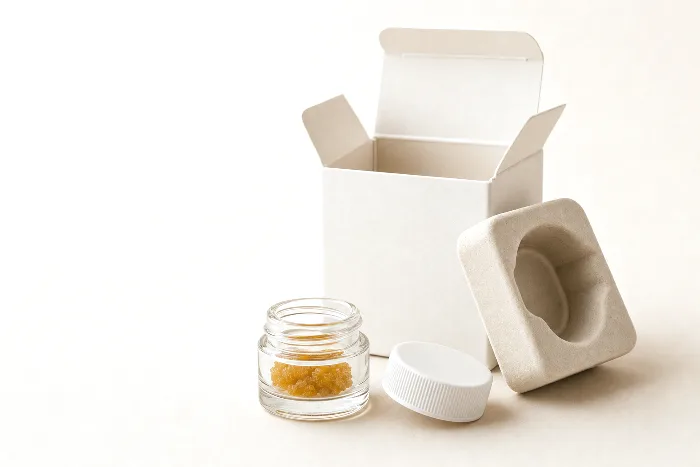
- It protects a fragile, valuable unit. Glass jars and their contents survive the trip better cushioned inside a rigid carton, usually with a fitted insert or foam that holds the jar still.
- It shields the extract from light and shelf handling and gives the brand a real canvas for shelf presence and unboxing.
- It can add a second tamper-evident and child-resistant layer — a CR slider box, for example — so the whole retail unit passes even if the jar closure is doing the primary CR work.
The insert is the underrated part. A concentrate jar rattling loose in an oversized box looks cheap and risks breakage; a snug pulp, foam, or paperboard insert makes the unit feel considered and keeps the glass centered. These secondary structures are ordinary folding cartons at heart, so the same style choices — tuck-end, sleeve, rigid, or slider — apply, tuned for a small, heavy, breakable payload.
How PackOS handles concentrate packaging
Concentrate packaging is a stack: a small primary container, a CR closure, a tightly-fitted compliance label, and usually a secondary carton with an insert — each with its own geometry and its own artwork. PackOS treats that stack as one connected job. Upload the label art or a die file and it detects the structure, rebuilds an editable, parametric dieline for the container and its box, checks the artwork against bleed and safety on the curved small-format label, and returns a photoreal 3D proof and an instant quote. Because concentrate SKUs multiply fast — a line often ships many strains and sizes on the same base container — a parametric model lets one approved template reflow to each variant instead of being rebuilt by hand. You can watch the reconstruction run on the technology page, and if you make regulated products, our cannabis packaging solutions page shows how the per-market variants are managed. This is a spoke of our complete guide to cannabis packaging — start there for the format map across flower, pre-rolls, edibles, concentrates, and vapes.
Frequently asked questions
What is the best container for cannabis concentrates?
Glass and silicone are the two most common choices because both are inert and release sticky extracts cleanly. Small glass concentrate jars with a child-resistant lid suit shatter, sauce, and diamonds, while food-grade platinum-cured silicone containers flex so soft extracts like badder and rosin peel out. The right pick depends on the extract's texture, the fill volume, and the child-resistance and labeling rules in your market.
Do cannabis concentrate containers have to be child-resistant?
In most regulated cannabis markets, yes. Child-resistance is one of the most consistent requirements across states, and it usually must be demonstrated to a recognized standard such as ASTM D3475 or the CPSC protocol under the Poison Prevention Packaging Act. Rules vary by jurisdiction and change over time, so confirm the current requirement with your state regulator.
Why is silicone used for concentrate containers?
Silicone is non-stick, flexible, and inert, so sticky extracts release cleanly and the container can be squeezed to remove the last of the product. Food-grade platinum-cured silicone is the grade generally used for concentrate containers. Its main trade-offs are a less premium feel than glass and limited recyclability through most curbside programs.
What size are cannabis concentrate containers?
Concentrate containers are small because the product is potent and sold in small amounts. Common jar volumes are in the single-milliliter range, which leaves very little room on the container for the required compliance labeling. That space limit is often why the mandated warnings and symbols move onto a secondary retail box or a separable label layer.
How is a concentrate container labeled when it is so small?
The label has to carry the potency and warning symbols, a tamper-evident feature, and batch and licensing information, which rarely fits on a jar the size of a thumbnail. The usual solutions are a wrap or lid label sized to the container, a peel-back multi-layer label, or moving the full compliance panel onto a secondary carton. Requirements differ by market, so verify what your jurisdiction mandates.