
SIPP & SIOC: designing a box that passes Amazon's tests
On Amazon, the biggest packaging win usually isn't a prettier box — it's a box that ships in its own container and survives the trip without an overbox. That's what SIPP and SIOC certify, and it's an engineering problem before it's a paperwork one.
THE SHORT ANSWER
SIPP (Ships in Product Packaging) and SIOC (Ships in Own Container) are Amazon programs that let a product ship in its own packaging with no added Amazon overbox — and to qualify, that packaging must be certified to survive e-commerce transit on its own, typically against a test in the ISTA-6-Amazon family. The manufacturer's edge is designing the box to pass before you pay for a test:
- Right-size the box so there's little void to crush — and less dimensional weight to pay for
- Spec the board to the real, derated compression load, not the lab-fresh number
- Secure the product inside so it survives drop and vibration
- Seal and mark it per Amazon's current rules — and verify every spec in Seller Central
What SIPP and SIOC actually are
Both programs belong to Amazon's Frustration-Free Packaging family — the effort to cut over-packaging, damage, and unboxing friction. The common thread is that the product's own packaging is the shipping container: it goes to the customer without a second Amazon box wrapped around it. That's the reward. The obligation on the other side is that your packaging has to prove it can survive shipping alone.
- SIOC — Ships in Own Container. Generally, the product's retail or master box is also its shipping box. Think of a mid-size item whose printed carton is engineered to double as the mailer.
- SIPP — Ships in Product Packaging. Generally applies to items whose existing product packaging is durable enough to ship as-is, without extra protective material added at the fulfillment center.
The exact program names, tiers, and qualifying criteria are defined by Amazon and change over time, so treat the definitions here as the shape of the thing and confirm the current specifics in Seller Central. This article is one spoke in our guide to packaging requirements by sales channel — the same product often needs a different package for FBA, retail, and direct parcels.
| Path | What it means | The catch |
|---|---|---|
| Standard (overboxed) | Your unit ships inside an added Amazon box with fill | More material and dimensional weight; the overbox does the surviving, not you |
| SIOC | Your own container is the shipping box — no overbox | Must be certified to survive transit alone and carry the right marks |
| SIPP | Durable product packaging ships as-is | Eligibility is product-specific; verify the current criteria in Seller Central |
Why Amazon rewards shipping in your own container
Every overbox is material, labor, and cube that Amazon would rather not spend. When your package ships in its own container, there's less to buy, less to fill, fewer touches at the fulfillment center, and — importantly for you — lower dimensional weight. Carriers and fulfillment networks bill by the larger of actual and dimensional weight, so a right-sized SIOC box that removes the void an overbox would have added can move your unit into a smaller billable size.
Amazon publishes its packaging incentives and its fee schedules in Seller Central, and both move over time. We won't quote dollar figures here because any number printed on a blog goes stale — check the current amounts and any credits or surcharges in Seller Central directly. The durable takeaway is directional: right-sizing wins on cost almost everywhere, which is a theme that runs through e-commerce packaging generally, not just Amazon.
How Amazon tests the box: ISTA-6-Amazon at a glance
SIPP/SIOC eligibility hinges on transit testing. Amazon references the ISTA 6-Amazon family of test protocols, developed with the International Safe Transit Association to simulate the abuse a single parcel takes in an e-commerce network — the kind of handling an overbox normally absorbs. There are different protocols for over-boxed versus own-container shipments, so the tier that applies depends on how your item ships.
At a high level, a transit-test protocol in this family exercises the package against the real hazards of the supply chain:
- Drop / impact — the free-fall and rotational drops a parcel sees during handling and sortation.
- Compression / stacking — the sustained top load from being stacked in trailers and on pallets.
- Vibration — the road and conveyor vibration that loosens closures and lets a rattling product wear through its own box.
- Random shock / incline — additional impact events some tiers add to mimic rough handling.
The specific drop heights, compression loads, cycle counts, and pass criteria are defined by ISTA and Amazon and vary by tier and product — so confirm the exact protocol and thresholds with ISTA and in Seller Central before you build to them. The strategic point is simpler than the test sheet: passing means your packaging survives on its own merit, without the crutch of an overbox.
Designing a box that passes: the manufacturer's edge
Here's where a company that actually engineers packaging gets ahead of a company that just orders it. You can design most of the failure modes out of the box before it ever reaches a test lab, which turns certification from a gamble into a formality. Four levers do the heavy lifting:
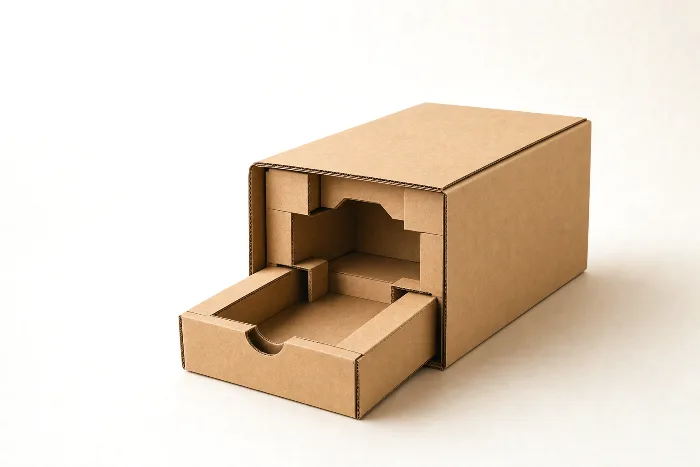
- Right-size the box. Empty space is the enemy: void lets the product move (failing vibration) and lets the walls cave (failing compression), and it inflates dimensional weight. Cut the headspace to the minimum that still protects the product. A regular slotted container sized to the product is the workhorse here.
- Spec the board to the derated load. Compression is where SIOC boxes most often fail. A board grade that looks fine on a fresh, single box in a dry room can crush in a humid trailer under a week-old stack. Size the board to the derated load, not the lab-fresh number — humidity alone can cut compression strength by roughly half, and long-duration stacking and die-cut openings take more. Estimate it with the box compression calculator and read the full method in corrugated box strength.
- Secure the product inside. A snug fit — internal blocking, bracing, or a thermoformed insert — keeps the product from rattling and beating a hole through its own container during the vibration and drop stages.
- Seal and mark it correctly. Use the right closure and tape pattern, and apply the shipping marks and labels Amazon requires for own-container shipments (including the placement rules that keep barcodes scannable). Confirm the current marking and label spec in Seller Central.
A SIPP/SIOC readiness checklist
Before you commission a transit test, walk the box through this. It's the difference between a first-pass certification and paying for a re-test.
| Check | What good looks like | Where to confirm |
|---|---|---|
| Right-sized | Minimal void; product held snug with little headspace | Your dieline / fit test |
| Board grade | Clears the derated compression load with a safety factor | Compression calculator + a real BCT test |
| Product secured | No rattle; blocking or insert controls movement | Shake and drop bench check |
| Closure / seal | Correct tape pattern or glue; stays shut through vibration | Your line + the transit protocol |
| Marks & labels | Required own-container marks present; barcodes scannable and placed right | Amazon Seller Central |
| Test tier | The correct ISTA-6-Amazon protocol identified for how you ship | ISTA + Amazon Seller Central |
Notice how much of that list is decided at design time. Two rows — the marks and the test tier — are pure lookups against the official sources; the rest are things you build in.
How PackOS helps you design to pass
PackOS was built by a team that manufactures at scale, so the SIOC problem is native to it. Upload artwork or a die file and it detects the structure, rebuilds an editable parametric dieline, and dimensions the box — then it estimates board and compression against the derated load and right-sizes the pack, so you walk into a transit test knowing the box is spec'd to survive rather than hoping it does. From the same model it produces a 3D proof and an instant quote. See the logistics engine on the technology page, or run a real file through Quick Quote. Whatever the tool tells you, treat Amazon and ISTA as the final word on the certification path — verify it there before you commit tooling.
Frequently asked questions
What's the difference between SIPP and SIOC?
Both let a product ship in its own packaging without an added Amazon overbox. SIOC (Ships in Own Container) generally means the product's shipping container is also its retail box. SIPP (Ships in Product Packaging) generally applies to items whose existing product packaging is durable enough to ship as-is. Amazon defines the exact criteria and current program names in Seller Central, so confirm which one your product qualifies for there.
How does Amazon test SIPP/SIOC packaging?
Qualifying packaging is evaluated against a transit-test protocol in the ISTA-6-Amazon family, which simulates the drops, compression, and vibration a parcel sees in e-commerce handling. The exact test tier, drop heights, and pass criteria depend on the product and are defined by ISTA and Amazon, so verify the current protocol before you test.
Do I have to pay a lab to certify my packaging?
Certification generally goes through a testing process recognized by Amazon, which can mean an ISTA-certified lab. You can lower the risk of a costly failed test by designing the box to survive first — right-sizing it, specifying board to the derated load, and securing the product. Confirm the current certification path and any self-test options in Seller Central.
Does a SIOC box still need an Amazon shipping box around it?
No. The point of Ships in Own Container is that the product's own box is the shipping box, with no added overbox. That is also why the packaging has to survive transit on its own and carry the required shipping marks and labels. Verify the current marking and labeling rules in Seller Central.
How do I make sure my box passes the compression test?
Compression failures usually trace to board that is under-specified for the real, derated load. Estimate the stacking load, apply a safety factor for humidity and long-term storage, and choose a board grade that clears it, then confirm with a compression calculator or a test. Right-sizing the box to cut headspace also helps, because empty space invites crush.