
Cannabis flower packaging: jars, pouches & tins
Cannabis flower is fragile cargo: it dries out, loses aroma, and reacts to light, all while facing some of the strictest packaging rules in retail. This guide covers the three formats brands actually use — jars, pouches, and tins — and how to choose between them.
THE SHORT ANSWER
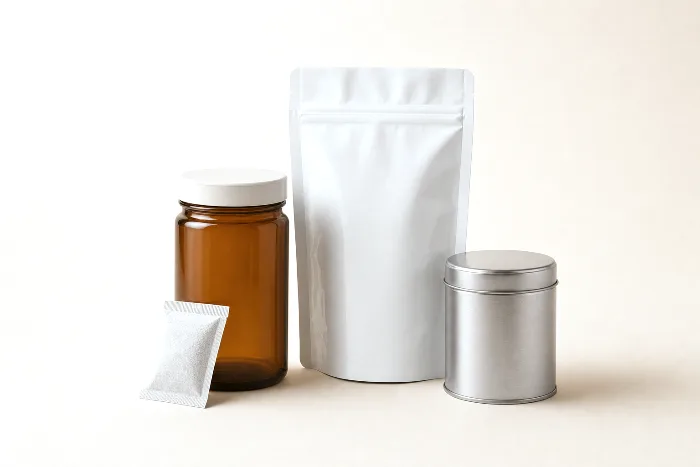
Cannabis flower is packaged in three main formats — glass jars, high-barrier mylar pouches, and metal tins — each available with a child-resistant closure. The right one balances freshness, odor and light control, child-resistance, shelf presence, and shipping cost. The differences that decide it:
- Glass jar with a CR cap — premium feel, inert, reseals and reuses well, widely recyclable; heavy and breakable
- Mylar stand-up pouch with a CR zipper — light, high odor and moisture barrier, low ship cost; hard to recycle
- Metal tin with a CR lid — durable, opaque by default, reusable feel; freshness depends on the lid seal
- Then add a two-way humidity pack, block light, and confirm your state's child-resistance and opacity rules before you commit
What cannabis flower packaging has to do
Cannabis flower is one of the more demanding products to package. It is a cured botanical that keeps changing after it leaves the grow — it dries, oxidizes, and loses its aromatic compounds — and it sits inside one of the most heavily regulated retail categories, where the package is expected to be child-resistant, tamper-evident, and labeled to a state's exact specification. The formats that survive balance all of those jobs at once. This is a deep dive inside our complete guide to cannabis packaging — focused only on flower.
Before choosing a format, it helps to be clear about what the package is actually protecting against:
- Moisture loss and gain — flower cured to a target moisture holds its character; too dry turns harsh and brittle, too wet risks mold.
- Oxygen and aroma loss — oxygen degrades cannabinoids and terpenes, and the volatile terpenes that carry smell and flavor escape through low-barrier materials.
- Light — UV and visible light break cannabinoids down, which is why so many flower packages are opaque or tinted.
- Odor containment — flower is pungent, and retailers and regulators expect the smell to stay inside the pack.
- Child-resistance and tamper-evidence — effectively universal for flower in legal markets.
- Shelf presence — dispensary shelves are crowded, and the package is the brand.
The three main formats: jars, pouches, and tins
Almost all retail flower ends up in one of three formats. Each can be built to be child-resistant, and each has a natural fit by price point and brand position.
| Format | Child-resistant options | Best for |
|---|---|---|
| Glass jar | Push-and-turn CR cap, or a certified CR lid | Premium eighths and quarters; brands leaning on shelf presence and a reusable jar |
| Mylar stand-up pouch | CR press-to-close zipper or CR slider | Value and mid-tier flower, multipacks, and any program watching shipping weight |
| Metal tin | CR push-tab or twist lid | Pre-packed eighths, a durable reusable feel, and an opaque pack by default |
The glass jar is the premium default: inert, so it never interacts with the flower or its terpenes, airtight when resealed, substantial in the hand, and often kept and reused — at the cost of weight, breakage, and no light protection unless it is tinted or boxed. The mylar stand-up pouch is the volume workhorse: a high-barrier laminate that blocks moisture, oxygen, and odor at a fraction of a jar's weight, cannot shatter in transit, ships cheaply, and prints edge to edge, with recyclability its main trade-off (covered below).
The metal tin sits between the two: opaque by default, dent-resistant rather than breakable, lighter than glass, and durable in the hand. Its weak point is the seal — a tin keeps flower fresh only as well as its lid gasket, so freshness-critical products often pair a tin with a liner or humidity pack.
Humidity control and why terpenes degrade
Freshness in flower is mostly a moisture story. Cured flower is stored at a target moisture level; hold it there and it keeps its texture and aroma, drift away and it either dries into a brittle, harsh product or holds enough moisture to risk mold. Many brands target roughly 55–62% relative humidity inside the pack as a typical storage window, though the right number depends on the product and is best treated as approximate rather than fixed.
Terpenes are the second half of the story — the volatile aromatic compounds that give each strain its smell and flavor. They evaporate faster when the flower is too dry, when oxygen is present, and when the barrier is weak, and once they are gone the flower smells flat no matter how it was grown. So the best-protected flower combines a target moisture level, a high barrier to slow oxygen and aroma escape, and something to hold humidity steady.
That "something" is usually a two-way humidity control pack — a small sachet that absorbs and releases moisture to hold the pack at a set relative humidity. It works in any of the three formats and is one of the cheapest ways to protect an expensive product. A short checklist for a fresh flower pack:
- Start with flower cured to the right moisture — packaging cannot fix flower that went in too wet or too dry.
- Choose a high-barrier material, add a correctly sized two-way humidity pack, and block light and headspace where the format allows.
Light, opacity, and shelf color
Light degrades cannabinoids, so protecting flower from it matters on the merits alone — and it is also a compliance question in many markets. Some states require cannabis packaging to be opaque or non-transparent so the product is not visible, while others permit clear packaging. Because opacity is one of the requirements that varies most from state to state, treat it as something to verify rather than assume.
Each format handles light differently. A tin is opaque by nature, and a mylar pouch with a metallized or foil layer blocks light completely — while a clear-windowed pouch may be non-compliant where opacity is required. The glass jar needs a deliberate choice: clear glass offers no light protection, so brands reach for amber, UV-blocking, or colored glass, or box a clear jar in an opaque carton.
Odor and barrier: what mylar actually does
"Mylar" is used loosely in cannabis to mean any high-barrier flexible pouch, but the barrier comes from a laminate, not one magic film. A pouch stacks several bonded layers: a printable outer layer, one or more barrier plies (a metallized film or aluminum foil) that stop oxygen, moisture, and aroma, and an inner sealant that welds it shut. The same laminate engineering that governs any flexible package applies here — our stand-up pouch spec guide has the structural detail. For flower, the levers that matter are the barrier ply (foil is strongest; metallized film is lighter and friendlier to recycle), the seal quality on the zipper and welds, and whether a clear window is worth the barrier and opacity it costs.
Child-resistance, tamper-evidence, and labeling
A note before specifics: this is general information, not legal or regulatory advice. Cannabis packaging rules are set state by state, there is no single federal framework, and they change often. Confirm every requirement with your state's cannabis regulator — and, where the stakes warrant it, qualified counsel — before you commit a package to production.
That said, the compliance layer for flower is consistent in shape even where details differ. Child-resistance is effectively universal: most legal markets require the retail flower package to be child-resistant, and many require it to stay child-resistant after it is reclosed — which is why CR zippers and caps exist rather than one-time seals. That performance is evaluated against established protocols, such as the framework the U.S. Consumer Product Safety Commission administers under the Poison Prevention Packaging Act and the classification testing in ASTM D3475, so a "child-resistant" closure is one tested to a recognized standard, not merely one that is hard to open. We go deeper in our guide to child-resistant packaging requirements.
Tamper-evidence — visible proof the package has not been opened — is commonly expected alongside child-resistance, and labeling carries the most state-by-state variation: universal symbols, THC content, warnings, and batch and license identifiers each have their own formats. Rather than restate rules that shift by market, we keep the running detail in cannabis packaging requirements, state by state, and point you to the official source before you print.
The sustainability trade-off
Flower packaging sits on an honest tension: the pack that protects the product best is often the hardest to recycle, and the lightest, cheapest-to-ship option is usually the multi-layer laminate that curbside programs cannot process. No format wins every column, so it is worth seeing the trade-offs side by side.
| Factor | Glass jar | Mylar pouch | Metal tin |
|---|---|---|---|
| Odor & oxygen barrier | Excellent (inert, airtight with a liner) | Excellent (high-barrier laminate) | Good (depends on the lid seal) |
| Light protection | Needs tint, color, or an outer box | Opaque with a foil or metallized ply | Opaque by default |
| Weight & ship cost | Heavy, breakable | Light, shatterproof | Light, dent-resistant |
| Reseal & reuse | Reseals airtight, often reused | Zipper reseal | Lid reseal, reusable |
| Recyclability | Widely recyclable where glass is collected | Hard to recycle (multi-layer) | Recyclable where metal is collected |
Glass and metal are broadly recyclable where local programs accept them — the sustainability argument for both, offset by the freight cost of shipping heavy glass. The mylar pouch flips it: light and low-footprint per pack, but the same lamination that gives it a great barrier makes it hard to recycle, since most recovery streams cannot separate the bonded layers. Mono-material pouches — a recyclable barrier built from a single plastic family — are a real and growing answer, and we cover their honest state in our guide to recyclable mono-material pouches. Be careful with claims, though: recyclability depends on whether local infrastructure or a store drop-off actually accepts the material, so verify before printing a recycling promise.
How PackOS helps with cannabis flower packaging
Choosing a format is only the start; then it has to become a manufacturable spec — the right pouch laminate or jar and closure, the structure, the artwork placed on it, and a price you can act on. PackOS compresses that. Upload artwork, a previous pack, or a spec and it detects the structure, rebuilds an editable parametric model, renders a photoreal 3D proof, and returns an instant quote — so you can compare a jar against a pouch against a tin as real, priced options rather than guesses. Watch the reconstruction on the technology page, see how we support the category on our cannabis packaging page, or run a real file through Quick Quote.
Frequently asked questions
Does cannabis flower have to be in child-resistant packaging?
In legal cannabis markets, child-resistant packaging is effectively universal for flower — most state programs require the retail package to be child-resistant, and many require it to stay child-resistant after it is reclosed. The specific standard and how it is tested vary by state, so confirm the current rule with your state's cannabis regulator before you commit to a closure.
What keeps cannabis flower fresh in its packaging?
Freshness comes down to controlling moisture, oxygen, and light. Flower cured to the right moisture level holds its terpenes and texture best, so many brands add a two-way humidity control pack to hold a target relative humidity, use a high-barrier material to slow oxygen and aroma loss, and choose an opaque or tinted pack to block light. Together these slow the drying and degradation that make flower harsh and flat.
Do cannabis flower bags and jars have to be opaque?
It depends on the market. Some states require cannabis packaging to be opaque or non-transparent so the product is not visible, while others allow clear packaging. Opacity also helps protect flower from light regardless of the rule. Because this is one of the requirements that varies most by state, verify the current standard with your state regulator.
Are mylar cannabis bags recyclable?
Usually not easily. Most high-barrier mylar pouches are multi-layer laminates of different materials bonded together, which most curbside programs cannot separate or recycle. Mono-material pouches designed for recyclability are emerging, but recovery still depends on local infrastructure and whether a store drop-off exists. Treat broad recyclability claims with caution and confirm what your local system actually accepts.
Glass jar or mylar pouch for cannabis flower — which is better?
Neither is universally better — they trade off. Glass jars feel premium, are inert, reseal well, and are widely recyclable, but they are heavy, breakable, and cost more to ship. Mylar pouches are light, high-barrier, and shatterproof and cost less to ship, but they are hard to recycle and feel less premium. The right choice depends on your brand position, price point, and freight math.