
Cannabis packaging cost: what actually drives it
"How much does cannabis packaging cost?" is the most-asked question we get, and almost every answer online is a made-up number. Here is the honest version — the mechanics that move the price, from a team that actually manufactures the parts.
THE SHORT ANSWER
Cannabis packaging cost is driven mostly by the child-resistant closure, the format, decoration, and compliance overhead — not the raw material itself. A certified child-resistant (CR) mechanism, whether the format is a jar, a mylar bag, a pre-roll tube, or a carton, how it's decorated, and the volume you run each pull the per-unit price in different directions. Because those variables swing so widely, no honest per-unit figure exists in the abstract — the real number comes from a real spec.
- The CR closure or mechanism is usually the single biggest cost lever.
- Format — jar vs. mylar vs. pre-roll tube vs. carton — sets the material and tooling baseline.
- Decoration (colors, foil, labels, finishes) adds plates, passes, and steps.
- Volume spreads tooling and setup, so per-unit cost falls as the run grows.
- The only trustworthy number is a live one — get a real cannabis packaging quote.
What drives cannabis packaging cost
Ask a search engine "how much does cannabis packaging cost" and you'll get a wall of confident per-unit ranges. Ask five of those pages the same follow-up — for which format, which CR system, and at what volume? — and the numbers fall apart, because they were never anchored to a real specification in the first place. Cannabis packaging cost is not one number; it's the sum of a handful of decisions, and the biggest of those decisions has nothing to do with the plastic or board itself.
The dominant lever is compliance. A cannabis package generally has to be child-resistant, and depending on the market it may also need to be opaque, resealable, tamper-evident, and carry a specific set of warnings and symbols. Each of those requirements attaches to a physical mechanism or a manufacturing step, and each step has a cost. Strip the compliance overhead away and you're left with roughly the same jar, pouch, or tube that any other consumer category buys — the cannabis premium lives in the closure, the barrier, and the label program, not the raw material.
Who actually makes this (and why it matters)
Most articles about cannabis packaging cost are written by people who have never cut a die or certified a closure. This one isn't. PackOS is built by Calyx Containers, which manufactures cannabis packaging at scale — the jars, closures, tubes, and flexible formats this article describes. That's why you won't find a fabricated "cost per unit" table below: we know the number moves too much to print honestly, and we'd rather explain the mechanics and then hand you a real quote than guess.
That vantage cuts both ways. Because we make the parts, we can tell you exactly which choices add cost and which don't — but it also means the responsible thing is to send you to a live price against your own spec rather than a marketing range. If you want the full regulatory picture behind these costs, our cannabis packaging requirements guide and the complete guide to cannabis packaging cover the rules that this article prices out. You can also see the formats in context on the cannabis industry page.
The cost drivers, one by one
Here are the variables that actually move the price, and the direction each one pushes. None of these are dollar figures — they're the relationships, so you can reason about your own project before you get a quote.
| Driver | Why it moves cost | Note |
|---|---|---|
| CR closure / mechanism | A certified child-resistant cap, locking slider, or CR pouch closure is engineered and tested — it costs more than a plain lid or heat seal. | Often the single biggest lever; certification is tied to the specific package design. |
| Format | A rigid jar, a mylar pouch, a pre-roll tube, and a folding carton each carry different material, tooling, and line costs. | Format also dictates which CR mechanisms are even available to you. |
| Decoration | More print colors, foil, soft-touch, and applied labels each add plates, press passes, and finishing steps. | A one-color print is cheaper than a full-wrap process print plus foil. |
| Opacity / barrier | Many markets and light-sensitive products need opaque, moisture- and UV-barrier structures rather than clear stock. | Higher-barrier laminates and fully opaque resins cost more than a basic clear material. |
| Volume / MOQ | Tooling and setup are one-time costs spread across the run — larger volumes lower the per-unit cost. | Custom tooling carries a minimum order to justify cutting it. See MOQ, explained. |
| State-specific rules | Symbols, warnings, and format restrictions vary by market and can force extra label layers or separate SKUs. | Per-market variants multiply setup and inventory cost, not just artwork. |
Notice that the two heaviest levers — the CR mechanism and the barrier — are both compliance costs, not aesthetic ones. That's the part most cost estimates miss. If you're weighing a fully custom package against an off-the-shelf compliant one, our breakdown of custom vs. stock packaging walks through where the money actually goes.
Cost by format: jar, mylar, pre-roll, carton
Format is the second-biggest driver after the closure, and it's the one buyers control most directly. Each common cannabis format concentrates its cost in a different place.
| Format | Where the cost goes | Note |
|---|---|---|
| Glass or plastic jar | The container (stock mold or custom tooling), the CR lid, and decoration. | Cannabis jar cost swings most with the CR closure and whether the jar is stock or custom-tooled. |
| Mylar / stand-up pouch | The laminate structure, the CR zipper or press-to-close, and the print. | Mylar bag cost rises with added barrier layers and with certifying the CR closure. |
| Pre-roll tube | The tube body, a CR cap, and any label, sleeve, or print. | Pre-roll packaging cost is usually dominated by the CR cap and the decoration method. |
| Folding carton | Board grade, the cutting die, print and finishing, and any CR inner container. | Cartons are often paired with a CR jar or tube inside rather than being child-resistant themselves. |
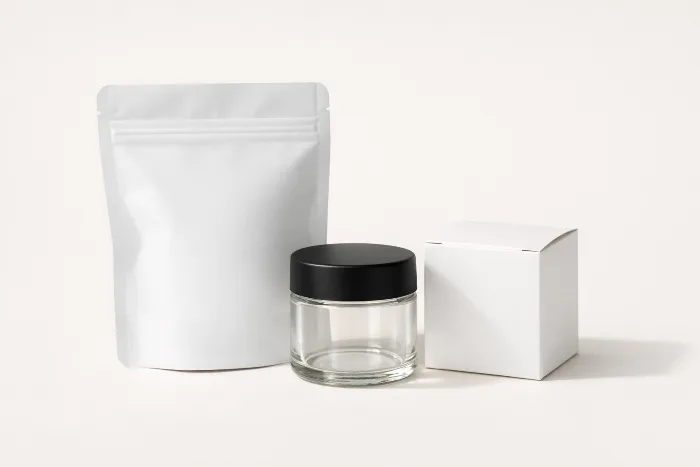
A useful rule of thumb: flexible formats (mylar) tend to have low tooling and material cost but the CR closure and barrier laminate can close the gap; rigid formats (jars, tubes) carry more material and closure cost but decorate cleanly and stack well. There is no format that is universally cheapest — it depends on your product, your fill, your barrier needs, and your volume. The honest cannabis packaging cost per unit for a mylar bag at low volume can look nothing like the same bag at scale.
Why online price ranges contradict each other
If you've collected quotes and "typical prices" from around the web, you've probably noticed they don't agree — sometimes by a wide margin. That's not always because someone is wrong. It's because they're pricing different things and rarely say so. The usual culprits:
- Different CR systems. A basic push-and-turn cap and a certified locking mechanism are both "child resistant," but they aren't the same part or the same cost.
- Different volumes. A per-unit price at a small pilot run and one at a full production run describe the same package at very different points on the cost curve.
- Different decoration. "A mylar bag" might mean a plain stock pouch or a custom-printed, foiled, multi-SKU program. The word is the same; the cost isn't.
- Fabricated numbers. Plenty of pages publish per-unit figures with no spec behind them at all, because a specific number ranks better than an honest "it depends."
Our position is the opposite: we won't invent a number. What we can do is explain the drivers above and then price your actual spec. If you want to see how the same variables show up on a real estimate, read how minimum order quantity affects your per-unit price before you request one.
Compliance overhead: closure plus label
Compliance shows up in the cost in two places: the physical protection (child-resistance, tamper-evidence, and barrier) and the information layer (state-mandated symbols, warnings, and lab data). The first attaches to hardware and materials; the second attaches to your label and artwork program.
The physical side is where certification lives. A closure has to pass a recognized child-resistance protocol for the specific package design, which is why you can't simply move a certified cap from one container to another and assume it still qualifies. Our guides to child-resistant packaging requirements and cannabis packaging requirements go deep on what that testing covers. The information side is where the multi-market tax hides: when symbols and warnings differ by state, one product can need several label variants, each with its own setup — a cost that's invisible until you're running more than one market.
How PackOS helps: when you upload artwork or a spec, the platform detects the structure, dimensions it, and runs it through preflight so the print-and-compliance layer is checked before it becomes a cost surprise. You can see how that quality and preflight step works on the quality & preflight technology page. Getting the file right up front is itself a cost lever — reprints and rejected plates are the most expensive line item nobody quotes for.
How to get a real cannabis packaging cost
Because cannabis packaging cost swings with format, CR system, decoration, barrier, and volume, the only number worth acting on is one priced against your real specification. That's what the instant quote is for: give it your format, dimensions, closure, and volume, and it returns a real figure instead of a range you can't trust.
You don't need a finished dieline or a perfect spec sheet to start — upload existing artwork, a competitor sample's details, or a rough description, and PackOS will detect the structure and reconstruct what it needs to price. If you're comparing formats, run the same product as a jar and as a pouch and let the two real numbers settle the question. Start a Quick Quote and get an honest cannabis packaging cost for your actual package.
Frequently asked questions
How much does cannabis packaging cost per unit?
There is no honest single per-unit figure, because cannabis packaging cost depends on the format, the child-resistant closure, the decoration, the barrier, and the volume you run. Any page that gives you one fixed number is guessing. The reliable way to learn your cost is to price your actual specification, which is what an instant quote does.
What drives cannabis packaging cost the most?
The child-resistant closure or mechanism is usually the single biggest lever, followed by the format and the barrier requirements. These are compliance costs, not aesthetic ones. The raw material itself is rarely the main driver — the cannabis premium lives in the certified closure, the opacity or barrier, and the labeling program.
Why do online cannabis packaging prices vary so much?
Because they price different things without saying so. A basic child-resistant cap and a certified locking mechanism are both called child resistant but cost differently, a pilot run and a full production run sit at different points on the cost curve, and many published figures have no real specification behind them. Comparable numbers only come from pricing the same defined spec.
Is a jar or a mylar bag cheaper for cannabis?
It depends on your product, fill, barrier needs, and volume — neither format is universally cheaper. Flexible mylar pouches tend to have lower tooling and material cost, but the child-resistant closure and barrier laminate can close the gap. Rigid jars carry more material and closure cost but decorate cleanly and stack well. The way to decide is to price your product as both.
Does child-resistant packaging add a lot to the cost?
Yes, relatively — a certified child-resistant closure is engineered and tested for a specific package design, so it costs more than a plain lid or heat seal, and it is often the largest single component of the price. It cannot simply be swapped between containers, because certification is tied to the exact package it was tested on.