
Capsule & blister packaging: unit-dose basics
A blister pack turns a bottle full of capsules into a sheet of individually sealed doses. It is the default format for pharmaceuticals and, increasingly, for supplements that need per-dose protection, counting, or tamper-evidence. Here is how blisters are built and when they beat a bottle.
THE SHORT ANSWER
A blister pack is a unit-dose format: each tablet or capsule sits in its own formed cavity, sealed under a lidding foil you push or peel through. Because every cavity is an individually sealed, tamper-evident dose, blisters are standard for pharmaceuticals and increasingly common for supplements. The main choices:
- Two families — thermoform (clear plastic, product visible, moderate barrier) and cold-form (aluminum, maximum barrier, opaque)
- Per-dose sealing — every cavity is its own tamper-evident unit, which also makes counting and portioning easy
- Unit-dose wins for regimens, samples, travel, and moisture-sensitive actives; a bottle wins for high counts of a stable product
- Child-resistance is optional — a plain push-through blister is not child-resistant; peel-push lidding and a wallet make it so
- Artwork lives on the printed lidding foil and the backing card or wallet the blister is mounted to
What a blister pack actually is
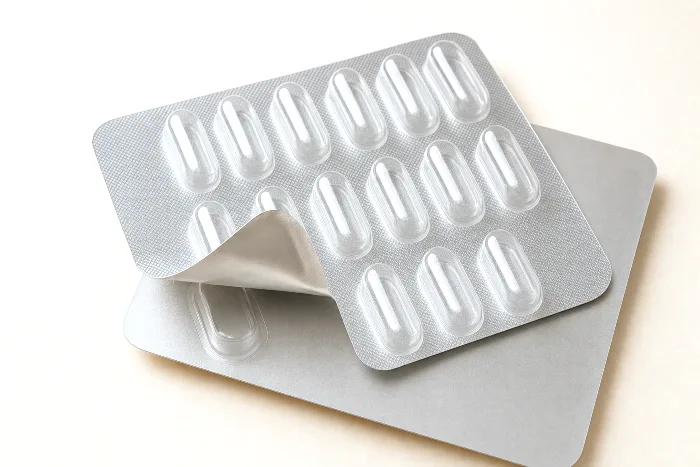
A blister pack is made of two parts. The forming web is the bottom layer: a film that is warmed and shaped — or pressed cold — into a grid of small pockets, the "blisters," each sized to hold one dose. The product drops into the cavities, and then the lidding — usually a printed aluminum foil — is sealed across the top. The result is a sheet of doses, each hermetically closed in its own compartment.
To get a dose out you either push the capsule through the lidding foil, which tears, or peel the foil back. That single design decision — push-through versus peel — is what separates an everyday supplement blister from a child-resistant one, and we come back to it below. The name itself comes from the domed cavity: it looks like a blister raised off the flat sheet.
Blisters are one branch of what the industry calls unit-dose packaging, where each dose is packaged separately rather than loose in a bottle. (A close cousin is the strip pack, where the product is sealed between two flat foils with no formed cavity — common for powders and effervescent tablets.) Blisters are part of the wider toolkit covered in the complete guide to supplement packaging, and they solve a specific set of problems a bottle cannot.
Thermoform vs cold-form: the two blister families
Almost every blister falls into one of two families, defined by how the forming web is made and how much barrier it provides. The trade-off is the same one that runs through most packaging: visibility and cost on one side, barrier protection on the other.
Thermoform blisters are formed from a clear plastic film that is heated until pliable and then drawn or pressed into the cavity shape. The product stays visible, the material runs fast and economically, and the cavities can be shallow and neat. The catch is barrier: bare PVC gives only a modest moisture and oxygen barrier. Where a product needs more protection, converters coat or laminate the film — for example PVDC-coated PVC, or higher-barrier films — which raises the moisture barrier while keeping the pack more or less clear.
Cold-form (often called alu-alu) blisters take a laminate that contains a layer of aluminum foil and press it into shape cold, without heat. Aluminum is effectively a total barrier to moisture, oxygen, and light, so cold-form is the choice for the most sensitive actives. The trade-offs are real: the pack is fully opaque, so the product can't be seen; the formed cavities are larger and more rounded, so fewer fit on a sheet; and the forming process is slower. Cost per dose is typically higher.
| Type | Barrier | Notes |
|---|---|---|
| Thermoform — PVC | Basic | Clear, product visible, fastest and most economical; suits stable products in low-humidity markets. |
| Thermoform — coated/high-barrier | Moderate to high | PVDC coatings or higher-barrier films lift the moisture barrier while staying largely see-through. |
| Cold-form — alu-alu | Very high (near total) | Aluminum laminate blocks moisture, oxygen, and light; opaque, bulkier, slower to run, higher cost per dose. |
The lidding foil is a variable too. Most blisters are lidded with a printable aluminum foil that the dose pushes through cleanly. Child-resistant and peelable formats use different lidding constructions — paper or film laminated to the foil — so the foil doesn't simply tear on the first push. The forming web and the lidding are specified as a pair.
When unit-dose beats a bottle
A bottle is the workhorse of supplement packaging, and for a stable product sold in large counts it is usually the cheaper, simpler choice — see supplement bottle packaging for that side of the decision. Unit-dose earns its extra cost when the value is in the individual dose rather than the bulk count. Blisters tend to win when:
- Adherence and counting matter. A calendar or day-of-week wallet makes it obvious whether today's dose has been taken. Regimens, courses, and combination packs all lean on this.
- Every dose needs its own barrier. A moisture-sensitive active is protected in its sealed cavity right up to the moment it's used — you're not exposing the whole count to humidity each time the pack is opened, so a desiccant inside the pack is often unnecessary.
- Tamper-evidence per unit is the goal. Because each cavity is sealed on its own, a broken cavity is visible proof that dose was reached. This is why unit-dose is common where per-dose integrity is expected.
- Samples, travel, and portions. A two- or seven-count blister is a natural sample or trial pack, and a small strip travels far better than a full bottle.
Where the product is stable and sold by the hundred, a bottle almost always beats a blister on material and cost per dose. The honest read is that blisters buy per-dose protection and presentation, and you pay for it in material and run speed.
Tamper-evidence is one reason blisters show up so often in regulated and health categories, from over-the-counter medicines to the supplements our nutraceuticals customers ship. If tamper-evidence is your main driver but a full blister line isn't warranted, the broader options — induction seals, shrink bands, and the like — are covered in our guide to tamper-evident packaging.
Child-resistant blisters
A common misconception is that a blister is automatically child-resistant. It is not. A plain push-through blister — the kind most supplements use — is easy for a child to open, because a small amount of pressure pops the dose out. Child-resistance is an added feature, engineered into the lidding and often the surrounding pack:
- Peel-push — the consumer first peels back a film layer to expose the foil, then pushes the dose through. The two-step motion is the barrier.
- Peel-then-push with a laminate — a paper or polyester layer over the foil resists tearing until it is deliberately peeled, so a simple push alone won't release the dose.
- Wallet and card systems — the blister is mounted in a folding wallet that has to be manipulated in a specific sequence to reach a dose, adding a mechanical step to the chemistry of the lidding.
Whether a given product must be child-resistant, and which test standard applies, depends on the product and the market. Child-resistance is verified against recognized protocols — standards such as ASTM D3475 for blister classification, administered in the US under agencies including the CPSC — but the specifics are exactly the kind of detail you should confirm rather than assume. Our overview of child-resistant packaging requirements walks through the mechanisms and where they apply.
Not legal or regulatory advice. Whether a supplement needs child-resistant or tamper-evident packaging — and how it must be labeled — depends on the product and the market, and the rules change over time. Name the standards, then verify the current requirements with the relevant authority (in the US, agencies such as the FDA and CPSC) and your own regulatory counsel before you commit tooling.
The backing card, wallet, and secondary pack
A blister sheet is rarely sold bare. It is usually mounted to a printed backing card or folded into a wallet, and that card carries most of the branding and the required label copy — the sealed foil simply doesn't have room for a full ingredient panel. The card also stiffens the pack, protects the cavities, and gives retail a face to merchandise.
Formats range from a simple heat-sealed blister card, to a fold-over wallet that doubles as a dosing calendar, to a blister tucked inside a folding carton for a more premium presentation and extra print real estate. The right choice depends on how much labeling you need to carry, how much shelf presence you want, and whether the wallet itself is doing child-resistance work. Because the card and the blister are sealed together, they are specified as one system: the cavity layout, the card die, and the seal area all have to agree.
Getting blister artwork right
Two printed surfaces matter on a blister pack: the lidding foil and the backing card. The foil is commonly printed with the product name, dose, and lot or expiry information, repeated so it reads over each cavity; the card carries the full artwork and labeling. Printing on foil has quirks a paper job doesn't — inks behave differently on a metallic, non-absorbent surface, and small type over a run of cavities has to stay in register so it doesn't drift off a dose.
The practical rule is the same as any converted job: build the artwork to the converter's template, keep it in vector form, respect bleed and safety, and hand off a correct, print-ready file. Our print-ready PDF guide covers how to prepare that file so the foil and card print cleanly the first time, without a preflight bounce.
How PackOS handles unit-dose packaging
Unit-dose formats are a system, not a single part: a forming web, a lidding, a cavity layout, a backing card or wallet, and a secondary carton, all of which have to fit the dose and each other. PackOS treats that the way it treats any structure — it reads the artwork or a spec, works out the components and their geometry, and turns them into an editable, dimensioned model you can proof and price. Change the count or the capsule size and the cavity grid, the card, and the material area follow. You can see how the detection and quality checks run on the technology page, or put a real file through it with Quick Quote.
Frequently asked questions
What is a blister pack?
A blister pack is a unit-dose format made of a formed plastic or foil cavity that holds one tablet or capsule, sealed with a lidding foil the dose is pushed or peeled through. Each cavity is its own sealed, tamper-evident unit, which is why blisters are standard for pharmaceuticals and increasingly common for supplements.
What is the difference between thermoform and cold-form blisters?
Thermoform blisters are made by heating a clear plastic film such as PVC or PET and forming it into cavities, so the product stays visible but the moisture and oxygen barrier is only moderate. Cold-form blisters are made by pressing a laminate containing aluminum foil into shape, which gives a near-total barrier but hides the product and takes up more space.
When is a blister pack better than a bottle?
A blister pack is better than a bottle when you need per-dose protection, clear dose counting, or tamper-evidence on every unit — for example daily regimens, sample packs, travel packs, and moisture-sensitive products. A bottle is usually simpler and cheaper for large counts of a stable product.
Are blister packs child-resistant?
A standard push-through blister is not child-resistant on its own. Child-resistant blisters use peel-push or peel-then-push lidding and are often paired with a wallet or backing card that has to be manipulated in a specific way. Whether child-resistance is required depends on the product and the jurisdiction, so verify the applicable rules.
Can you print on blister foil and backing cards?
Yes. Lidding foil is commonly printed with the product name, dose, and lot information, and the backing card or wallet the blister is mounted on carries the full artwork and labeling. Printing on foil has its own ink and registration considerations, so supply a correct print-ready file built to the converter's template.