
Supplement packaging: the complete guide
Vitamins, minerals, gummies, powders, and capsules all live or die by how they are packaged. The right pack keeps a sensitive formula stable, proves it has not been opened, and carries a compliant label — this guide walks through how supplement packaging is chosen, format by format.
THE SHORT ANSWER
Supplement packaging has three non-negotiable jobs: protect a moisture- and oxygen-sensitive formula, prove the package has not been opened, and carry a compliant Supplement Facts label. Everything else — the exact bottle, pouch, jar, or blister — follows from the dose form and how fragile the ingredients are.
- Barrier first — tablets, capsules, gummies, and powders all degrade from moisture and oxygen
- Tamper-evidence — usually an induction foil seal or shrink band, expected across the category
- Child-resistance — required only for certain ingredients (iron above set limits, for example), not every product
- Compliant labeling — a Supplement Facts panel plus identity, net-quantity, and manufacturer information
- Format follows dose form — bottles, pouches, jars, and blisters each fit different products
What supplement packaging has to do
A dietary supplement is a small amount of an expensive, often reactive material that has to stay potent from the day it is filled to the day the last dose is taken — frequently a year or more later. The package is the thing standing between that formula and everything trying to degrade it: humidity in the air, oxygen, light, heat, and physical handling. It also has to reassure a shopper that the product is safe and to communicate a surprising amount of regulated information on a surface that is often no bigger than a business card.
Those pressures pull in different directions, which is why supplement packaging is a real engineering problem rather than a matter of picking a nice-looking bottle. Break the job into four demands and every format decision downstream gets easier to reason about:
- Protection. Keep moisture, oxygen, and light away from the formula for its full shelf life. This is usually the deciding factor, and it is why so many supplements ship with a desiccant or an oxygen absorber tucked inside.
- Assurance. Show, visibly, that the package has not been opened or tampered with — and, where the ingredients demand it, resist being opened by a small child.
- Compliance. Carry a legible Supplement Facts panel and the other required copy without cramming the label into an unreadable block.
- Presentation and handling. Look credible on a crowded shelf, survive the trip to the customer, and dispense cleanly — a scoop that fits, a mouth wide enough to reach the last capsule, a pouch that reseals.
Almost every trade-off in this guide is one of those four demands competing with another. A heavier glass jar feels premium but costs more to ship; a high-barrier laminate protects powder beautifully but is harder to recycle; a full child-resistant closure adds safety but frustrates the older customers who buy a lot of supplements. Good packaging is the version that resolves those tensions for a specific product.
How supplements are regulated
In the United States, dietary supplements are overseen by the U.S. Food and Drug Administration (FDA) under the framework of the Dietary Supplement Health and Education Act of 1994 — usually shortened to DSHEA. The key thing to understand is that supplements are treated as a category of food, not as drugs. They are generally not reviewed or approved by the FDA before they go on sale; instead, the responsibility to make a safe, correctly labeled, truthfully described product sits with the company that markets it. That framing shapes the labeling rules directly, and it is why the Supplement Facts panel looks like a close cousin of the Nutrition Facts panel you would find on a food.
Because so much of what a supplement package has to say is dictated by these rules, labeling is worth its own deep dive — we cover the Supplement Facts panel, the DSHEA line between structure/function claims and disease claims, and the elements a label must carry in our guide to supplement label requirements. Many of the same food-contact and safety principles come straight from the food world, so it is also worth reading how food packaging regulations treat the materials that touch what people consume. If your product line sits in this space, our nutraceutical packaging overview shows how these formats and rules come together in production.
The moisture and oxygen problem
If there is one villain in supplement packaging, it is water. Many active ingredients are hygroscopic — they pull moisture out of the surrounding air — and once they take on water they can clump, soften, lose potency, or spoil. Gummies melt and stick together; effervescent tablets fizz prematurely; probiotics and some vitamins lose activity. Oxygen is the second villain, driving the slow oxidation that stales oils, fish-oil softgels, and sensitive botanicals. Light and heat accelerate both. So the barrier properties of the pack — how well it blocks water vapor and oxygen from getting in — are usually the first thing to specify, ahead of shape or shelf appeal.
Packaging fights this on two fronts. The first is a passive barrier: choosing a material and structure that simply lets very little moisture or oxygen through. Opaque high-density polyethylene (HDPE) bottles, glass, and multi-layer laminates with a metallized or foil layer all raise the barrier. The second is active protection placed inside the pack:
- Desiccants — silica gel or molecular-sieve sachets and canisters that absorb whatever moisture does get in, protecting hygroscopic tablets, capsules, and gummies.
- Oxygen absorbers — small sachets that scavenge residual oxygen, used where oxidation is the main threat.
- Induction seals — a foil membrane heat-welded to the bottle mouth that adds a strong moisture and oxygen barrier on top of its tamper-evidence role (more on that below).
- Headspace control — filling a container to a sensible level, sometimes with a nitrogen flush, so less reactive air travels with the product.
The right combination depends on the dose form and how sensitive the formula is. A robust pressed multivitamin tablet in an opaque bottle with an induction seal and a single desiccant may be plenty; a delicate probiotic or a batch of gummies might need a high-barrier laminate and a desiccant and a tight reseal. The point is to match the level of protection to the product rather than over- or under-building the pack.
Packaging by dose form
The single most useful way to reason about supplement packaging is by dose form — the physical shape the product takes. Tablets and capsules behave very differently from a fine powder or a sticky gummy, and the format that suits each one falls out naturally. The table below maps the common dose forms to their workhorse formats; each links to a deeper guide.
| Dose form | Common format | Why it fits |
|---|---|---|
| Tablets & capsules (multi-count) | Packer bottle (HDPE / PET) | Rigid protection, familiar shelf shape, easy induction seal and desiccant; the category default. |
| Gummies | High-barrier pouch or PET jar | Moisture is the enemy — a strong barrier plus a desiccant keeps them from clumping and melting. |
| Protein & powders | Canister/jar or stand-up pouch | Room for a scoop and headspace; pouches ship lighter, jars hold a bigger shelf face. |
| Unit-dose tablets/capsules | Blister pack | Each cavity is sealed and tamper-evident on its own — good for dosing, sampling, and travel. |
| Any (the label layer) | Compliant Supplement Facts label | Every format still has to carry the regulated panel and claims correctly. |
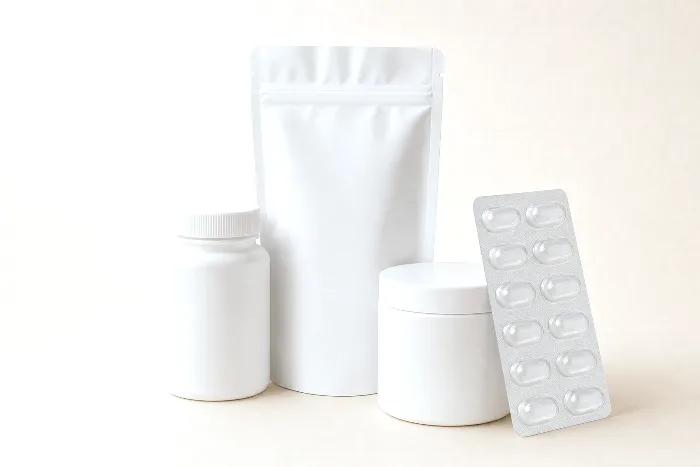
A few patterns are worth calling out. The packer bottle is the default for a reason: it protects rigid dose forms well, accepts an induction seal and a desiccant without fuss, and comes in a familiar round or oval shape that reads instantly as "supplement." Gummies force the biggest rethink, because their moisture sensitivity and stickiness make barrier and reseal the whole ballgame. Powders are really a shelf-versus-ship decision — a rigid canister commands presence, while a stand-up pouch uses far less material and travels more efficiently. And blisters win whenever unit-dose sealing, precise counting, or a printed backing card matters more than bulk economy.
Tamper-evidence and child-resistance
Two safety features get conflated constantly, and they are not the same thing. Tamper-evidence shows that a package has not been opened; child-resistance makes a package hard for a small child to open. A product can need one, both, or — for tamper-evidence at least — nearly always some form of it, because visible proof of an intact seal is what a shopper looks for and what the category expects.
On supplement bottles, tamper-evidence most often takes the form of an induction seal — the foil membrane bonded to the bottle mouth by an electromagnetic field as the cap is applied. The consumer has to peel or break it to open the bottle, and it doubles as a barrier layer. Shrink bands and sleeves around the cap-to-neck joint, breakaway ring closures, and the per-cavity seal of a blister are other common approaches. Because these mechanisms overlap with sealing and dispensing, they are best chosen alongside the closure itself.
Child-resistance is more selective. It is not a blanket requirement for every supplement; it is generally tied to specific ingredients — for example, products containing iron above certain thresholds have long been singled out under the Poison Prevention Packaging Act. Whether your particular formula needs a child-resistant closure turns on what is in it, so the requirement has to be checked ingredient by ingredient against the current rules — our guide to child-resistant packaging requirements walks through how that determination is made and what the closures look like. Treat the standards named here as pointers, not as a definitive ruling on your product.
Sustainability in supplement packaging
Supplement packaging sits in a genuine tension with sustainability, and it helps to be honest about it. The very thing that protects a sensitive formula — a high-barrier structure, often a multi-material laminate with a metallized or foil layer — is frequently the thing that makes a pack hard to recycle. Bottles bring their own version of the problem: opaque HDPE and clear PET are both widely recyclable in principle, but the desiccant, the induction liner, and a heavily inked shrink sleeve can complicate the stream. There is no free lunch, only better-informed choices.
The realistic levers, roughly in order of impact:
- Right-size the pack. The cleanest gain is using less material in the first place — matching the bottle or pouch to the fill so there is no wasted headspace and no oversized secondary carton.
- Move to mono-material where the barrier allows. A single-polymer bottle or pouch is far easier to recycle than a mixed laminate; the catch is that mono-material structures do not always hit the barrier a delicate formula needs.
- Use post-consumer recycled (PCR) content. PCR-HDPE and PCR-PET reduce virgin plastic, though color and clarity constraints and food-contact considerations apply.
- Favor recycle-ready decoration. Design labels and sleeves that do not disqualify the container from its recycling stream.
None of this should turn into a claim you cannot back up — environmental marketing is itself regulated, and overstated "recyclable" or "eco" language draws scrutiny. Our broader sustainable packaging guide covers how to weigh these levers without greenwashing, and how to talk about them accurately.
The full Supplements library
This guide is the map; each format below has its own detailed deep-dive. Together they cover the packaging decisions a supplement or nutraceutical brand faces most often:
- Supplement bottle packaging: HDPE, PET & closures — the workhorse packer bottle, how to size it to the count, and the induction seals, desiccants, and caps that finish it.
- Gummy supplement packaging: pouches & jars — keeping moisture-sensitive, sticky gummies from clumping with high-barrier structures and the right reseal.
- Protein powder packaging: jars & pouches — the rigid canister versus stand-up pouch trade-off, plus scoop, headspace, and ship-efficiency factors.
- Capsule & blister packaging: unit-dose basics — how thermoform and cold-form blisters work, and when unit-dose beats a bottle.
- Supplement label requirements (FDA & DSHEA) — a plain-language tour of the Supplement Facts panel, claims, and the elements a label must carry.
How PackOS handles supplement packaging
Supplement brands rarely run one format — they run a bottle line, a gummy pouch, a powder canister, and a blister sample, often across multiple markets with different label copy on each. PackOS is built for exactly that kind of multi-format, variant-heavy work. Upload artwork, a die file, or an existing spec and it detects the structure, reconstructs an editable parametric model of the pack, and produces a photoreal 3D proof plus an instant quote — so a change to a dimension, a barrier, or a label reflows the whole thing instead of restarting the job. You can watch that reconstruction and quality checking run on the technology page, or put a real file through it with Quick Quote.
Frequently asked questions
How are dietary supplements regulated in the US?
In the United States, dietary supplements are regulated by the FDA under the framework of DSHEA, the Dietary Supplement Health and Education Act of 1994. Supplements are treated as a category of food rather than as drugs, so they are generally not approved before sale, but they must carry a Supplement Facts panel and follow labeling and manufacturing rules. This is general information, not legal advice, so verify current requirements with the FDA and qualified counsel.
What packaging keeps supplements fresh?
Supplements degrade mainly from moisture and oxygen, so freshness comes from a good barrier plus active protection inside the pack. Common measures are a high-barrier bottle or pouch, an induction heat seal under the cap, and a desiccant or oxygen absorber. The right combination depends on the dose form and how sensitive the formula is.
Do supplements need child-resistant packaging?
It depends on the product. Child-resistant packaging is generally required only for supplements that contain ingredients regulated under the Poison Prevention Packaging Act, such as iron above certain levels, while many everyday vitamins do not require it. Because the rule turns on the ingredient, confirm your specific formula against the current CPSC requirements.
What is an induction seal on a supplement bottle?
An induction seal is a foil membrane bonded to the bottle mouth by an electromagnetic field during capping. It provides tamper-evidence, because the consumer must break or peel it to open the bottle, and it adds a moisture and oxygen barrier. It is one of the most common ways a supplement bottle shows that it has not been opened.
Is a bottle or a pouch better for supplements?
Neither is universally better; it depends on the dose form and priorities. Rigid bottles protect tablets and capsules well and hold a familiar shelf shape, while stand-up pouches use less material and ship more efficiently, which suits powders and gummies. Many brands match the format to the product rather than standardizing on one.