
Supplement bottle packaging: HDPE, PET & closures
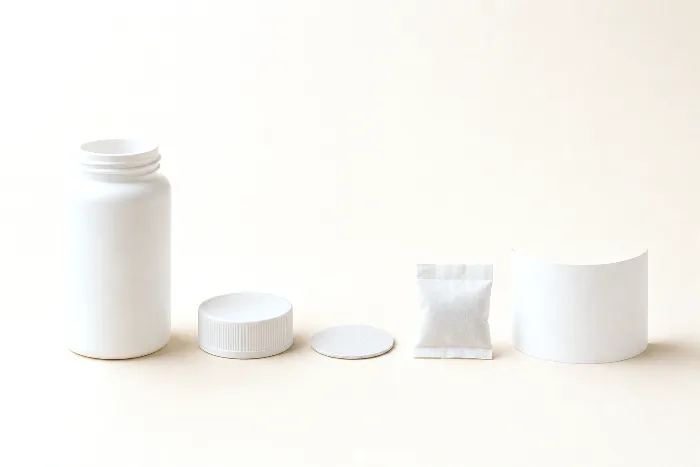
The packer bottle is the workhorse of the supplement shelf — the round, screw-cap bottle behind most vitamins, capsules, and softgels. Simple as it looks, a good one is a stack of small decisions: material, size, closure, seal, and label. Here's how each is chosen.
THE SHORT ANSWER
A supplement bottle is a rigid packer bottle — usually round, molded in opaque HDPE or clear PET — sealed with an induction liner for tamper-evidence and closed with a child-resistant or standard cap, often with a desiccant inside to keep the contents dry. The spec comes together from a handful of linked choices:
- Material — HDPE (opaque, resin #2) for barrier and light protection, PET (clear, resin #1) when the product sells on visible color
- Size — chosen to fit the pill count with controlled headspace, not oversized
- Closure — a standard screw cap, or a child-resistant cap where the product calls for one
- Seal — an induction foil liner is the usual tamper-evidence and freshness layer
- Finish — a wrap label sized to the bottle, and a neck finish that matches the cap
What a supplement packer bottle is
A packer bottle is a rigid, wide-mouth bottle built to be filled with solid dose forms — tablets, capsules, softgels, or gummies — on a high-speed line, then sealed and capped. The name comes from exactly that: it's the bottle a filler "packs" pills into. It's the default primary package across the nutraceutical category because it protects the contents, dispenses one or two units at a time, stacks well on shelf, and takes a wrap label cleanly. Most brands we work with across the nutraceutical industry reach for it first and only move to a pouch, jar, or blister when the product demands it.
The classic shape is a straight-sided cylinder with a wide neck for fast filling. Round is the standard; oval and oblong "cosmo" shapes exist where a brand wants a slimmer face or an easier grip. HDPE bottles are made by extrusion blow molding; PET bottles are stretch-blow molded from a preform. Whichever the material, the packer bottle sits inside a larger system — it is only one of several formats a supplement can ship in. For how bottles compare with pouches, jars, and blisters across the category, see our complete guide to supplement packaging.
Sizing the bottle to the count
The first real decision is volume. A supplement bottle is sized to hold a target count of a specific dose form, and the pill itself sets the packing density — a bulky softgel takes far more room per unit than a small coated tablet. Bottles are specified by internal volume (commonly in cubic centimeters), and a converter or fill house matches that volume to the count the label promises.
The goal is enough headspace to run the fill line reliably and to fit a desiccant and any cotton or "coiler," but no more. Too little headspace and the line jams or the seal foul; too much and you get several problems at once:
- Rattle and breakage — pills tumble in the void and can chip or powder.
- Slack-fill perception — a half-empty bottle reads as short-changed on shelf.
- Wasted material and freight — an oversized bottle costs more to make and more to ship.
Non-functional slack fill — empty space that serves no purpose — is treated as potentially deceptive under general labeling and consumer-protection rules, so headspace should be there for a reason (filling tolerance, settling, desiccant), not for shelf theater. Size the bottle to the product, and let the label panel and the count drive the dimensions rather than picking a bottle and hoping the count fits.
HDPE vs PET: choosing the bottle material
Two resins cover most supplement bottles, and the choice is usually about barrier versus visibility. HDPE (high-density polyethylene) is naturally opaque, blocks light, and offers a strong moisture barrier — the safe default for tablets, capsules, and anything light- or moisture-sensitive. PET (polyethylene terephthalate) is glass-clear, so it's chosen when the product sells on its color and form, like gummies or amber softgels. A third option, PP (polypropylene), shows up where heat tolerance or a particular clarity is needed.
| Material | Clarity | Barrier | Best for |
|---|---|---|---|
| HDPE (resin #2) | Opaque | Strong moisture barrier; blocks light | Most tablets and capsules; light- or moisture-sensitive actives |
| PET (resin #1) | Clear (can be tinted) | Good clarity; moderate moisture barrier | Gummies and softgels that sell on visible color |
| PP (resin #5) | Translucent to clear | Good moisture barrier; heat-tolerant | Products needing heat resistance or a specific look |
Both HDPE and PET are among the most widely collected and recycled resins in curbside programs, which is part of why they dominate the category. That doesn't make either automatically "recyclable" in every market — pigments, pressure-sensitive labels, and metal or multi-material caps can all interfere with sorting and reprocessing. The design-for-recycling guidance from the Association of Plastic Recyclers is the practical reference for keeping a bottle acceptable to recyclers. If you want the broader family of bottle materials, shapes, and neck styles beyond the supplement packer, our bottle types guide covers packer, Boston round, cosmo, and more.
Closures: child-resistant vs standard
The cap does three jobs: it seals, it dispenses, and — for some products — it resists opening by children. The everyday supplement closure is a continuous-thread (CT) screw cap, usually with a foam or foil liner. For products that need it, a child-resistant (CR) cap — typically a push-and-turn or squeeze-and-turn design — replaces the standard cap and is tested to resist opening by young children while still being usable by adults. You can go deeper on the mechanisms in our caps and closures guide.
Not every supplement needs a CR cap. Many ship with a standard closure. Some do fall under child-resistant packaging rules — certain iron-containing products are a well-known example under the Poison Prevention Packaging Act (PPPA), administered by the Consumer Product Safety Commission (CPSC). Whether a given product is covered depends on its formulation and can change, so treat CR as a compliance question to confirm, not an assumption. Our overview of child-resistant packaging requirements walks through how the testing and classification work.
This article is general information, not legal or regulatory advice. Packaging and labeling requirements for supplements vary by product and market and change over time. Confirm what applies to your product with the relevant authority (for example the FDA or CPSC) and qualified counsel before you finalize a package.
Induction seals and tamper-evidence
Almost every supplement bottle carries an induction seal: a thin foil-backed liner placed in the cap that is heat-bonded to the rim of the bottle as the capped bottle passes under an induction coil. The result is a hermetic membrane the consumer peels off before first use. It does two things at once — it provides tamper-evidence, because a broken or missing seal is a visible sign the bottle may have been opened, and it adds a moisture and oxygen barrier that helps keep the product fresh.
Tamper-evident — packaging with a feature that gives visible proof of first opening, so a consumer can tell whether the package has been breached. See more terms in the packaging glossary.
Tamper-evidence is expected across consumer health products and is commonly built into supplements even where a specific rule doesn't name it, following the same logic the FDA applies to over-the-counter medicines. The induction seal is the usual mechanism, but it isn't the only one — shrink bands and breakaway cap rings are alternatives, and some products combine them. For how these features work across categories and how they differ from child-resistance, see our guide to tamper-evident packaging.
Desiccants and moisture control
Moisture is the main enemy inside a supplement bottle. Many actives are hygroscopic — they pull water out of the air — and humidity can soften tablets, cloud capsules, degrade potency, or make gummies clump. That's why so many bottles include a desiccant: a small canister or packet of silica gel or molecular sieve that absorbs moisture in the headspace. Some moisture- and oxygen-sensitive products add an oxygen absorber as well.
Moisture control is a system, not a single part. The pieces work together:
- The bottle — an HDPE wall gives a better moisture barrier than clear PET.
- The seal — the induction liner closes the package hermetically until first opening.
- The desiccant — absorbs the moisture that's already inside and any that enters after opening.
- The cap liner — a foam or lined closure resists moisture ingress once the induction seal is removed.
One label note: desiccant canisters are not edible and are marked "do not eat." Where the product is highly moisture-sensitive, the desiccant load and the bottle's barrier are chosen together during development rather than bolted on at the end.
The label and the neck finish
Two finishing details turn a molded bottle into a shelf-ready package: the label and the neck finish. The label is almost always a wrap — a pressure-sensitive label that wraps the cylinder — sized to the bottle's circumference and label panel so the copy and the Supplement Facts panel fit without wrapping onto the seam. Get the label dimensions from the bottle, not the other way around; our label sizes guide explains how to measure the wrap and leave the right gap. The required panels and claim rules on that label have their own regime — see supplement label requirements for what has to appear and where.
The neck finish is the specification of the bottle's opening — its diameter and thread style, written as something like 38-400 or 45-400. It matters because the closure has to match it exactly: a cap is designed for a specific finish, and a mismatch means a leaking, cross-threaded, or unsealed bottle. When you pick a bottle and a cap, you're really picking a matched pair by neck finish. The full logic of finishes and how they map to caps lives in the bottle types guide.
How PackOS specs supplement bottles
Specifying a supplement bottle means reconciling all of the above at once — material, size, closure, seal, label, and neck finish — into a single manufacturable package. PackOS is built to do that from whatever you already have. Upload a label, a reference bottle, or a rough spec, and it detects the format, dimensions the container and the wrap label, and matches a closure and seal, then produces a photoreal proof and an instant quote. Because the model understands the bottle and its finish, it can carry the choices through to the label layout and the price without a week of back-and-forth. You can see the reconstruction on the technology page, or try it on a real file with Quick Quote.
Frequently asked questions
What is a supplement packer bottle?
A packer bottle is a rigid, wide-mouth bottle — usually round and molded in HDPE or PET — designed to be filled with tablets, capsules, or softgels on a high-speed line, then sealed and capped. It is the most common primary package for supplements because it protects the contents, dispenses easily, and takes a wrap label well.
Should a supplement bottle be HDPE or PET?
HDPE is opaque and gives a strong moisture and light barrier, so it suits most tablets and capsules and anything light-sensitive. PET is clear, so it is chosen when the product sells on its visible color, such as gummies or softgels. Both are widely recycled, so the decision usually comes down to barrier needs and shelf appearance.
What does the induction seal on a supplement bottle do?
The induction seal is a thin foil liner that is heat-bonded to the rim of the bottle under the cap. It creates a hermetic seal that provides tamper-evidence and helps keep moisture and oxygen out. The consumer peels it off before first use, and a broken or missing seal is a visible sign the bottle may have been opened.
Do supplement bottles need child-resistant caps?
Not all of them. Many supplements ship with a standard screw cap, while certain products — for example some iron-containing supplements — can fall under child-resistant packaging rules under the Poison Prevention Packaging Act. Because the requirements depend on the product and can change, confirm what applies with the CPSC and qualified counsel rather than assuming.
Why is there a desiccant packet in my supplement bottle?
The desiccant — usually silica gel or a molecular sieve — absorbs moisture inside the bottle so tablets and capsules stay dry and do not degrade, soften, or clump. It works together with the bottle's own barrier and the induction seal to control humidity. The packet is not edible and is marked do not eat.