
Gummy supplement packaging: pouches & jars
Gummies have become one of the most popular ways to take a supplement — and one of the most difficult dose forms to keep stable on a shelf. This guide covers the pouches, jars, and desiccant strategies that stop them from clumping into one sticky block, plus the tamper-evidence and labeling every supplement carries.
THE SHORT ANSWER
Gummy supplements are one of the most moisture-sensitive dose forms in nutraceuticals, so their packaging is fundamentally a water-vapor barrier problem. The job is to keep humidity out — and inside a narrow range — so the gummies don't turn tacky, clump together, soften, or dry out and grain. That means a high-barrier package, a desiccant, and a reliable reclosure for multi-serving packs, on top of the tamper-evidence and Supplement Facts labeling required of any supplement.
- High barrier — a moisture-and-oxygen barrier laminate pouch or an induction-sealed jar
- Desiccant — silica gel or molecular-sieve packs, canisters, or lined caps to absorb residual moisture
- Reclosure — a press-to-close zipper or threaded lid for packs meant to last multiple servings
- Tamper-evidence & labeling — induction seals or shrink bands, plus a compliant Supplement Facts panel
Why gummies are the hardest supplement to package
A gummy is a soft confection — a gelatin or pectin gel loaded with sugars or sugar alcohols (polyols), flavor, acid, color, and the active ingredient. That matrix is hygroscopic: it wants to reach equilibrium with the humidity around it, and it will pull water vapor out of the air to get there. Left in an unsealed or low-barrier pack, gummies absorb moisture, the surface turns tacky, and pieces bond to one another. Given enough time and warmth they can slump, soften, and fuse into a single block — the failure every gummy brand dreads.
The opposite failure is just as real. If a gummy loses moisture — dry air, an over-aggressive desiccant, a long shelf life — it hardens and the sugar can crystallize on the surface, a defect called graining. So the target isn't simply "as dry as possible." It's holding the internal humidity inside a workable window while keeping oxygen and light from degrading sensitive actives. Compared with tablets and capsules, which tolerate a much wider range, gummies leave far less margin for error.
That single fact drives every packaging decision below. It's also why gummies sit apart from other dose forms in the complete guide to supplement packaging: a bottle that works fine for capsules can let a gummy count clump before the customer finishes it. The enemy is water vapor, so the package is first and foremost a barrier.
The formats that work: pouches, jars, and mono-dose
Three formats carry the bulk of the gummy-supplement market, and each answers the moisture problem a little differently. The right one depends on the serving count, the retail channel, and how premium the brand wants the pack to feel.
| Format | Barrier | Reseal | Best for |
|---|---|---|---|
| High-barrier stand-up pouch | High — depends on the laminate structure | Press-to-close zipper | Multi-serving retail counts; lightest, cheapest to ship |
| PET or HDPE jar w/ induction seal | High with a foil membrane and desiccant | Threaded lid | Bulk counts; rigid, premium shelf presence |
| Mono-dose sachet / stick pack | Very high per unit | None — single serving | On-the-go, sampling, precise single doses |
The stand-up pouch is the workhorse. A well-built moisture-and-oxygen barrier film with a press-to-close zipper reseals well between servings, stands on shelf, and ships far lighter than a jar. The structure of the film is what does the work — see the stand-up pouch spec guide for how gussets, seals, and closures are specified. The jar trades weight and shipping cost for a rigid, premium feel and a very secure reclose; paired with an induction seal and a desiccant it's a strong barrier package, and the jar packaging guide covers materials, liners, and lids in depth. Mono-dose sachets and stick packs give each serving its own sealed environment — ideal where no reclosure is needed and dose precision matters — at the cost of more material per serving.
Moisture control: desiccants, canisters, and seals
Barrier film and a sealed jar slow water-vapor transfer, but no practical package is perfectly airtight over a full shelf life — and every time a multi-serving pack is opened it takes on humid room air. That residual and ingressed moisture is what a desiccant handles. The common options:
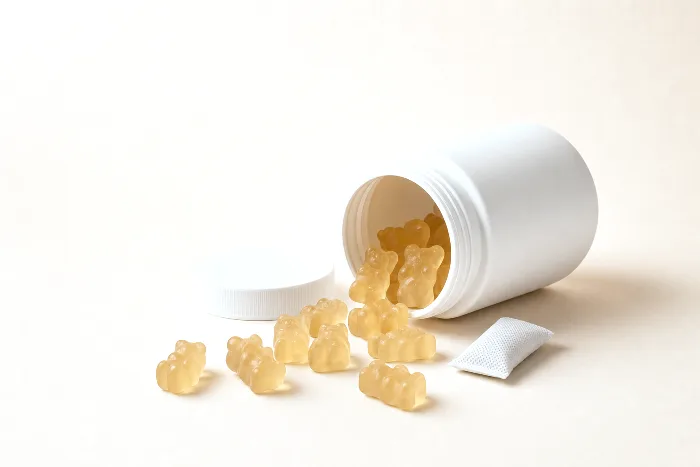
- Silica gel packets — the familiar loose sachet dropped into a jar or pouch; broadly used, low cost.
- Molecular-sieve desiccants — adsorb moisture more aggressively at low humidity, useful for the most sensitive formulas.
- Desiccant canisters — a rigid cartridge for jars, harder to mistake for something edible.
- Desiccant-lined caps and liners — build the drying agent into the closure so there's no loose insert.
How much desiccant a pack needs isn't a fixed number. It depends on the barrier of the structure, the amount of headspace, the target shelf life, and how often the pack is opened, so it's sized together with your converter rather than guessed. A note specific to gummies: because both too-wet and too-dry cause defects, the goal is buffering the humidity, not stripping every trace of moisture — over-desiccating can grain the product just as ambient air can clump it.
On jars, the induction seal earns its place twice over. A foil membrane welded to the jar rim is both a moisture barrier and a visible tamper-evidence feature the customer breaks on first use. Pouches achieve the same first-open evidence through a factory-sealed top above the zipper, or a separate tamper feature; the principle is that the barrier and the tamper story are often the same seal.
Food-contact safety for gummies
Gummies are eaten, so every material that touches the product is a food-contact application and has to be suitable for that use. In the United States the FDA oversees food-contact substances, and dietary supplements are regulated as a category of food. In practice that means the pouch film, the jar and its liner, the desiccant, and any inks or coatings on the product-contact side all need to be appropriate for direct or indirect food contact — a spec detail worth confirming with your converter, not assuming.
The broader rules for materials in contact with food, migration, and suitability are their own subject; our primer on food packaging regulations walks through the FDA food-contact framework at a high level. Treat that as background, and verify the specifics for your product and market with the relevant authority.
Reclosure for multi-serving packs
Any gummy pack that holds more than one serving lives or dies on its reclosure, because the pack spends most of its life opened and re-closed by the customer. The two dominant answers:
- Press-to-close zipper on a pouch — reseals the barrier top after each serving; the seal quality of the zipper track matters as much as the film.
- Threaded lid on a jar — a firm mechanical reclose, often over an induction seal that stays intact as the primary barrier until first use.
Two more considerations shape the closure choice. First, some markets or products may call for child-resistant packaging, and because gummies can resemble candy this deserves real attention rather than an assumption either way — child-resistance is not universally required for supplements, and the requirements vary and change, so confirm what applies to your product. Second, the reclosure interacts with the desiccant: a pack that reseals poorly lets in humid air on every open, which shortens how long a given desiccant load keeps the gummies separated.
Labeling gummy supplements
Not legal or regulatory advice. The points below are general and educational. Supplement labeling and packaging requirements differ by ingredient, product, and jurisdiction, and they change over time. Verify what applies to your product with the FDA and qualified counsel before you finalize artwork or a package.
A gummy supplement carries the same core label as any US dietary supplement: a statement of identity, the net quantity of contents, a Supplement Facts panel, an ingredient list, and the name and place of business of the manufacturer, packer, or distributor. Dietary supplements are regulated under the framework established by DSHEA, and industry groups such as the Council for Responsible Nutrition publish guidance on responsible labeling practice. None of that is unique to gummies — but two things about the format make the artwork harder in practice.
First, gummies are often packed in small pouches and jars with limited flat label area, so fitting a complete, legible Supplement Facts panel takes careful layout. Second, the same candy-like appeal that sells gummies invites scrutiny around not making them attractive as treats and around clear dosing. Brands serving the nutraceuticals category tend to treat the label as a compliance surface first and a branding surface second. Get the panel right, keep claims within the supplement lane, and confirm the current requirements with the authority — the packaging can't fix a non-compliant label.
How PackOS specs gummy packaging
PackOS treats a gummy pack as a system: the barrier structure, the desiccant strategy, the closure, and the label all have to agree before the pack is right. When you bring a pouch or jar artwork file, PackOS detects the structure, dimensions it, and rebuilds an editable parametric model — so if you change the count, the pouch or jar resizes and the panels reflow with it, and the material area, print, and production route can be priced from that. You can watch the reconstruction run on the technology page, or put a real gummy pouch or jar file through it with Quick Quote. For the other dose forms, the protein powder packaging guide and the rest of the supplement cluster follow the same logic.
Frequently asked questions
Why do gummy vitamins clump or melt in the package?
Gummies are a hygroscopic gel with high sugar or polyol content, so they readily absorb water vapor from the surrounding air. As they pick up moisture the surface turns tacky and pieces bond to one another; in warm conditions they can soften and slump into a single block. Losing moisture is the opposite failure, where the gummies harden and the sugar crystallizes. A high-barrier package plus a desiccant keeps the internal humidity in the range that avoids both.
Do gummy supplements need a desiccant?
In most cases yes. Even a good barrier film or an induction-sealed jar lets a small amount of water vapor through over a product's shelf life, and each time a multi-serving pack is opened it takes on humid air. A silica gel or molecular-sieve desiccant absorbs that residual and ingressed moisture so the gummies stay separate. The exact amount depends on the barrier, the headspace, and the shelf life, so it is sized with your converter.
Are stand-up pouches or jars better for gummy supplements?
Both work, and the choice is a trade-off. A high-barrier stand-up pouch with a press-to-close zipper is lighter, ships more efficiently, and reseals well for multi-serving counts. A jar with an induction seal gives a rigid, premium shelf presence and a very secure reclose, but weighs more and costs more to ship. Mono-dose sachets suit single servings where no reclosure is needed. Match the format to the count, the channel, and the brand.
Does gummy supplement packaging need to be child-resistant?
It depends on the product and the market. Child-resistance is not universally required for dietary supplements, but gummies can resemble candy, and some ingredients, formats, or jurisdictions call for child-resistant packaging or specific warnings. Because the requirements vary and change, confirm what applies to your product with the relevant authority and qualified counsel rather than assuming.
What food-safety rules apply to gummy supplement packaging?
Gummies are ingested, so the packaging is a food-contact application and the materials that touch the product must be suitable for that use. In the United States the FDA oversees food-contact substances and regulates dietary supplements as a category of food under DSHEA. This is general information, not legal advice, and the rules change, so verify the current requirements with the FDA and qualified counsel before you finalize a package.