
Protein powder packaging: jars & pouches
Protein and powdered supplements share one awkward packaging problem: a light, bulky product that has to hit an exact fill weight, keep moisture out, fit a scoop, and still earn its place on a crowded shelf. Two formats do almost all of the work — rigid jars and canisters, and stand-up pouches.
THE SHORT ANSWER
Protein powder and other powdered supplements are packaged in two dominant formats — rigid jars and canisters, or flexible stand-up pouches — and the choice trades shelf presence and scoop convenience against shipping cost and material use. A jar or canister looks premium, holds a scoop easily, and stands tall on shelf; a pouch is lighter, ships flatter and cheaper, and uses less material. Whichever you pick, powder needs a moisture barrier, a reliable reclosure, and enough headspace to be filled by weight.
- Jars & canisters — best shelf presence, easy scoop access, premium feel; heavier and costlier to ship
- Stand-up pouches — lighter, cheaper to ship, less material; a smaller shelf face
- Moisture is the enemy — powder is hygroscopic, so barrier and reclosure both matter
- Fill by weight, not volume — expect headspace, because powder settles and compacts
- Many brands run both — a jar for retail, a pouch for refills and value sizes
What protein powder packaging has to do
Powder is a deceptively demanding product to pack. It is light for its volume, it flows and settles, it clumps the moment it meets humidity, and it is usually dispensed a scoop at a time over weeks. Before you compare formats, it helps to line up everything the package has to deliver:
- A moisture barrier. Most protein and greens powders are hygroscopic — they pull water out of the air, which turns free-flowing powder into clumps and shortens shelf life. The pack has to seal well and often carries a desiccant.
- Room to scoop. A buried scoop and a narrow mouth make a mess. The opening and the headspace both have to accommodate the scoop the consumer will actually use.
- Fill by weight. Powder is sold by grams, not by volume, and different flavors and formulas have different bulk densities, so the same container may look more or less full across a line.
- A big shelf face. Protein competes on grams of protein, flavor, and brand — it wants a large, flat front panel to say all of that.
- Transit durability and reclosure. The pack gets tossed in shipping and reopened dozens of times, so it needs a closure that reseals cleanly serving after serving.
Powdered nutraceuticals — protein, greens, pre-workout, collagen, meal replacements — are one of the biggest categories we build for; you can see the broader industry view on our nutraceuticals packaging page. This article is one spoke of the complete guide to supplement packaging, focused specifically on powders.
Jars, canisters, and pouches at a glance
Nearly every powder SKU lands on one of two structures: a rigid container (a plastic jar or a composite canister) or a flexible stand-up pouch. Here is how the main options compare on the factors that usually decide it. Cost is shown relative — for a real price on your spec, run a quote.
| Format | Shelf presence | Ship efficiency | Cost | Best for |
|---|---|---|---|---|
| Rigid plastic jar (HDPE / PET) | High — bold, premium, big front panel | Low — bulky and heavier | Higher | Flagship retail tubs, larger counts |
| Paperboard composite canister | High — premium, paper-forward look | Low–moderate | Higher | Premium and single-serve-forward brands |
| Stand-up pouch (Doyen) | Moderate — good, but a smaller face | High — ships flat, very light | Lower | Refills, value sizes, online-only |
| Flat-bottom (box) pouch | Moderate–high — squarer, more facing | High — still ships flat | Lower–moderate | Pouches that need more shelf stance |
The headline trade-off is simple: rigid containers buy you presence and convenience, pouches buy you efficiency. Everything below is really about which of those two your product, channel, and margin care about most — and plenty of brands split the difference by running a jar in retail and a pouch for refills.
The pouch case: lighter and cheaper to ship
The strongest argument for a pouch is what happens after the product leaves the plant. Empty pouches ship and store flat, so you are not paying to move air the way you are with pre-formed jars. Filled, a pouch weighs a fraction of a rigid tub of the same volume, which matters twice over: less weight on every pallet, and a smaller, lighter parcel for direct-to-consumer orders.
That second point is where the savings show up for online brands. Parcel carriers bill on dimensional weight — the greater of actual weight and a volume figure — so a compact, low-profile pouch is often billed lighter than a boxy jar holding the same servings. Over a subscription's worth of monthly shipments, that difference compounds.
A pouch built for powder is not just a bag. It is a laminate structure engineered for barrier — commonly a printed outer web, a barrier layer, and a sealant — closed with a press-to-close zipper and often a heat-sealed top the consumer tears off on first use. The bottom gusset gives it a footprint to stand, and the barrier keeps oxygen and moisture out over a long shelf life. Our stand-up pouch spec guide walks through the seals, gussets, closures, and material choices in detail; for powder, prioritize a high-barrier structure and a zipper robust enough to survive daily reopening.
Scoop, headspace, and fill
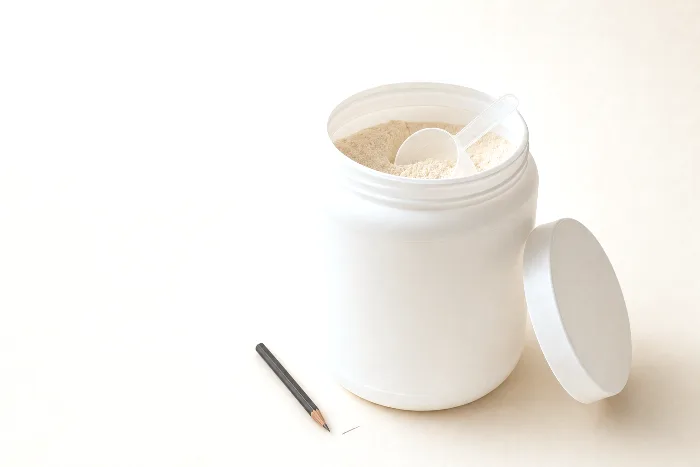
Open a fresh tub of protein and it looks half empty. That is not a cheat — it is the physics of filling powder, and there are three reasons for it.
- Fill is by weight. The label promises grams of product, not a full container. Manufacturers size the pack to a target weight, and the leftover volume is headspace.
- Powder settles and compacts. Freshly filled powder is fluffed with air. Vibration in transit and handling packs it down, so a container filled to the brim at the plant would look shorted by the time it reaches a shelf — the headspace absorbs that settling.
- You need room for the scoop. Consumers have to dip a scoop in without spilling, and often the scoop ships buried in the powder. Headspace and a wide enough mouth make that workable.
There is a fair-packaging dimension here too. Regulators — the FDA among them — pay attention to non-functional slack fill, meaning empty space that serves no real purpose. The headspace above is generally functional (settling, dosing, fill-by-weight), but the honest move is to size the container close to the settled volume rather than oversizing it purely to look bigger on shelf. Match the pack to the real bulk density of your formula, and account for the scoop.
When a rigid jar or canister wins
For all the efficiency of pouches, rigid containers still own the premium retail tub. A jar or canister gives you a large, flat, wraparound label area, it stacks and stands without help, and it survives rough retail handling. The wide mouth makes scooping easy, and an induction seal under the cap provides clear tamper-evidence and a strong moisture barrier at first open.
The common rigid options break down like this:
- HDPE jars — opaque, tough, and the workhorse of the category; good chemical resistance and an easy fit with induction sealing.
- PET jars — clear when you want to show the product, with solid barrier and a bright, premium look.
- Paperboard composite canisters — a spiral-wound paper body with a metal or plastic base and a plastic lid; a paper-forward look that reads premium and cuts plastic on the body.
Jars and canisters share a lot of engineering with other wide-mouth containers — neck finishes, liners, induction seals, and closures. If you are weighing rigid formats, our jar packaging guide covers the materials, styles, and sealing options in depth. The trade-off you are accepting is freight: a rigid tub is heavier and ships pre-formed, so it costs more to move than the equivalent pouch.
Sustainability: less material, honest trade-offs
Powder packaging is a genuinely interesting sustainability case, because the two formats pull in opposite directions and neither is a clean win.
By material and weight, the pouch is the lighter footprint. It uses far less packaging per serving than a rigid tub, and its lower shipped weight means less fuel to move the same product. The catch is end of life: most high-barrier pouches are multi-layer laminates that are difficult to recycle in today's curbside systems. Mono-material pouch structures are closing that gap by building the barrier from a single polymer family, but collection and acceptance still vary by location.
Rigid jars have the recycling edge — PET and HDPE are among the most widely accepted materials in curbside programs in many areas — but they carry more material and more freight weight to begin with. There is no universally greener answer; the honest framing is to weigh source reduction and freight against real-world recyclability for your market. The Association of Plastic Recyclers publishes design-for-recyclability guidance that is worth checking before you lock a structure.
How PackOS helps you spec powder packaging
Because the powder decision is really a systems decision — format, fill weight, freight, and cost all move together — it pays to see the downstream numbers before you commit. PackOS reads a spec or existing artwork, rebuilds the structure, and works out material area, pack-out, and the pallet and freight math for each format, so you can compare a jar and a pouch on shelf presence and landed cost at the same time rather than guessing. Upload what you have and start a Quick Quote to price both paths on a real spec.
Frequently asked questions
Are jars or pouches better for protein powder?
Neither is universally better. Rigid jars and canisters give a bigger shelf face, a premium feel, and easy scoop access, while stand-up pouches are lighter, cheaper to ship, and use less material. Many brands run a jar for the flagship retail SKU and a pouch for value sizes, refills, or online-only products.
Why do protein powder containers have so much empty space?
That empty space is headspace, and it is mostly intentional. Powder is sold by weight, not volume, and it settles and compacts during shipping and handling, so the container is filled to a target weight with room left over. Headspace also leaves room to dip a scoop without spilling.
Does protein powder need a moisture barrier?
Yes. Protein powder is hygroscopic, meaning it absorbs moisture from the air, which causes clumping and can shorten shelf life. Rigid containers use an induction seal and often a desiccant, while pouches rely on a high-barrier laminate structure and a good reclosure to keep moisture out between uses.
Are stand-up pouches cheaper to ship than jars?
Generally yes. Pouches ship flat and weigh far less than rigid jars, so they take up less space and add less weight to a parcel or pallet. Because carriers bill by dimensional weight, the lighter, more compact pouch usually costs less to move for the same amount of product.
Can protein powder packaging be recycled?
It depends on the format. Rigid PET and HDPE jars are widely accepted in curbside recycling in many areas, while most high-barrier pouches are multi-layer laminates that are hard to recycle today. Mono-material pouch structures are improving pouch recyclability, but availability of collection still varies by location.