
Label core size and roll diameter, explained
A label that prints perfectly can still be unusable if the roll it ships on doesn't fit your applicator. Core size, roll diameter, and how the labels are wound are as much a part of the spec as the artwork — and they decide whether your line runs or stalls.
THE SHORT ANSWER
Core size, outer diameter, and labels-per-roll are the roll specification, and all three have to match your applicator, or the line stalls. The core is the tube the labels wind around; the outer diameter sets how many labels fit before a reload; the wind direction and unwind position set how each label feeds and faces. Get the roll wrong and even flawless labels won't run.
- Core inner diameter — the tube size your applicator's mandrel needs (commonly 1 in or 3 in)
- Roll outer diameter — capped by your equipment; a bigger roll means fewer reloads
- Labels per roll — set by core, outer diameter, label height plus gap, and material thickness
- Wind & unwind — the direction and position each label feeds and faces
What a label roll spec is
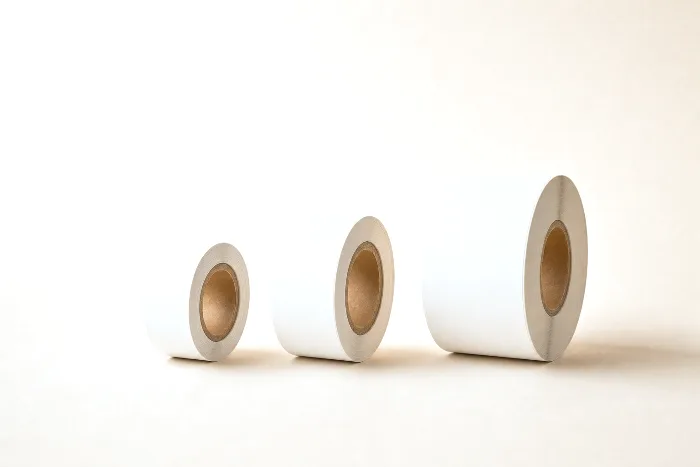
Pressure-sensitive labels don't ship as loose stickers — they arrive die-cut on a liner and wound into a roll around a cardboard or plastic core. That roll has a specification of its own, separate from the label's artwork and size: the core's inner diameter, the finished roll's outer diameter, how many labels are on it, and which way each label is wound and faces as it feeds. This is the roll spec, and it's the part of a label order that decides whether your applicator can actually run the job.
It's easy to get right once you know it exists, and expensive to get wrong. A roll that's beautifully printed but wound onto the wrong core simply won't seat on your applicator's mandrel. A roll built to too small an outer diameter will run out constantly and stop the line. Roll geometry belongs on the same sheet as face stock and adhesive — it's part of our complete guide to label printing, not an afterthought.
Two related choices sit next to the roll spec. How the labels are die-cut on the web — through the face only, or through the liner too — affects how the roll strips and dispenses; that's covered in die-cut vs kiss-cut labels. And which way each label unwinds is a spec in its own right, which we'll come back to below.
The parts of a roll spec
A complete roll spec answers five questions. Suppliers ask for all of them, and a good quote confirms them back to you before anything is printed.
| Spec | What it is | Why it matters |
|---|---|---|
| Core inner diameter | The inside diameter of the tube the labels are wound onto — commonly 1 in or 3 in. | Must match your applicator or printer's mandrel exactly, or the roll won't mount. |
| Roll outer diameter (OD) | The finished diameter of the wound roll, measured across the outside. | Capped by your equipment; a larger OD holds more labels and means fewer reloads. |
| Labels per roll | The count of finished labels on one roll. | Sets how often the line stops to change rolls; driven by OD, core, label height plus gap, and material thickness. |
| Wind direction | Whether the printed face winds out or in. | Must match how your applicator peels and presents the label. |
| Unwind position | The orientation the label leads with as it comes off the roll. | Has to match the way your applicator feeds, so the label lands right-side up and correctly placed. |
Core size: the number that matters most
Of everything on the roll spec, core size is the one that most often stops a job cold, because it's binary: the roll either fits your mandrel or it doesn't. Two core sizes cover most work. A 3-inch core is the most common choice for semi-automatic and automatic applicators — it's the default on most inline labeling equipment. A 1-inch core is typical for hand-held rolls, desktop and benchtop printers, and small dispensers. You'll also see 1.5-inch cores, and larger cores still on some high-volume or wide-web work.
The core does two jobs. It gives the roll a rigid center so it can mount on a spindle and rotate without wobble, and its diameter sets a minimum bend radius for the label stock — a thick or stiff material wound onto too small a core can take a set or resist lying flat when it's applied. When in doubt, match the core your existing equipment already uses: the safest core size is the one on the roll your line runs today.
Outer diameter and labels per roll
Outer diameter is where you tune the roll for your run. Within the maximum your equipment can hold, a larger OD packs more labels onto each roll, so the line runs longer between reloads. That's why the practical rule is simple: order the largest outer diameter your applicator will accept. Every reload is a stop, and stops are where throughput and consistency get lost.
The ceiling is set by the equipment, not the label. Many tabletop and hand applicators accept rolls only up to a modest OD, while inline automatic systems take much larger rolls. Check your machine's maximum OD before you decide — a roll built larger than the equipment can hold is as unusable as one on the wrong core.
Labels per roll then falls out of the geometry. For a fixed core and OD, the count depends on:
- Label height — the dimension in the direction of travel — plus the gap between labels; taller labels and bigger gaps mean fewer per roll
- Material and liner thickness — thicker stock builds diameter faster, so fewer labels reach the same OD
- Core size — a larger core starts the roll at a bigger diameter, leaving less room to wind
Because all of these interact, don't guess the count — your supplier can calculate an exact labels-per-roll figure once the core, maximum OD, label size, gap, and material are fixed. That number is what you plan reloads and inventory around.
Matching the roll to your application method
How you apply labels drives the roll spec more than anything else, so decide the application method first. In general, the more automated the line, the larger the core and outer diameter it wants — automation is built to run long without intervention, and big rolls on sturdy cores are how you feed it.
| Application method | Typical core & roll | What it means for your roll |
|---|---|---|
| Hand apply | Small core (often 1 in), small OD | Low volume, samples, and short runs; easy to handle, and frequent reloads are acceptable. |
| Semi-automatic dispenser | Commonly a 3 in core, moderate OD | Mid-volume; a peel-and-present dispenser needs a consistent core and a defined unwind position. |
| Automatic inline | 3 in core (or larger), large OD | High volume; wants the biggest roll the machine accepts to minimize stops, on a rigid core with steady tension. |
For the full picture of how each method works and what it demands, see label application methods. The takeaway: don't spec the roll in the abstract — spec it for the machine that will run it.
Wind direction and unwind position
Two labels can be identical in size and material and still be wrong for your line if they're wound the wrong way. Wind direction describes whether the printed face points outward or inward on the roll. Unwind position describes the orientation the label leads with as it peels off — the combination of which edge comes first and which way the copy faces.
There's a standard shorthand for this: eight numbered unwind positions that pair a wind direction with a leading edge. Your applicator is built to feed one of them. Specify it explicitly, because a roll wound to the wrong position may run backwards, upside down, or off-center even though every other number on the spec is correct.
Wind direction and unwind position are important enough — and easy enough to get backwards — that they get their own guide: roll direction and unwind positions walks through all eight and how to pick the right one for your applicator.
Avoiding jams and frequent reloads
Two different problems get blamed on "the roll," and they have different fixes.
If the line keeps running out, the roll simply isn't big enough. The outer diameter is smaller than your equipment can hold, so each roll carries fewer labels than it should. The fix is to order the largest OD your applicator accepts on the correct core, so more labels ride on each roll and you change over less often.
If the line jams or misfeeds, the roll size usually isn't the culprit. Jams more often trace to the wrong unwind position, incorrect web tension, a core that doesn't seat properly, or labels flagging and lifting on the liner. Getting the core and unwind position right removes the roll-related causes; the rest is machine setup and material. Our guide to label applicator jamming works through the diagnosis in order.
A quick checklist before you commit a roll spec:
- Confirm the core inner diameter your applicator requires.
- Ask for the largest outer diameter the machine will accept.
- Fix the wind direction and unwind position for that machine.
- Have your supplier calculate labels per roll from the final size, gap, and material.
- Order a small first roll and test it on the actual line before the full run.
How PackOS specs your roll
How PackOS handles this: when you quote a label, the roll spec is captured alongside the artwork and size, not bolted on afterward. Core size, maximum outer diameter, wind direction, and unwind position are part of the specification the quote is built from, so the labels-per-roll count and the production plan reflect the machine that will actually run them. You can see how the roll spec feeds the rest of the workflow on our technology page.
The practical result is fewer surprises at the line. Instead of a perfect label that won't mount, you get a roll built for your applicator from the start. Start a Quick Quote and specify the core and roll format with the rest of your label, and we'll confirm the labels-per-roll and format back to you.
Frequently asked questions
What core size do most label applicators use?
The most common core inner diameter is 3 inches, which fits most semi-automatic and automatic applicators. Smaller 1-inch cores are typical for hand-held rolls and desktop printers. Confirm the core size your specific applicator needs before ordering, because a roll that does not fit the mandrel cannot run.
How many labels fit on a roll?
Labels per roll depends on the core size, the maximum outer diameter, the label height plus the gap between labels, and the thickness of the material and liner. A taller label or thicker stock means fewer labels at the same outer diameter. Your supplier can calculate an exact count once those inputs are fixed.
What outer diameter should I order?
Order the largest outer diameter your applicator or printer will physically accept. A larger outer diameter puts more labels on each roll, so the line runs longer between reloads. The limit is set by your equipment, not the label, so check the machine's maximum outer diameter first.
What is the difference between wind direction and unwind position?
Wind direction is whether the printed face winds outward or inward on the roll. Unwind position is the orientation the label leads with as it comes off the roll, given as one of eight standard positions. Both have to match how your applicator feeds, so specify them together with the core and outer diameter.
Why does my labeling line keep stopping to reload?
Frequent reloads usually mean the outer diameter is smaller than your equipment can hold, so each roll carries fewer labels than necessary. Ordering the largest outer diameter your applicator accepts, on the correct core, reduces changeovers. If the line jams instead of simply running out, the cause is more often unwind position, tension, or label flagging than the roll size.