
How to reduce packaging costs without cutting quality
Cutting packaging cost is rarely about beating up a supplier on the unit price. The real money is in how the package is sized, specced, ordered, and shipped — here are the honest levers, with no invented savings figures.
THE SHORT ANSWER
The biggest packaging savings come from right-sizing, simplifying the structure and decoration, consolidating SKUs and runs, using standard components where the brand allows, and optimizing freight — not from squeezing the per-unit price. The unit number on a quote is the sum of several inputs, so the way to lower it is to change what drives those inputs. Where you'll actually save depends on your product, volume, and channel, so run your own spec to see real numbers. The levers, in rough order of impact:
- Right-size — less material per unit, and often lower shipping cost on every order
- Simplify — fewer print colors, special inks, and finishes to tool and set up
- Consolidate — fewer setups and larger runs that reach better price breaks
- Standardize — stock or standard components skip custom tooling
- Freight — better cube and pallet efficiency lowers delivered cost
Start with where the money actually is
When a brand asks how to reduce packaging cost, the instinct is to push the supplier for a lower unit price. That is usually the smallest lever on the board. The unit price you see on a quote is the sum of several things — material, tooling and setup, the print and decoration, the production run, and freight — and the biggest savings almost always come from changing what drives those inputs, not from haggling the total down.
This article is part of our guide to what drives packaging cost, and it focuses on the levers that actually lower it without cutting the quality your product needs. None of them are magic, and none of them come with a made-up savings figure — where you'll save depends on your product, your volume, and your channel. To turn any of these levers into a real number for your own job, run your spec through an instant quote rather than trusting a range you read online.
The levers that lower packaging cost
Six levers do most of the work. In rough order of how much they typically move — and how often they get overlooked:
- Right-size the package to the real product, cutting material and, for anything you ship, its dimensional weight.
- Simplify the structure, colors, and finishes so there is less to tool, set up, and run.
- Consolidate SKUs and runs so you pay for fewer setups and reach better price breaks.
- Use standard components and stock wherever the brand can flex, to skip custom tooling.
- Order to real demand, not to a price break you can't actually use before the artwork changes.
- Optimize freight, not just the box price, because delivered cost is what you actually pay.
Here is the same picture as a quick-reference table.
| Lever | How it lowers cost | Watch-out |
|---|---|---|
| Right-size | Less material per unit; often a lower shipping tier on every order | Don't shrink below what protects the product |
| Simplify | Fewer plates, less make-ready, fewer finishing passes | Keep the brand cues that genuinely drive sales |
| Consolidate | Fewer setups; larger runs reach deeper price breaks | Don't over-order ahead of demand you can see |
| Standardize | Skips custom tooling and shortens lead time | Only where the brand can flex on shape |
| Order to demand | Avoids obsolescence, storage, and write-offs | Balance against the break you'd earn ordering more |
| Optimize freight | Better cube and pallet fit lowers cost per unit delivered | Verify with your own weights and dimensions |
Right-sizing: the biggest lever most brands skip
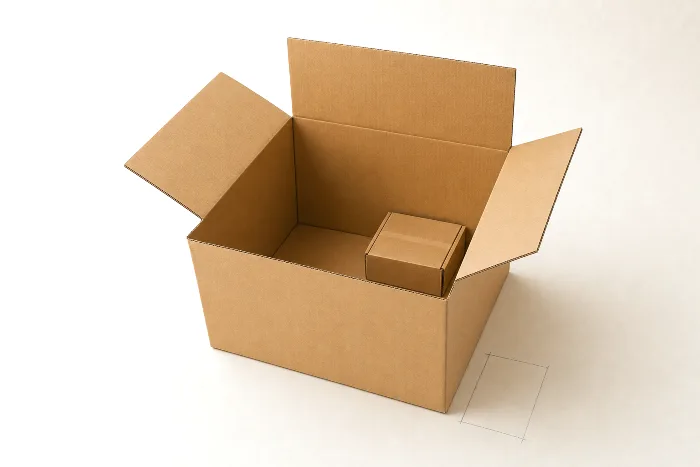
Right-sizing means building the package to the real dimensions of what goes inside it, rather than dropping the product into whatever stock size is closest. It is often the single biggest lever, because it pays twice: a smaller package uses less material per unit, and — for anything you ship — it usually bills less on dimensional weight, so the saving repeats on every order you send.
Dimensional weight — a carrier's pricing method that bills a shipment on the space it occupies, not just its actual weight, so a light but bulky package can cost as if it were much heavier. See more terms in the packaging glossary.
Oversized boxes are expensive in three directions at once: extra board or film, extra void fill to stop the product rattling, and a higher shipping tier for the wasted air. Tightening the box to the product shrinks all three. Before you commit to a size, model the trade with the dimensional-weight calculator and read how dimensional weight is calculated so you can see which dimension is actually driving the bill — sometimes shaving a single side is enough to drop a tier.
Simplify the structure, colors, and finishes
Every additional print color, special ink, and finish tends to add tooling, make-ready, and complexity. A design with fewer colors needs fewer plates; metallics, opaque whites, foils, and spot varnishes each add a setup and a pass. Simplifying the artwork to the colors that matter, and dropping finishes that don't earn their keep, lowers both the one-time and the ongoing cost — often with no visible difference on shelf.
The structure itself carries cost too. A simpler fold pattern uses less material, runs faster, and is less likely to jam a line. The goal is not a stripped-down package; it is to spend your decoration budget only where it changes how the product sells, and to let everything else be as plain and as efficient as the job allows.
Consolidate SKUs and runs
Setup and make-ready are largely fixed costs: you pay them roughly the same whether the run is small or large. Splitting your volume across many little runs means paying for setup over and over, and it keeps every order near the shallow end of the price curve. Combining orders, aligning your SKUs onto shared structures, and gang-running versions that share a die all spread those fixed costs over more units.
This is why per-unit cost falls as quantity rises: the one-time charges amortize. The catch is that bigger is only cheaper if you can use it — so pair consolidation with a clear read on your minimum order quantities and real demand, which is the next lever.
Standard components and stock, where the brand allows
Custom tooling is a one-time cost and a stretch of lead time before you can run at all. Standard and stock components — off-the-shelf closures, bottles, jars, mailers, or carton styles — skip that entirely, because the tooling already exists and the item is proven on a line. Where the brand can flex on shape, a stock component can be dramatically faster and cheaper than a bespoke one that looks only marginally different on shelf.
The honest trade is brand distinctiveness against cost and speed. Reserve custom tooling for the parts of the package a customer actually notices and remembers, and use stock for the parts they don't. Our comparison of custom versus stock packaging walks through where that line usually falls.
Optimize freight, not just the box price
Delivered cost — the box plus what it costs to move it — is what you actually pay, so freight belongs in the cost conversation from the start. Two packages with the same per-unit price can cost very differently to ship if one palletizes tightly and the other wastes cube. A box that stacks cleanly on a pallet, fills a trailer's height, or drops below a dimensional-weight threshold can lower delivered cost even when the box itself is no cheaper.
The levers here are cube efficiency, pallet utilization, and dimensional weight. Small changes to a footprint can improve how many units fit a pallet or a parcel tier, so it's worth testing a couple of candidate sizes against your real weights and lanes rather than assuming the smallest box wins. Read how carriers price by dimensional weight before you finalize a size, and check the delivered math with your own numbers.
The false economy: don't cut the spec until it breaks
The tempting move — dropping to a lighter board, a thinner film, or a cheaper adhesive — is where cost cutting goes wrong most often. A box built with too little board can crush in transit, and the damaged product, replacements, returns, and lost trust usually cost far more than the material you saved. Under-specifying trades a visible, small saving for an invisible, larger loss.
Match the spec to the real hazards the package faces — the drops, the stacking, the vibration, the humidity — then remove only what testing shows you don't need. Our explainer on why boxes crush in shipping covers how stack load and board grade interact, so you can cut weight where it's genuinely safe and hold the line where it isn't.
Where cost savings and sustainability line up
Cost and sustainability are often assumed to pull against each other. In packaging they line up more than they conflict, because material and freight are exactly where much of the money lives. Using less material, right-sizing to cut wasted space, and reducing the number of separate components all lower cost and the footprint at the same time.
It isn't automatic — some specialty sustainable materials do carry a premium, and a recyclable structure can require its own tooling — so treat the two goals as usually aligned, not always. Our sustainable packaging guide covers the moves that save on both counts, and the ones where you'll have to decide which matters more for your brand.
How PackOS helps you find the savings
Finding these levers usually means knowing how a change to one dimension ripples through material, decoration, and freight — which is hard to eyeball. PackOS reads your spec or artwork, rebuilds the package as a parametric model, and shows how the dimensions drive material area, print, and the cube and pallet math behind freight, so you can see the effect of right-sizing or simplifying before you commit. You can explore how it models the logistics side on the technology page, or put your own spec through a transparent, itemized instant quote and see exactly where the cost is going — no invented ranges, just your numbers.
Frequently asked questions
What's the fastest way to reduce packaging cost?
Right-sizing usually moves the most money the fastest. A package built to the real product dimensions uses less material and often bills less on dimensional weight, so you save on the unit and on every shipment at once. Squeezing the per-unit price is almost always the smallest lever.
Does ordering more packaging always make it cheaper per unit?
Per-unit cost generally falls as quantity rises, because one-time setup and tooling spread over more units. But ordering ahead of real demand ties up cash and risks obsolescence if artwork or specs change. Order to demand you can actually see, not to chase a price break you cannot use.
Will cheaper materials save money?
Sometimes, but under-specifying is a common false economy. A box built with too little board can crush in transit, and the damaged product, replacements, and returns usually cost far more than the material you saved. Match the spec to the real hazards, then remove only what testing shows you do not need.
How do fewer colors and finishes lower cost?
Every additional print color, special ink, and finish can add tooling, setup, and complexity. Simplifying the artwork to fewer colors and dropping finishes that do not earn their keep reduces both the one-time and the ongoing cost, often with no visible difference on shelf.
Is sustainable packaging more expensive?
Not necessarily. Many sustainability moves — using less material, right-sizing, and consolidating components — also lower cost, because material and freight are where much of the money is. The two goals line up more often than people expect, though some specialty sustainable materials do carry a premium.